
10 Outdoor Fall Planter Ideas For a Cozy Fall Porch
Last Updated on August 18, 2026 by Duncan
When summer flowers start looking tired, your porch and patio do not have to follow them into retirement.
Fall is one of my favorite seasons for containers because the cooler weather opens up a completely different palette of rusty reds, warm oranges, deep purples, burgundy, bronze, and soft greens.
After styling hundreds of outdoor planters, I have found that the best fall containers are not the ones stuffed with the most plants.
They are the ones where every plant has a job, the container fits the space, and the arrangement still looks good three weeks later.
The trick is to create a planter that looks abundant without becoming crowded, colorful without looking chaotic, and seasonal without turning your porch into a pumpkin warehouse.
Here are the outdoor fall planter ideas I rely on, including a few details that are easy to overlook until your beautiful container starts looking tired.
A layered fall porch display

A single pot on a single step reads like an afterthought, and I say that with love.
The porches that stop people mid walk have layers, a tall arrangement by the door, a medium planter on the step, and something low near the walkway.
Vary the heights of your containers too, not just the plants inside them, so your eye travels up and down instead of sitting flat.
I usually build from the door outward, biggest and boldest by the entrance, smaller accents trailing off toward the steps.
Ornamental Kale and Cabbage
:max_bytes(150000):strip_icc()/PhotosLamontagne-5c438a244cedfd000109d705.jpg)
Kale and cabbage are the unsung workhorses of a fall planter because they hold their shape and color long after mums have given up.
If you plant ornamental kale in September when it’s still warm out, it stays plain green and unimpressive for weeks.
That gorgeous purple and white ruffled color you see in photos only shows up after a few cold nights trigger the pigment change.
Be patient with it, because the payoff comes in late October and November when everything else is winding down and your kale is just getting started.
I’ve had clients call worried their kale is “broken” in September, and it’s not broken, it’s just waiting for the weather to catch up.
Use it as your structural base layer, tucked around the edges of the pot, and let showier plants take the center.
Chrysanthemums
:max_bytes(150000):strip_icc()/GettyImages-1787299442-ab10a4f3bd07400398ea5a4495cb15d1.jpg)
Mums are the flower everyone reaches for first, and there’s a reason. Nothing else delivers that dense pop of color so fast.
But mums are gorgeous for about three to four weeks, and then they go crispy and brown, usually right when you have people coming over for a fall gathering.
Buy them in bud, not in full bloom, so you stretch that window as long as possible.
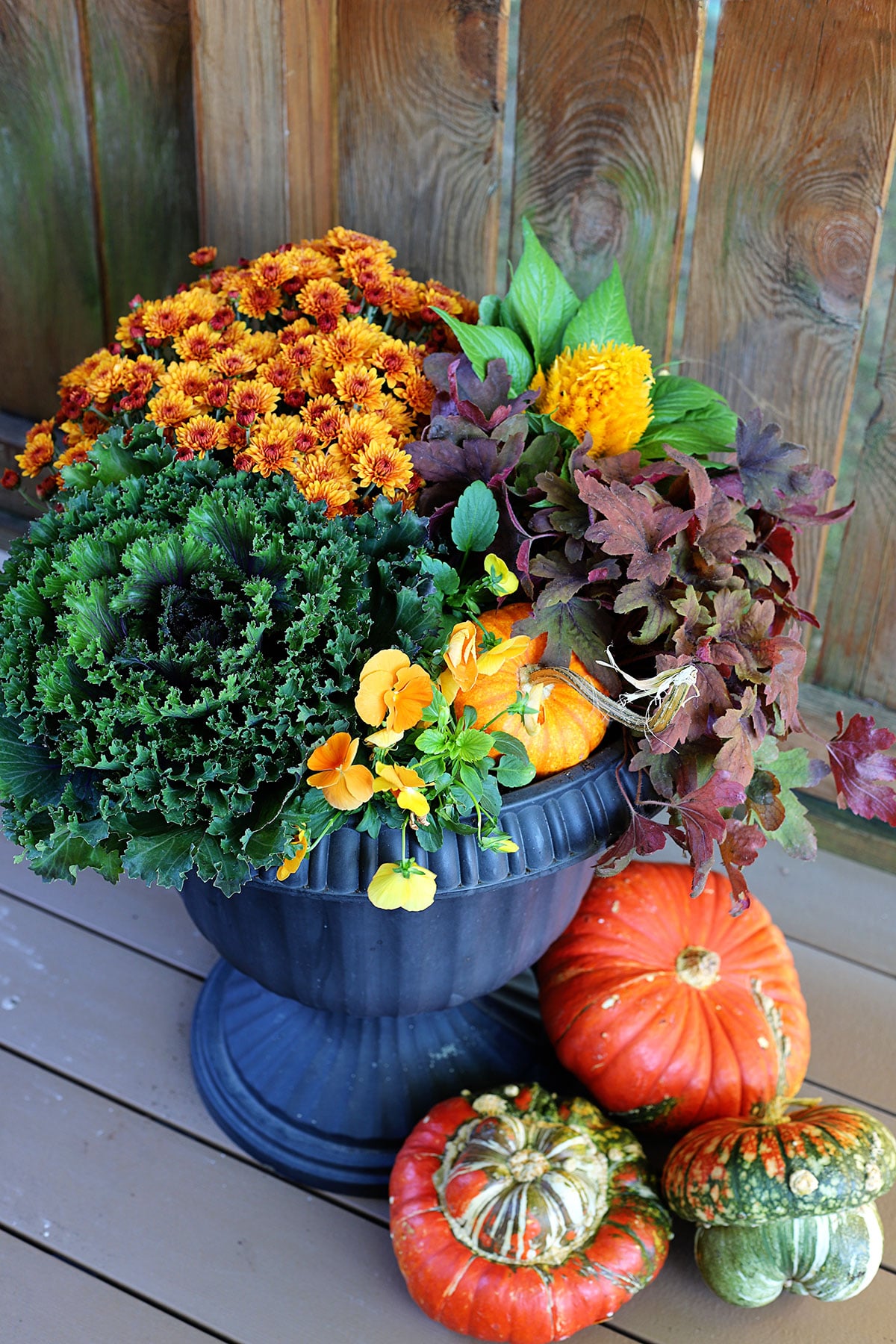
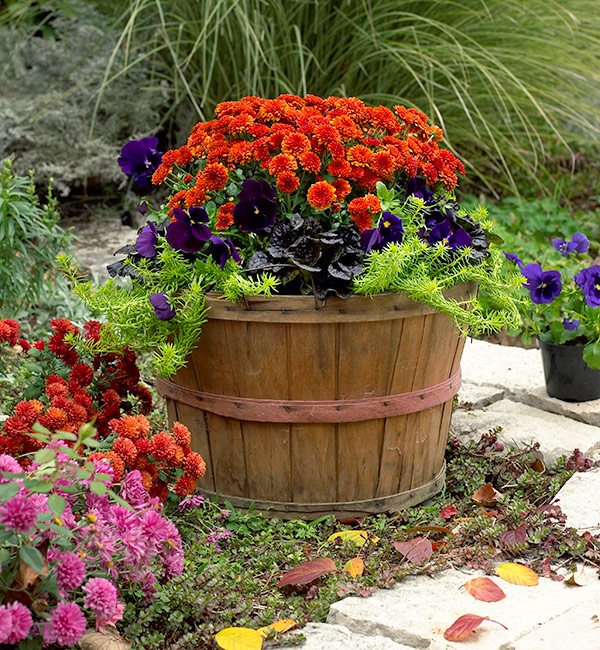
Treat mums as your centerpiece, not your whole planter, so when they fade you’re not staring at an empty pot.
I plant kale, heuchera, or ornamental peppers around the mums specifically so the planter still looks intact after the flowers give out.
Ornamental grasses
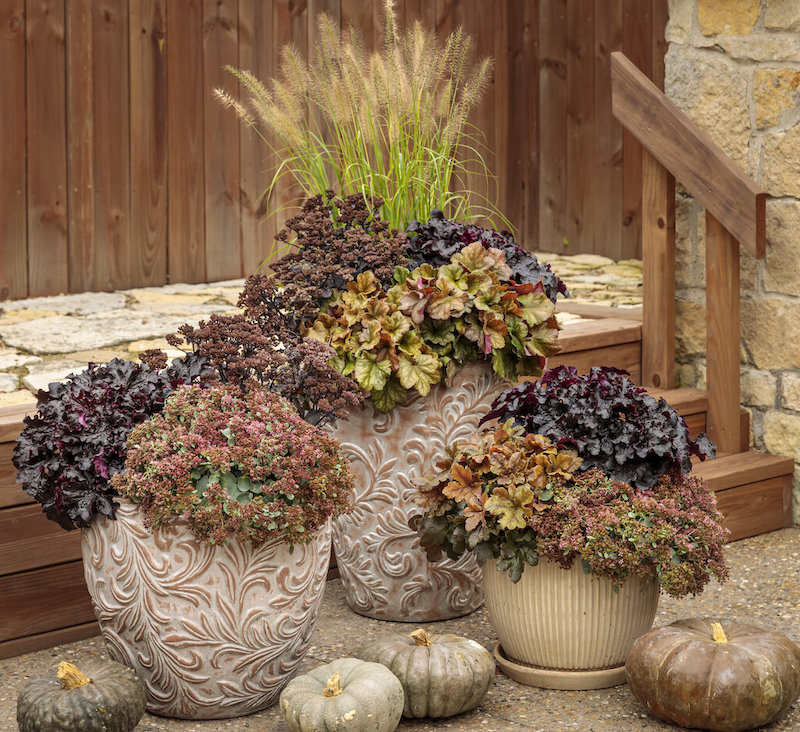
Every planter I build feels a little stiff until I add something that moves in the wind, and grasses are my go to for that.
Purple fountain grass, fiber optic grass, or a small carex variety add motion and softness against all those solid mum blooms and heavy pumpkins.
They also hold up through light frost far longer than most flowering plants, so they keep your planter looking full even as other elements fade.
Place your grass toward the back or center as your thriller element, and let it arch out over the shorter plants around it.
Pansies

Pansies are the plant most people forget about until the mums are already toast, and by then it’s almost too late to shop for them.
They handle cold shockingly well, and I’ve seen them bounce back from a light frost looking better than they did the day before.
Tuck pansies in as your low filler layer so when everything else starts fading in November, you’ve still got color at the base of the pot.
Plant them a little earlier than you think you need to, because they take a few weeks to fill in and look lush.
Heuchera
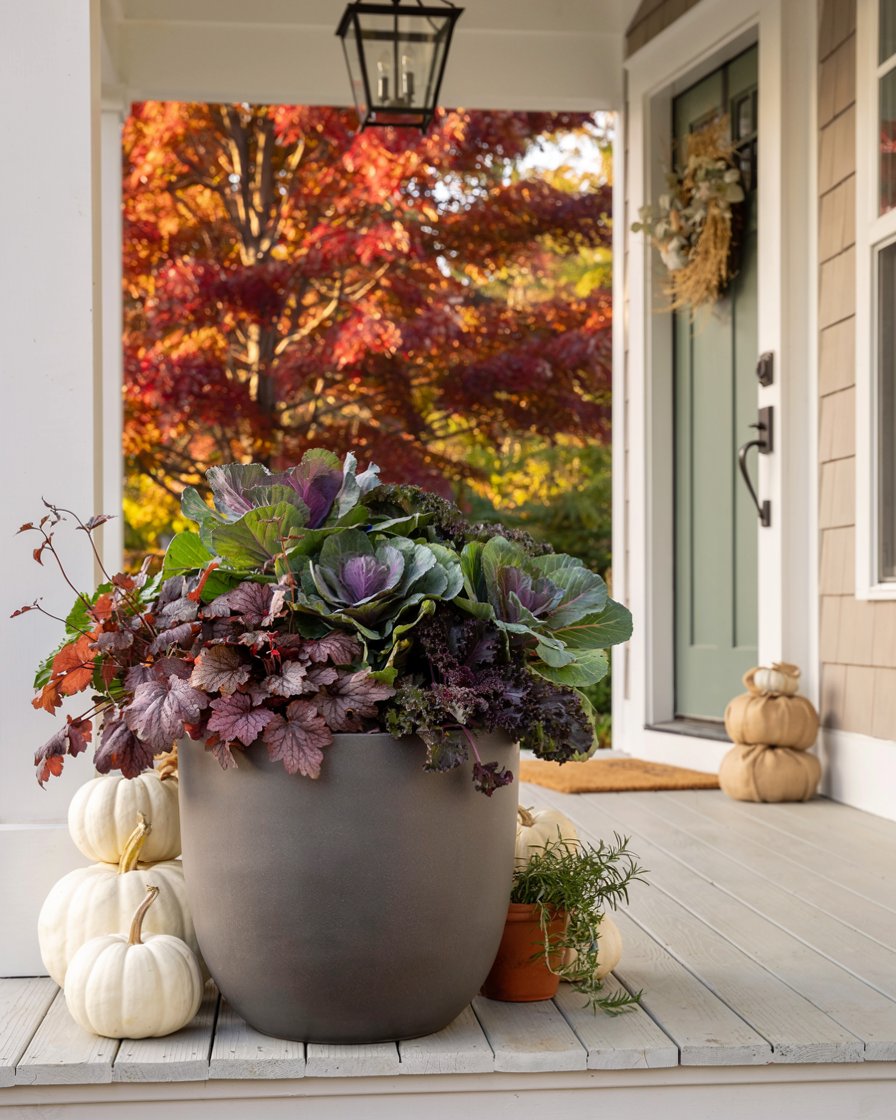
Heuchera, sometimes called coral bells, gives you deep burgundy, amber, or almost black foliage without needing a single flower to make an impact.
It’s a perennial, so depending on your zone, you might get to keep it in the ground after the season instead of tossing it with everything else.
I lean on heuchera constantly for planters that need to survive from early September warmth through possible frost in November, because it genuinely does not care about the temperature swing.
Pure mums and pure pumpkins peak fast and fade fast, so anchoring your design with heuchera gives it actual staying power through the whole season.
Miniature Evergreens

They have become one of my favorite tricks for planters that need to survive well past Thanksgiving.
A small dwarf conifer or miniature spruce gives your arrangement a backbone that never fades, never browns, and quietly transitions your porch straight into winter.
Tuck one in the back of a large planter with kale and grasses around it, and you’ve got a display that still looks intentional in December when everyone else’s mums are long gone.
It costs more upfront than a flat of mums, but you can often replant it in the yard afterward instead of throwing it away, so it’s not really wasted money.
Ornamental peppers
Ornamental peppers in deep purple, orange, or red add a texture nothing else in a fall planter really matches, little glossy pops scattered through the greenery.
They’re not for eating, they’re bred for looks, and they hold their color and shape for weeks longer.
I like using them as a secondary accent around mums, filling the gaps where the blooms haven’t quite closed up the pot yet.
They also handle a light frost better than the mums sitting right next to them, so they often outlast your centerpiece flower entirely.
Pumpkins

Nothing says fall faster than pumpkins stacked into or around a planter, but there’s a wrong way to do this that I see constantly.
Dried corn stalks and wheat bundles look beautiful tucked in with pumpkins, but they are essentially kindling sitting next to your front door where people sometimes still light cigarettes or drop matches.
Keep dried elements away from anywhere with foot traffic that includes smoking, grills, or fire pits, and never place them near exterior light fixtures that get warm.
If you love the look, spritz dried stalks with water occasionally to keep them from turning into tinder, or swap them for faux versions near high traffic zones.
This is not a rule most fall decorating articles mention, but I’ve seen the aftermath of a dried arrangement catching a stray ember, and it’s not worth the risk.
For the pumpkins themselves, use real mini pumpkins as your seasonal filler and swap them out as they soften, rather than planting anything permanent right up against them.
Best practices for a successful fall planter
Break the orange
Orange mums, orange pumpkins, orange leaves everywhere, and suddenly your porch looks like a pumpkin patch threw up on it.
Pull in deep purple, burgundy, or even that mustard yellow to break things up and make the orange pop instead of blending into mush.
A planter with just one color reads flat from the street, even if every plant is beautiful up close.
Some of the best fall porches I’ve styled leaned heavily purple and cream with just a touch of orange, and people stopped to take pictures of those, not the orange-on-orange ones next door.
Match your container to the season
A bright glossy turquoise pot that looked perfect for summer geraniums fights with warm fall tones no matter what you plant in it.
Terracotta, aged metal, dark charcoal, and matte finishes read as fall automatically, even before you add a single mum.
You don’t need to buy new pots every season, but a quick coat of matte spray paint on an old container can shift the whole mood for a few dollars.
Color clashing between pot and plant is one of the quietest reasons a planter feels off, and most people can’t even name why it bothers them.
Ideas are the fun part, but these are the habits that decide whether your planter is still standing in November or dumped in the yard waste bin by mid October.
Choose plants that can handle your fall conditions
What thrives on a porch in Georgia will turn to mush on a porch in Minnesota, so shop with your actual first frost date in mind, not the plants that looked prettiest at the store.
I always ask clients when their first hard frost typically hits before I even start picking plants, because that single date changes almost every choice after it.
Do not pack the container too tightly
Fall displays tend to go big on drama, corn stalks, gourds, mini pumpkins, mums, and kale all fighting for the same six inches of space.
Overcrowded planters look busy instead of festive, and the plants inside can’t get enough airflow, which invites mold and mildew fast.
Give your centerpiece room to breathe and let three or four well-chosen elements do the talking instead of piling on everything the garden center had in stock.
Use quality potting mix
That soil sitting in your pot from summer has been feeding plants for months and it’s exhausted, compacted, and full of old root systems fighting for space.
Fresh potting mix costs you a few dollars and gives your fall plants room to establish roots before the ground gets cold.
I’ve dug into “failed” fall planters more times than I can count, and almost every time the soil underneath looked like a brick.
Check drainage before you plant
Summer rain comes and goes fast. Fall rain sits, and sits, and sits some more.
A planter without proper drainage holes turns into a swamp by October, and root rot sets in before you even notice anything’s wrong.
If you’re using a decorative pot with no holes, drill them yourself or use it as a cover pot with a plastic liner that actually drains.
Protect containers from strong winds
Fall storms roll in fast, and a tall thriller stem or a top heavy pumpkin arrangement can catch wind like a sail.
Tuck containers near a wall, under an overhang, or against a railing instead of leaving them exposed at the edge of open stairs.
Wet potting soil, a few pumpkins, and a ceramic pot add up fast, so a stable spot matters as much as a stable pot.
I’ve seen more than one gorgeous fall arrangement end up shattered on a driveway because nobody thought about wind before setting it up top-heavy.
Give fall containers a little breathing room
This is different from cramming one pot too full, this is about the space between multiple containers on your porch.
Push everything together and it reads like storage, spread things out slightly and each container gets to stand on its own.
Leave enough space between pots that you can actually walk the porch comfortably, especially if trick or treaters or holiday guests will be coming through.
Group containers in odd numbers

Two matching pots flanking a door look fine, but three pots of varying heights look styled.
Odd numbers, three, five, or seven, trick the eye into seeing an arrangement instead of a pair, and it’s a trick that works every single time I use it.
Vary the heights slightly within the group so it doesn’t look like a matched set from a store display.
Add lanterns around large containers
A lantern or two tucked beside a large planter adds warmth once the sun goes down, which matters more in fall when it gets dark earlier and earlier.
Battery operated candles are worth the extra cost near dried elements like corn stalks or wheat bundles, since real flame near anything dry is asking for trouble.
Cluster a small lantern grouping at varying heights next to your biggest container the same way you’d group the pots themselves.
Go with the right height

If your planter sits next to your front door, everything in it needs to work with that door, not compete with it.
A tall dramatic branch arrangement looks incredible until it blocks your house numbers or smacks guests in the face on their way in.
Measure the space between your planter and your door before you buy that six-foot curly willow branch that seemed like a great idea at the nursery.
I once styled a porch where the thriller element was so tall the homeowner had to duck every time she checked the mail.
You don’t want this.