Does Irish Spring Soap Keep Mice Away?
Last Updated on May 9, 2026 by Duncan
No — Irish Spring soap does not keep mice away. Video evidence shows mice actively approach, climb on, chew, and even carry off bars of Irish Spring soap.
It is not an effective mouse deterrent and you should not rely on it in place of proven pest control methods.
My Personal Experience With This Claim
I’ve been the hands-on gardener in my family since I was 15. Now at 32, I manage a small garden where I grow guavas, peaches, onions, and more. Over the years I’ve dealt with my share of rodent problems — both indoors and in the garden.
A few years back, I noticed droppings near the pantry and heard scratching behind the walls late at night. I’d used outdoor rat traps successfully before, but I didn’t have any on hand. My brother George stopped by and confidently suggested I try Irish Spring soap — apparently he’d read it online.
I love Irish Spring myself. The sharp, green scent is distinctive; the kind that lingers on your hands long after you’ve rinsed. If I found it strong,
I assumed a mouse surely would too. I grated a bar and placed pieces near the baseboards and in the pantry corner where I’d spotted the droppings.
Three nights later, I checked the camera I’d set up. The mouse was back — and it wasn’t running from the soap. It was next to it, seemingly unbothered. I found bite marks on one of the grated pieces the following morning.
That’s when I started digging into the research. What I found confirmed my disappointing result: Irish Spring soap is not a mouse repellent.
Video Evidence: What Mice Actually Do With Irish Spring Soap
My experience alone isn’t proof — so here is the documented video evidence that shaped my conclusion.
Test 1: Shawn Woods’ Field Experiment
Shawn Woods, a well-known pest control YouTuber, left a full bar of Irish Spring soap for one week in a mouse-infested area and recorded the results.
What the footage shows:
- The mouse lingered around the soap without any sign of distress
- It climbed directly onto the bar
- It gnawed at the soap repeatedly over several nights
- By the end of the week, the bar had visible bite marks and had been dragged around
The mouse returned every single night of the week-long test. The soap created zero deterrent effect.
Test 2: Sharon’s Kitchen Camera Footage
Sharon had already noticed mice eating her household soap, so she set up bars on her counter and installed a camera to document the behavior.
What the footage shows:
- A mouse runs off with a bar that wasn’t fully secured
- A second bar was anchored in place — so the mouse simply ate it on the spot, in front of the camera
- The soap was a different brand from Irish Spring, which reinforces a broader point: mice are attracted to soap in general, not repelled by it
Two independent video tests demonstrate that mice approach, chew, and carry away soap rather than avoiding it. Irish Spring’s strong scent does not function as a repellent.
What Other Homeowners Have Found
Beyond the videos, community feedback from homeowners who tried the Irish Spring method consistently reports failure.
The screenshots below show firsthand accounts from people who placed soap around their homes only to find mice had chewed through it or ignored it entirely.
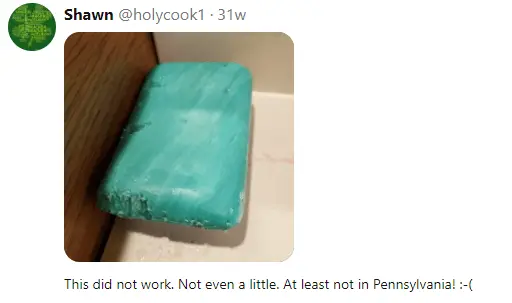





A pattern emerges across these accounts: people who tried the soap — often after reading optimistic blog posts — found it didn’t work and in some cases the soap was eaten.
Effective Ways to Keep Mice Out of Your Home
Soap won’t solve your mouse problem — but these methods will. After my own failed Irish Spring experiment, I worked through each of these approaches, and the combination of sealing entry points and using a sonic repeller resolved my situation within two weeks.
1. Seal All Possible Entry Points
This is the single most effective long-term solution. Mice can squeeze through gaps as small as a dime, so a thorough inspection is essential.
What to do:
- Caulk around all wires, pipes, and cables entering the house
- Place metal mesh screening over vents
- Seal foundation cracks with expanding foam or mortar
- Check where your dryer vent, plumbing, and electrical conduit enter the exterior walls
This is often challenging and time-consuming, but it addresses the root cause rather than just managing an existing infestation.
2. Use Ultrasonic Electric Repellers
These devices emit high-frequency sound waves that irritate rodents but are completely inaudible to humans and most pets. They’re one of the cleaner, guilt-free options available.
One of the best I’ve used is the Bocianelli Ultrasonic Pest Repeller. Key features:
- Covers up to 1,600 sq. ft.
- Simple plug-in design — no maintenance required
- Also effective against bedbugs, fleas, cockroaches, and other insects
After my soap experiment failed, I plugged one of these in near the pantry. Within a week I stopped hearing scratching at night.
3. Live Trapping and Relocation
If you’d rather not harm the mice, live cage traps are a humane option. Place them along walls or near areas of known activity, baited with peanut butter or chocolate.
Important: Release caught mice at least one mile from your home — ideally in a wooded area far from other residences. Releasing them nearby means they’ll likely return.
4. Snap Traps
The classic snap mousetrap remains one of the most effective and cost-efficient options available. Modern versions come in various sizes to handle both mice and rats (useful if you’re dealing with a broader rat menace in your garden).
Tips for effective use:
- Position traps perpendicular to the wall, with the bait end touching the baseboard
- Check traps daily and dispose of caught mice promptly
- Wear gloves when handling traps to avoid leaving your scent
Snap traps also work for chipmunks if that’s part of your problem.
Note on glue boards: Avoid glue board traps. They immobilize mice without killing them quickly, causing prolonged suffering. Tossing a live, struggling animal in the trash is not a humane or practical disposal method.
5. Should You Use Poison?
Rodenticides will kill mice, but they carry serious secondary risks that make them a last resort.
The risks of using poison:
- A pet dog or cat may find and eat a poisoned mouse and become ill or die
- Rat poisons typically cause intense thirst, driving mice outdoors to find water before they die — meaning they die in your yard or garden
- Wild animals (owls, foxes, hawks) may scavenge the poisoned carcass and be harmed in turn
- The dying process can take days and involves significant pain for the rodent
Use poison only as a last resort, and always follow label instructions carefully.
The Irish Spring Soap Myth Explained
Despite all evidence to the contrary, the Irish Spring myth persists — and it’s easy to see why. The soap has a powerful, distinctive scent. The logic seems intuitive: if it smells strong to us, surely rodents with more sensitive noses would find it overwhelming.
Here’s what the myth claims:
- Grating the soap and sprinkling shavings around affected areas creates a scent barrier mice won’t cross
- Using only “original” Irish Spring (not Icy Blast or Aloe variants) gives the best results
- Some claim it works on certain species of mice but not others
Why the myth persists:
- Anecdotal success stories spread faster than failure stories
- People who try it and see no mice afterward may credit the soap rather than other factors (seasonal change, habitat disruption, natural migration)
- There is very little academic research on the topic — the vacuum is filled by folk remedies
No peer-reviewed research supports Irish Spring soap as an effective mouse repellent. Available video evidence shows the opposite — mice treat soap as a food source, not a threat.
The bottom line: you cannot rely on Irish Spring soap to deter mice. Reach for an ultrasonic repeller or a mousetrap instead.
Frequently Asked Questions
Does Irish Spring soap repel mice?
No. Irish Spring soap does not repel mice. Video tests show mice approach, chew on, and carry away bars of the soap without any sign of aversion to its scent.
Why do people think Irish Spring keeps mice away?
The soap has a very strong scent, which led to the folk theory that it would overwhelm a mouse’s sensitive nose. However, this has not been supported by evidence, and mice appear to be attracted to soap as a food and nesting material source rather than repelled by it.
What smell actually keeps mice away?
Peppermint oil, clove oil, and cayenne pepper are commonly cited as natural deterrents with more anecdotal support than soap — though none are as reliable as physical exclusion (sealing entry points) or mechanical traps. Ultrasonic repellers are among the more consistent non-lethal options.
Do mice eat Irish Spring soap?
Yes. Multiple video experiments and homeowner reports document mice chewing and consuming bars of Irish Spring soap. It appears mice find the fats and ingredients in soap palatable.
What is the best way to get rid of mice?
The most effective approach combines two methods: sealing all entry points into the home (walls, pipes, vents, foundation gaps) and using snap traps or ultrasonic repellers to address any mice already inside. The Bocianelli Ultrasonic Pest Repeller is a good no-kill option for coverage up to 1,600 sq. ft.
Are glue traps a good option for mice?
No. Glue traps are considered inhumane because they trap mice alive without killing them quickly, causing prolonged stress and suffering. Snap traps or live cage traps are preferable alternatives.
Related Posts: