
17 Shed Organization Ideas for a More Functional Storage Space
Last Updated on September 14, 2026 by Duncan
A good shed should feel like a tiny workshop, not a dark cupboard where rakes go to disappear.
Over the years, I have found that the best setups are not the prettiest ones on day one.
They are the ones where you can grab the secateurs, hose connector, or bag of screws with one hand, then put it back without having to move six other things.
If you would like to keep your shed in order, here are shed organization ideas you should use to your advantage.
Organize by task.

Most people organize a shed like a hardware store.
All the wrenches together, all the paint together, all the rope together.
If feels tidy but it’s not effective.
Nobody walks into a shed thinking “I need a wrench.” They think “I need to fix the fence.”
To make your work easy, group items by the job they belong to.
For example, put your fence repair equipment together. Lawn care equipment together. Car equipment together. And so on.
When a project calls, you know the zone to go to, instead of hunting through six.
Build a “landing zone” near the door
:max_bytes(150000):strip_icc():format(webp)/ScreenShot2021-12-26at1.04.48PM-c2c8a4e3d85b4712935162d0bb74424b.png)
Here’s a pattern I see in every single messy shed.
There’s always a pile near the entrance of tools that are “in between” uses.
The wheelbarrow half unloaded. The gloves you’ll put away later. The bag of mulch you’re not done with.
Instead of fighting this, design for it. Leave a deliberate empty spot right by the door for transitional items.
Give chaos a home and it stops spreading into the rest of your system.
Put your five most used tools at chest height
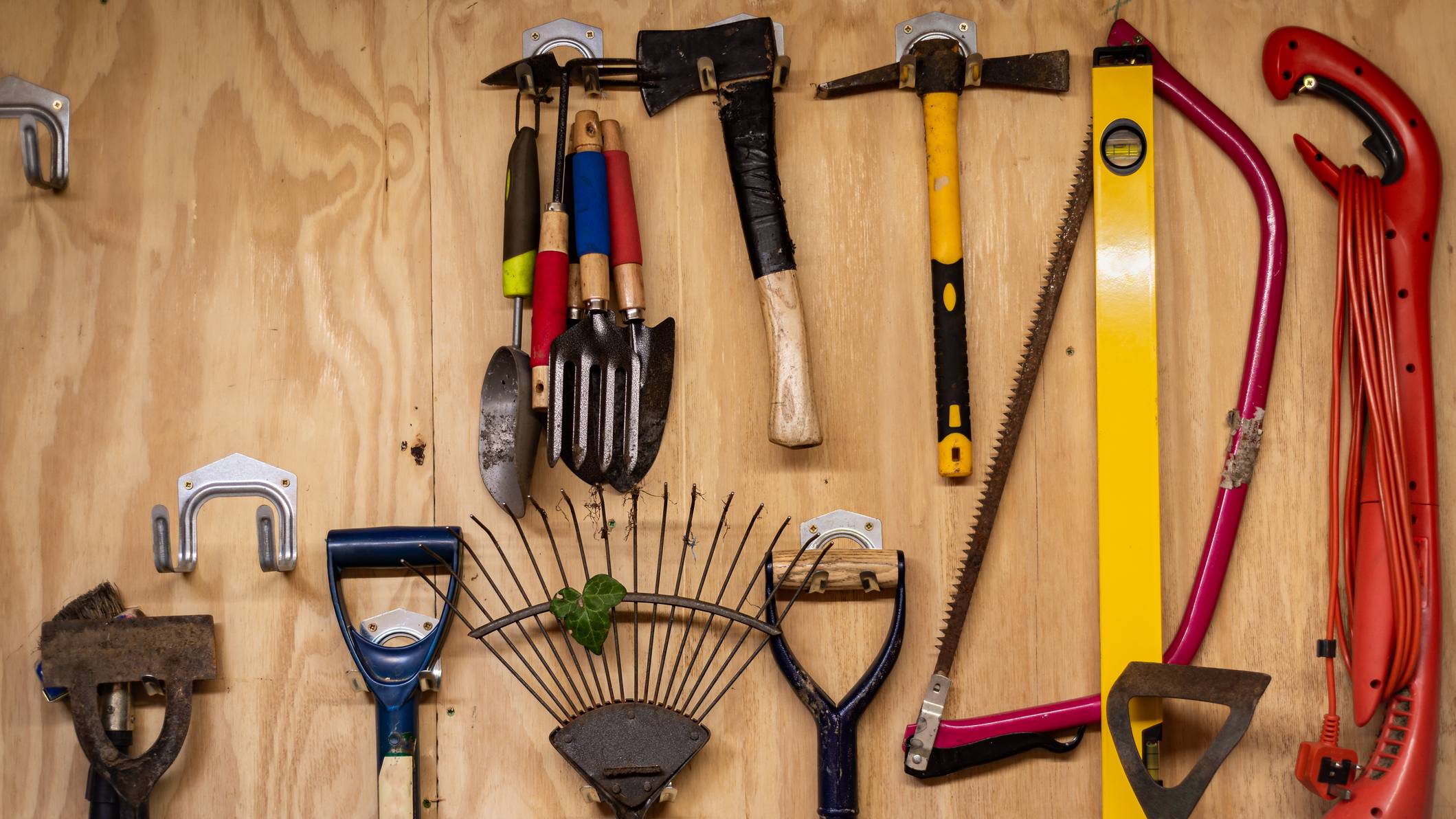
Not eye level. Chest height, right where your hand naturally falls.
You should leave eye level for tools you grab once a season, because it’s the easiest to see and the hardest to reach with a tool in hand.
Your everyday tools such as rake, hand trowel, gloves, pruners, whatever you touch weekly, place them at arm’s reach without bending or stretching.
Leave the rafters for the sleepers
:max_bytes(150000):strip_icc():format(webp)/shelf-5c4a323e6abe46e085b02581d7dcb3c4.jpg)
The top shelf or rafters should hold things you use maybe twice a year.
These include holiday decoration tools or extra fencing. The tent you take camping once a summer.
If you’re climbing on a bucket every week to reach something, your zones are backwards.
Use clear bins
:max_bytes(150000):strip_icc():format(webp)/ScreenShot2021-12-27at1.40.30PM-4d3bf5d31adb4853a5fe6d708b8e780a.png)
Labels peel, fade, or get covered in dust within a season.
Clear bins solve that, except for one problem nobody mentions.
Clear plastic yellows and clouds in direct sun from a shed window or a gap in the wall.
To be on the safe side pair clear bins with a written label and keep bins with small hardware or seeds out of any direct light.
Be strategic with the pegboard
:max_bytes(150000):strip_icc():format(webp)/2-26f10433c8cf44b5a37a709816bbf5b8.jpg)
Pegboard looks incredible in photos. In real sheds, it fails in three specific ways.
The hooks get loose from heavy tools swinging every time you grab something. The holes get overloaded on one panel while another sits empty.
And nobody ever updates the layout once the season’s tools change.
You can fix this by using locking pegboard hooks, not the friction fit type.
Spread heavy tools across the whole board instead of clustering.
Organize with pests in mind
A shed is basically a five star hotel for mice, and most organization advice ignores this completely.
Cardboard boxes are nesting material. Bags of grass seed or bird feed are a buffet. Piles of anything soft against a wall are an invitation.
Store anything edible to a rodent, seed, feed, fertilizer with any smell, in a hard sided container with a locking lid.
Keep storage off the wall by even an inch so you can see droppings or nests before they spread.
Rotate your shed twice a year
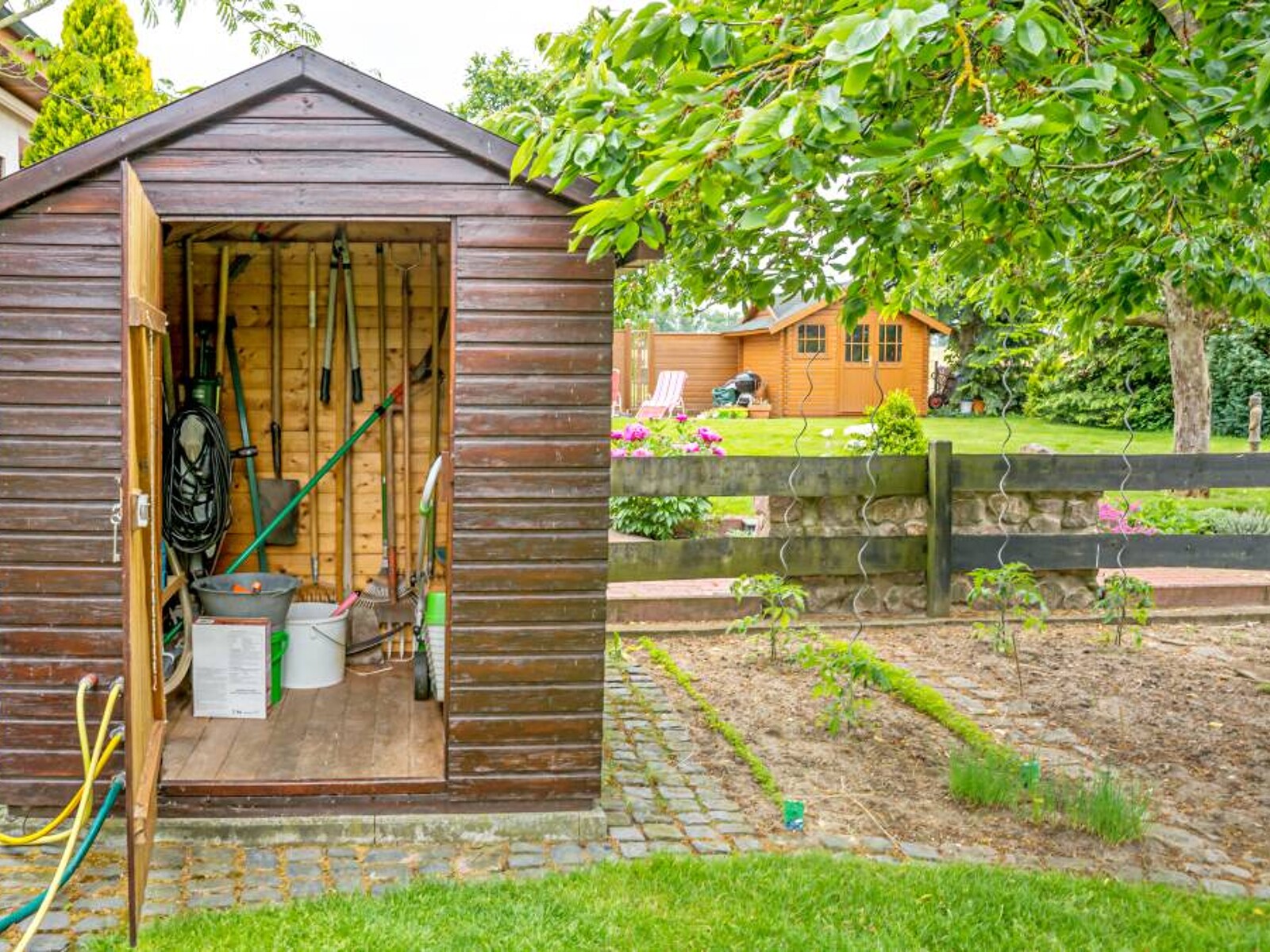
Most people organize a shed once and expect it to hold forever.
Your shed’s contents change dramatically between seasons, so its layout should too.
Come spring, garden tools should move to the front and holiday decorations to the back. Come fall, flip it.
Block twenty minutes on your calendar twice a year for this swap.
This means the difference between a shed that adapts to your life and one you’re constantly fighting.
Take advantage of the inside of your door
:max_bytes(150000):strip_icc():format(webp)/ScreenShot2021-12-26at12.19.28PM-98d29785d6c14545b5791289c0ea0e55.jpg)
Most people treat the back of the door like dead space. It’s actually some of the best storage in the whole shed that you should take advantage of.
Mount a slim tool rack or a few hooks for the things you grab on your way out.
These include seeds, twine, gloves, a folding knife, safety glasses.
The door is the last thing you pass before you’re outside working, which makes it the most convenient spot in the entire building.
Store small items in drawers, not deep boxes
Screws, washers, seed packets, twist ties, none of that belongs in a deep bin.
Drop small items into a deep box and it sinks to the bottom within a week.
You end up digging through inches of clutter for a single hinge bolt. You don’t want this, do you?
Shallow drawers or a small parts organizer keep everything visible at a glance. If you can’t see it without pulling everything out, it’s in the wrong container.
Use the corners for bulky, awkward equipment

The corners of a shed are the hardest space to use well, so most people waste them or cram random junk in there. Don’t do this.
Store your bulky stuff here.
Wheelbarrows, ladders, folded up tables, anything with an odd shape that won’t sit flush against a flat wall.
Corners eat awkward shapes better than any shelf ever will. After all, there’s nothing else that fits there anyway.
Have a “use soon” shelf
:max_bytes(150000):strip_icc():format(webp)/Garage-pegboard-wall-and-tool-cart-77ad059af5d5425f98f28adbcec99969.jpg)
Every shed needs one shelf that isn’t assigned to a category at all. It’s just for whatever you’re actively working on this week.
The half used bag of grass seed. The paint you’re touching up next weekend. The part you ordered for the mower.
Without a dedicated spot, these items either clutter your landing zone or get buried in a bin where you’ll forget they exist.
Have one shelf, that should always be empty until you need to place something there.
Leave breathing room around anything with wheels
:max_bytes(150000):strip_icc()/lawn-mower-storage-ideas-7228646-01-13dc4f23d0c34bfba9314c72ae35b9ff.jpg)
Wheelbarrows, mowers, and wagons need clearance to roll out, not just a space to sit parked.
I can’t count how many sheds I’ve walked into where the mower is technically “stored” but boxed in so tightly it takes five minutes of shuffling other items just to back it out.
Leave a clear path in front of anything with wheels, wide enough to pull it straight out without touching a single other item.
Hang your hoses
A coiled hose on the floor is a tripping hazard, a home for spiders, and a magnet for mildew where it touches damp concrete.
A simple wall mounted hose hanger gets it up, keeps it dry, and stops it from tangling into a knot every time you reach for it.
This one’s small, but it fixes a problem almost every shed has and almost nobody bothers to solve.
Give awkward shaped tools their own hooks
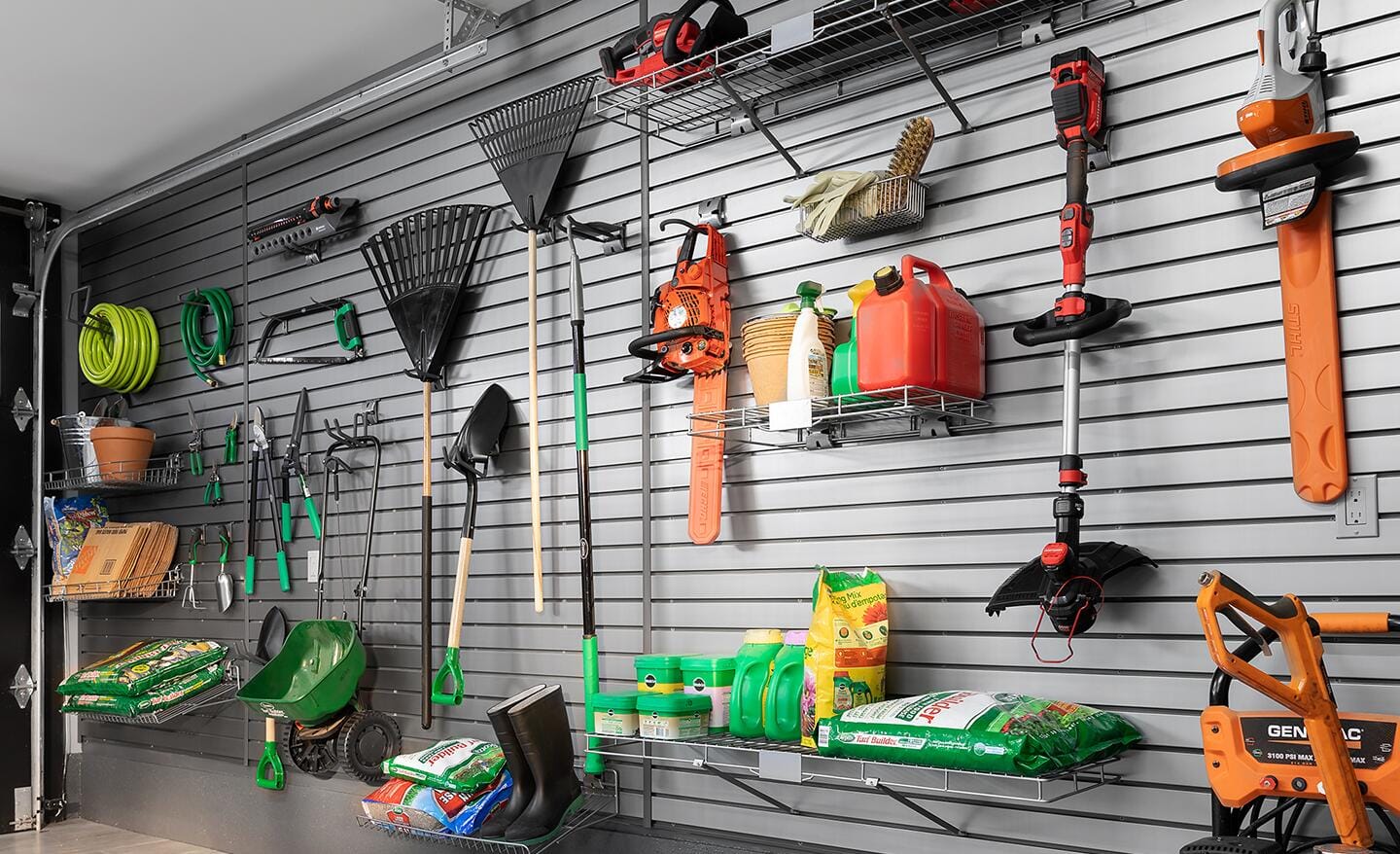
Rakes, shovels, and hoes get all the pegboard love.
Meanwhile the weird tools such as post hole diggers, loppers, that oddly shaped hedge trimmer, ends up leaning in a pile because nothing else fits it.
Don’t force odd tools into a system built for straight handles.
Give each one its own custom hook or bracket sized to its actual shape.
A single well placed hook for one odd tool beats a whole pegboard section that never holds it right.
Have a repair and maintenance box

Oil, spare blades, a spark plug wrench, replacement bolts, the items you only need when something breaks belongs together in one dedicated box.
Scatter that gear across the shed and every repair turns into a scavenger hunt at the exact moment you’re already frustrated something’s broken.
One labeled box, always in the same spot, means you’re fixing the problem instead of hunting for the tools to fix it.
Give dirty gear its dirty zone
Muddy boots, a filthy tarp, gear straight off a dirt job site, none of that belongs next to your clean stored items.
Dirt and grime spread fast in a closed space.
One muddy boot against a clean shelf and now everything nearby needs wiping down too.
Section off a spot near the door, ideally on a mat or tray, for anything that comes in dirty. Let it dry and brush it off there before it joins the rest of your system.
Always leave room for the next thing
Every shed I’ve organized that stayed organized had one thing in common. There was always a little open space left over, not packed edge to edge.
Pack a shed to full capacity and the first new purchase, a new tool, a bag of fertilizer, a gift you didn’t expect, has nowhere to go.
It ends up on the floor, and that’s how the slide back to clutter starts.
To be on the safe side leave ten percent of your shed empty on purpose. Future you will thank present you the next time something new needs a home.