Do Deer Eat Apples?
Last Updated on May 13, 2026 by Duncan
Yes, deer eat apples. They are highly attracted to them and will consume every variety, including crab apples. Once deer discover an apple source, they return to it habitually.
Deer can smell fallen apples from a distance, and if the supply is consistent, apples become one of their preferred food sources.
How Do Deer Eat Apples?
Here is a detail most people don’t know: deer have no upper front teeth (incisors). Instead, their upper jaw has a hard dental pad. That raises an obvious question: how can an animal bite into an apple without upper incisors?
The answer is elegant. A deer picks up the apple using its lower incisors and flexible lips, moves it to the back of its mouth, and crushes it with its powerful molars. It is awkward to watch, but it works extremely efficiently. Deer can process a whole apple in seconds.
Deer belong to the order Artiodactyla and are ruminants. Like cattle and sheep, they lack upper incisors entirely. Their lower teeth work against a tough upper gum pad for grabbing food, while the molars do the actual chewing.
This anatomy means deer are more comfortable with fallen, soft fruit than hard items they must bite through.
How to Deer-Proof Your Apple Tree
If you want to keep your harvest to yourself, there are several reliable ways to deter deer. The more of these you combine, the better your results will be.
Put Up a Fence Around the Apple Tree
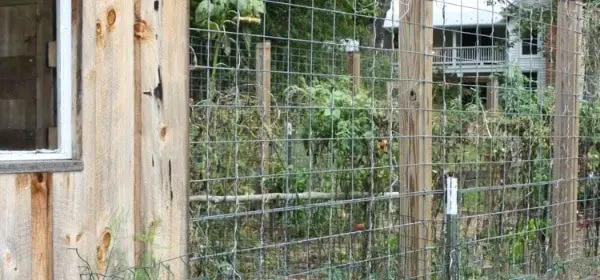
A properly installed wire fence is the most reliable long-term deer deterrent for fruit trees.
A high-tensile or woven mesh wire fence is the most reliable deer deterrent. When installing it, anchor the wire firmly to the ground and fill any gaps, dips, or holes with rocks or heavy material that cannot be displaced by wind or digging.
If budget allows, a New Zealand-style electric fence offers superior protection and is widely used in orchard settings.
According to the University of California, a fence must be at least 8 feet tall to reliably keep out the deer, since white-tailed and mule deer are capable of clearing lower fences when motivated by food. (Source: UC Agriculture and Natural Resources)
Place a Metal or Plastic Mesh Trunk Guard
If a full fence is beyond your budget, a trunk guard is a practical alternative. Male deer (bucks) rub their antlers against tree trunks to remove velvet and mark territory. This behavior can seriously wound or kill young trees.
To install: wrap metal or plastic mesh around the lower trunk, taking care not to press it directly against the bark. Secure it with wire and press the base into the ground to prevent deer from nosing it aside.
Leave a small gap between the mesh and bark to allow airflow and prevent moisture buildup.
Use Scented Soap as a Repellent
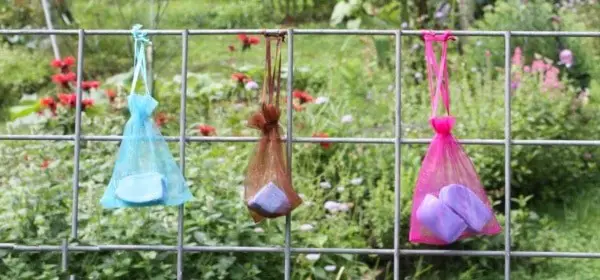
Strongly-scented soap bars, hung at nose height, create a chemical deterrent that deer instinctively avoid.
Deer have an extraordinarily sensitive sense of smell where it is estimated to be 1,000 times more powerful than a human’s. You can exploit this to your advantage.
Tie strings around bars of heavily scented soap (Irish Spring and similar tallow-based soaps work best) and hang them directly on each apple tree at nose height, roughly 3 to 4 feet above the ground.
Monitor them regularly and replace each bar as it disintegrates or loses its scent after rain.
If you have access to Milorganite (a bio-solid fertilizer with a strong odor), spreading it around the base of the tree serves a dual purpose: it repels deer and fertilizes the soil.
Use Deer-Resistant Plants as a Buffer
According to the California Department of Fish and Game, planting deer-resistant species around the perimeter of an apple tree creates a natural deterrent barrier. Deer are less likely to venture into an area surrounded by plants they find unappealing.
Effective species to consider include:
- Yarrow — strong scent, deer-resistant
- Aloe — spiky texture deters browsing
- Rosemary — intensely aromatic, highly effective
- Monkshood — toxic to many mammals; effective deterrent
Before planting any deterrent species, check whether the plant is classified as invasive or noxious in your region. Some effective options such as bamboo can rapidly escape garden boundaries.
To be on the safe side, always consult your local nursery for region-specific, non-invasive alternatives. (Recommended by the California Department of Fish and Game)
Using Apples as Deer Bait for Hunting
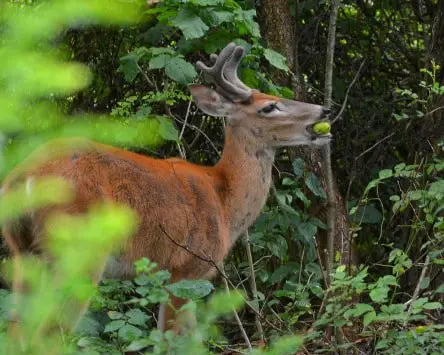
Deer are drawn to the sweet scent of apples. Crushing a few releases juice and aroma that can attract deer from significant distances.
If you hunt, apples are one of the most time-tested and effective natural baits available. Since deer are already highly attracted to them, they make a natural lure particularly in areas where apple trees grow wild or cultivated orchards are nearby.
Baiting deer is regulated differently by state. Some states permit it outright; others prohibit it entirely; many restrict it to specific seasons or distances from food plots.
Always verify the rules in your state before placing any bait. Violations can result in significant fines and the loss of hunting licenses.
If baiting is legal in your area, you have two options: plant a few apple trees in your backyard (which creates a persistent, seasonal food source) or purchase apples from a local farmers market just before season.
One proven technique: crush several apples before placing them. The released juice and pulp carry scent much farther on the breeze than intact fruit. If there are no competing food sources in the area such as acorns, persimmons, or corn deer will reliably feed on the apples.
If competing foods are abundant, success depends on whether the local deer population is already habituated to apples.
Note that deer may be reluctant to approach apples they have never encountered before. If this is the first time you are introducing apples to a new baiting site, allow several days for deer to investigate and become comfortable with the food source before your hunt.
- Deer do eat apples and will consume any variety, including crab apples.
- Deer eat apples by using their lower teeth and lips to pick them up, then crushing them with their molars they have no upper front teeth.
- The most reliable deer deterrent for apple trees is an 8-foot fence (per the University of California).
- Supplementary deterrents include trunk guards, strongly scented soap, and deer-resistant border plants.
- Apples are effective deer bait, but legality varies by state — always check local regulations first.
- Crushing apples before placing them as bait releases more scent and improves attraction.
Frequently Asked Questions
Do deer eat rotten apples?
Will deer eat apples off the tree, or only fallen ones?
Do deer eat crab apples?
How tall does a deer fence need to be?
Is using apples as deer bait legal?
Does scented soap really repel deer from apple trees?
Related Posts: