17 Things to Put in a Secret Garden That Create Pure Magic
Last Updated on July 19, 2026 by Duncan
A secret garden isn’t defined by rare flowers or expensive decorations.
It’s the feeling you get when you step inside and the outside world disappears for a while.
I’ve visited dozens of gardens over the years, and the ones that stay with me aren’t the biggest or the most polished.
They’re the ones that reveal themselves slowly.
You notice a hidden bench, hear trickling water before you see it, or catch the scent of jasmine drifting through the air.
If you’re wondering what to put in a secret garden, think beyond flowers.
Every item should invite you to slow down, explore, and linger a little longer.
Here are my favorite additions that turn an ordinary backyard into a place that feels tucked away from the rest of the world.
Inviting entrance
Everyone jumps straight to plant shopping. Wrong move.
Your entrance sets the mood before anyone sees a single flower.
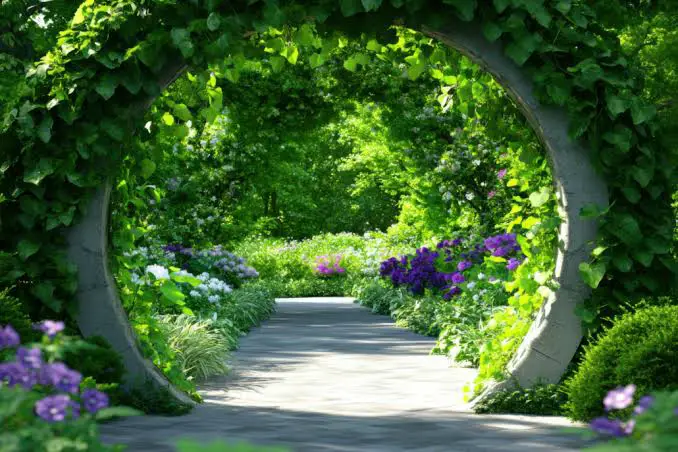
A gate, an arch, a gap between two tall shrubs, all of these work.
The width is what matters most.
Keep it narrow, somewhere around two feet, and it forces people to slow down and walk in one at a time.
Wide open entrances feel like a driveway.
Narrow ones feel like a secret you’re being let in on.
I like an arch dripping with something climbing.
A simple wooden gate does the same psychological trick, though.
You just want that moment of “am I allowed in here?”
A winding garden path
Once someone’s through that narrow entrance, the path takes over.
Its job is building anticipation.
A straight path tells your eye everything at once.
A winding one makes you wait for it.
And waiting is what makes a garden feel secret instead of just landscaped. Even a tiny space can fake this.
A path that curves once around a shrub before reaching the bench beats a straight line every time.
That’s true even if the actual distance is only ten feet.
Gravel, stepping stones, or bark mulch all work well here.
The slight unevenness underfoot naturally slows people down.
That’s exactly what keeps them looking around instead of marching to the end.
Skip poured concrete if you can.
It reads as driveway, not discovery.
A bird bath

I’m biased here, obviously. But a bird bath earns its spot in almost any secret garden.
It’s not just decoration. It brings in birds, and birds bring in sound.
And sound is what makes a space feel alive instead of staged.
Place it somewhere it catches dappled light, not full sun all day.
The water heats up and evaporates fast in direct blaze.
A spot under a small tree or near taller shrubs works best.
Clean it weekly in warm months.
Skip that step and you’ll grow algae, and nobody wants a green slime bath in their pretty garden.
Takes two minutes with a hose and a stiff brush.
A stone or concrete bath ages beautifully and picks up moss over time.
That moss just adds to the whole hidden, forgotten feel you’re going for.
Climbing plants
Passionflower, climbing roses, clematis, wisteria.
They all show up on every list, and for good reason.
But here’s what those lists skip. You need something to climb on before you plant anything that climbs.
An obelisk, a trellis, an arbor, or even an old ladder leaned against a fence works fine. Wisteria is gorgeous, and also a bit of a bully.
Give it a weak trellis and it will strangle the thing within three years.
Give it something sturdy, like a pergola or metal structure, instead.
Clematis is more polite.
It works well on a simple trellis against a fence, and gives you beauty without the wrestling match.
Passionflower grows fast in warm climates and dies back hard in cold ones.
Check your zone before you fall for the photos.
In colder regions, treat it like an annual, or bring pots indoors for winter.
An arbor
I mentioned an arch at the entrance earlier, but it deserves its own spotlight. It’s doing double duty in your design.
It frames the view, so whatever sits behind it gets a small dramatic reveal. And it gives your climbing plants somewhere sturdy to live.
Wood arbors feel soft and cottage-like as they weather.
Metal ones hold their shape better under a heavy vine like wisteria.
If your budget is tight, a simple arch kit from a hardware store works fine.
Nobody notices the frame once it’s covered in clematis or climbing roses.
Place it right at your entrance, or partway down the path as a second reveal moment.
Two arches in a small garden isn’t overkill.
It’s rhythm.
Ground cover

A garden with one tall layer and nothing else looks thin.
Even with expensive plants in it.
You want three layers. Something low and spreading at your feet.
Something mid-height filling the middle space. Something tall or climbing overhead.
Sweet woodruff, creeping thyme, or moss work beautifully at ground level.
They smell wonderful when you brush against them.
Hostas, ferns, and hydrangeas fill that middle zone nicely, especially in shadier corners.
Skip the middle layer and your garden reads as flat, no matter how nice the individual plants are.
It’s a mistake I see constantly, and it’s an easy fix.
Tall ornamental grasses
Flowers give you color.
Grasses give you motion, and motion is what makes a garden feel alive instead of frozen in a photo.
Feather reed grass or fountain grass swaying near your seating area adds a soft rustling sound.
It happens every time the wind picks up.
It’s a small detail.
But it’s the kind of thing people notice without knowing why they like it.
Grasses also work as a soft screen.
Plant a cluster along one edge of your path.
It partially blocks the view ahead without feeling like a solid wall.
That keeps the sense of discovery going a little longer.
They’re low maintenance too, which is a nice break from everything else on this list demanding attention.
Cut them back once in late winter and they return thicker every year.
Comfortable seating
A bench is the obvious answer, and it’s still a good one. But think about where you put it.
Face it toward something, not just into empty space.
A bird bath, a small pond, a statue, or even a particularly gorgeous shrub works.
Weathered wood or wrought iron reads as “this has always been here.” Brand new white plastic furniture kills that illusion instantly.
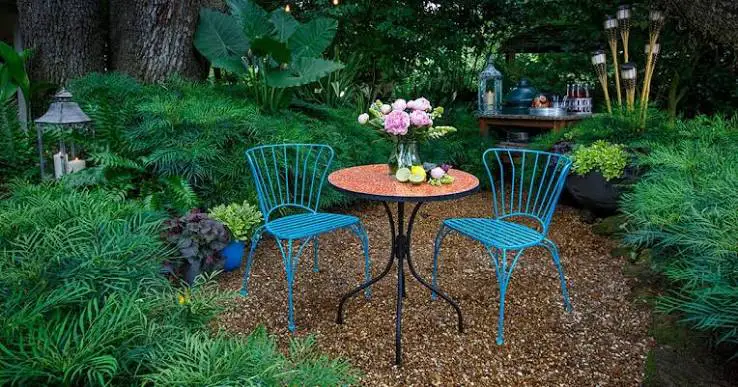
If space allows, try a small round table with two mismatched chairs.
It feels more personal than a matched patio set.
Secret gardens should feel collected over time, not purchased in one trip to a store.
Reading corner
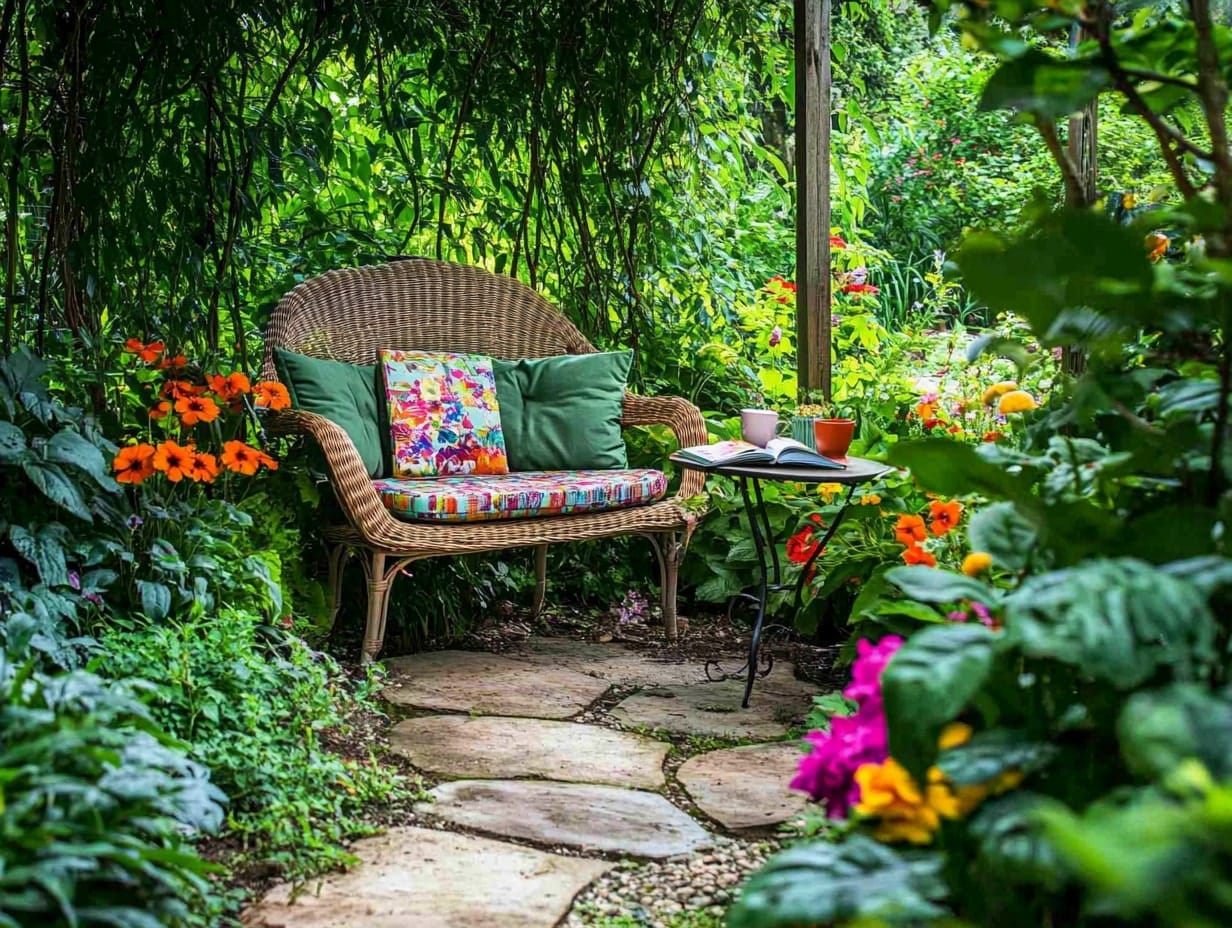
A garden without a purpose becomes a garden you walk through once and never visit again. Give yours a reason to keep coming back.
A reading corner doesn’t need much.
One comfortable chair, a small side table, and a bit of shade so you’re not squinting at your book by page two.
Tuck it slightly off the main path, rather than right in the middle of everything.
You want it to feel like you’ve found a spot, not like you’re sitting in the walkway.
Add a lantern on that side table for evening reading.
It turns the corner into something you’ll use year round, not just during the two peak weeks when everything’s blooming.
This is the detail that turns a garden people admire into a garden people live in.
Lighting

String lights are everywhere on Pinterest, and they can look lovely.
Overdo them, though, and your secret garden starts looking like a wedding venue.
Solar lanterns tucked low along the path give just enough glow to walk safely. That soft, uneven light is what keeps the mystery intact after dark.
Skip anything too bright or too white.
Warm, amber tones feel like candlelight, and cool white tones feel like a parking lot.
A single lantern hanging near your seating area does more for the mood than a hundred feet of fairy lights strung everywhere.
Water features

If you have room and budget, a small pond or fountain takes the sound element even further.
You don’t need anything elaborate.
A simple recirculating fountain the size of a large planter creates enough sound to mask street noise.
It might mask your neighbors too, which could be the real reason you wanted a secret garden.
Moving water also keeps mosquitoes away better than still water does.
So it’s practical, not just pretty.
Position it somewhere you can hear it from your seating area.
Maybe don’t let it be visible directly from the entrance, though, and let the sound pull people toward it instead.
Scent
Flowers get chosen for color constantly, and almost never for smell.
That’s a genuine missed opportunity.
Plant something fragrant right along the path, at nose height. Lavender, jasmine, sweet alyssum, or stock all work depending on your climate.
Scent triggers memory faster than almost anything else.
A garden that smells incredible is the one people remember.
They’ll remember it long after they’ve forgotten what it looked like.
Brush against a rosemary bush on your way to the bench.
Tell me that doesn’t make the whole walk feel special.
Vintage garden décor

Nothing says “this garden has secrets” faster than décor that looks like it’s been here for decades.
Even if you bought it last weekend.
An old watering can repurposed as a planter works well.
So does a weathered wheelbarrow tucked into a corner.
A rusted iron gate leaned against a wall, used as art instead of a functioning door, does plenty of heavy lifting too.
Thrift stores, estate sales, and flea markets are your best friends here.
You’re looking for texture and age, not perfection.
A little rust or peeling paint isn’t a flaw in this context, it’s the whole point.
Brand new anything reads as “just installed,” and that’s the opposite of what you’re going for.
Scatter these pieces rather than clustering them all in one spot.
One vintage item every few feet feels collected over time.
Five of them piled together feels like a display at an antique shop.
Personal touches
This is the part generic advice always skips. A secret garden should have something that only makes sense to you.
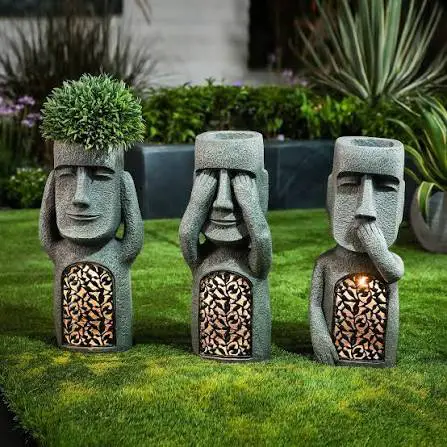
Maybe it’s a small statue you found at an estate sale.
Maybe it’s a wind chime your grandmother gave you, or stepping stones you painted with your kids one summer.
Those objects are what turn a nice garden into your secret garden. Anyone can buy a bird bath and a trellis.
Nobody else has your specific weird little collection of things. Don’t be afraid of a little clutter here, either.
A perfectly curated space feels staged. A slightly overgrown, slightly personal one feels like a place that belongs to someone.
Unexpected surprise
Every secret garden needs a moment that makes people stop mid-sentence. This is the part most lists leave out completely.
It doesn’t need to be big.
A hidden wind chime tucked behind a shrub, one you only hear once you’re deep in the garden, works well.
A small mirror positioned to make the space look twice its size is another option. So is a tiny fairy door tucked at the base of a tree, the kind that makes kids and adults both grin.
The trick is placement. Don’t put it where it’s visible from the entrance.
Save it for somewhere along the path, or near the reading corner. People should have to spend time in the space to find it.
That one surprise is what gets talked about after the visit ends. It’s the difference between “your garden is pretty” and “wait, did you see the little door under the oak tree?”
Pick one. Not five.
One well placed surprise beats a garden full of gimmicks that dilute each other.
What to Skip Entirely
Bright plastic anything. It photographs fine, but it never ages well.
It breaks the whole hidden, timeless feeling within a season.
Perfectly straight paths are another one to avoid.
Curves and slight bends do the heavy lifting for that sense of discovery.
A straight line just tells your eye exactly what’s coming.
Too many focal points is the last trap.
Pick one or two things you want people to notice, a bird bath, a bench, a single striking plant.
Let everything else support that instead of competing with it.
Build it in that order and you’ll end up with a space that feels discovered, not decorated.
That’s the whole goal, and it’s a lot more achievable than an overwhelming Pinterest board makes it look.
Related Posts: