How to Make Your Yard Scary for Halloween
Last Updated on September 3, 2026 by Duncan
A scary Halloween yard does not need to be packed with expensive decorations.
In fact, some of the creepiest yards I have worked on used a handful of well-placed props, clever lighting, darkness, and one or two details that made people stop and look twice.
After creating hundreds of Halloween displays, I have found that the biggest mistake homeowners make is treating the yard like a storage area for Halloween decorations.
Skeleton here, inflatable there, tombstone in the middle, orange lights everywhere.
In the end you have a Halloween yard, but not a scary one.
If you want your yard to feel like something unsettling happened there after dark, you need to think about what visitors see first, what they notice second, and what they discover when they get closer.
To shed more light, here is how to make your yard scary for Halloween, including the details many homeowners overlook.
Be strategic with the lighting
Your first instinct will be to light up your Halloween setup so everyone can see it, and that instinct is wrong.
I’ve seen yards with string lights, spotlights, and uplighting so bright they look like a high school football field during Friday night football.
The problem isn’t visibility, it’s that bright light kills fear.
Shadows are scary. Brightness is comforting.
When trick-or-treaters can see every detail of your decorations in harsh light, nothing surprises them, nothing unsettles them, and they walk past like they’re at a community craft fair.
You want them squinting a little, wondering what’s in that dark corner, not reading a newspaper by your porch lights.
Use warm, dim lighting as a guide, not a floodlight.
Small pathway lights along the walkway (think one every six feet) let people navigate without feeling lost, but they don’t illuminate your whole display.
A single porch light on its lowest setting is enough.
Add one or two well-placed warm spotlights aimed at specific decorations from behind or below to create shadows and depth, not a stage.
If you use any uplighting, point it low and angle it to make silhouettes, not to wash everything in color.
Have a focal point
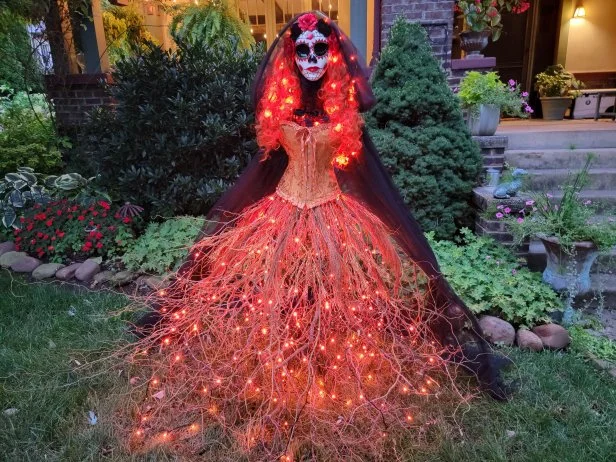
Most yards scatter decorations all over the place like someone opened a box and stuck things wherever there was space.
That’s not scary, that’s just cluttered.
When people pull up to your house, their eye lands somewhere first.
In most yards, it’s the front door.
If your front door is boring and most of your spooky stuff is scattered around the side or way back near the bushes, you’ve wasted your best real estate.
Walk out to the street at dusk and look at your own house. Where does your eye go naturally?
That’s your focal point, and that’s where your scariest element should be.
I decorated a yard where the homeowner had this beautiful old wooden garage door.
We made it the entire focal point, with a graveyard wrapping around the base and a looming zombie figure to one side.
From the street, you couldn’t look anywhere else.
It worked because it was intentional, not because the decorations were expensive. Every visitor felt that pull toward it.
To make your yard scary build one strong focal point, then support it with secondary elements.
Your focal point can be a figure, an installation, a lit window, or a carefully arranged scene.
Make it impossible to miss when someone first looks at the house.
Set things up early enough

If you put everything up at 2pm on Halloween, your decorations won’t have that settled, lived-in quality yet.
You know how something you just bought feels different from something that’s been yours for weeks?
Decorations are the same way. They need time to feel intentional instead of hastily assembled.
I start putting things up two to three weeks early.
This gives me time to fix what doesn’t work (and something always doesn’t work), to let outdoor elements weather-proof the setup, and for the whole scene to feel finished when the sun goes down on October 31st.
A day before Halloween is the absolute minimum, and you’ll be scrambling. Put up at least a week out.
This also means you have time to notice what looks wrong in daylight and tweak it before evening.
You might realize a zombie is facing the wrong direction, a tombstone placement blocks the path, or something is leaning that shouldn’t be.
Three weeks out, you have time to fix these things. Three hours out, you’re dealing with them while kids are already coming up your walkway.
Incorporate sound
Yards that nail the scary factor often have one element people overlook completely: sound.
Not full blast horror movie audio that neighbor Sam can hear two houses down, but something unexpected in the quiet moments.
A motion-activated sound effect (creaking door, whisper, chainsaw sound) makes people jump because their senses expect silence in a front yard.
I installed a sound effect in a tombstone in the front of a display once, and it went off at random intervals that visitors couldn’t predict.
The jumps came before people even saw anything. The anticipation of potential sound was even scarier than the decorations themselves.
Keep the volume at conversation level.
You want it to startle people, not punish them. The goal is that little jolt of adrenaline as they pass by, not a noise complaint from the street behind you.
Also, don’t overdo it.
Hide the zombie
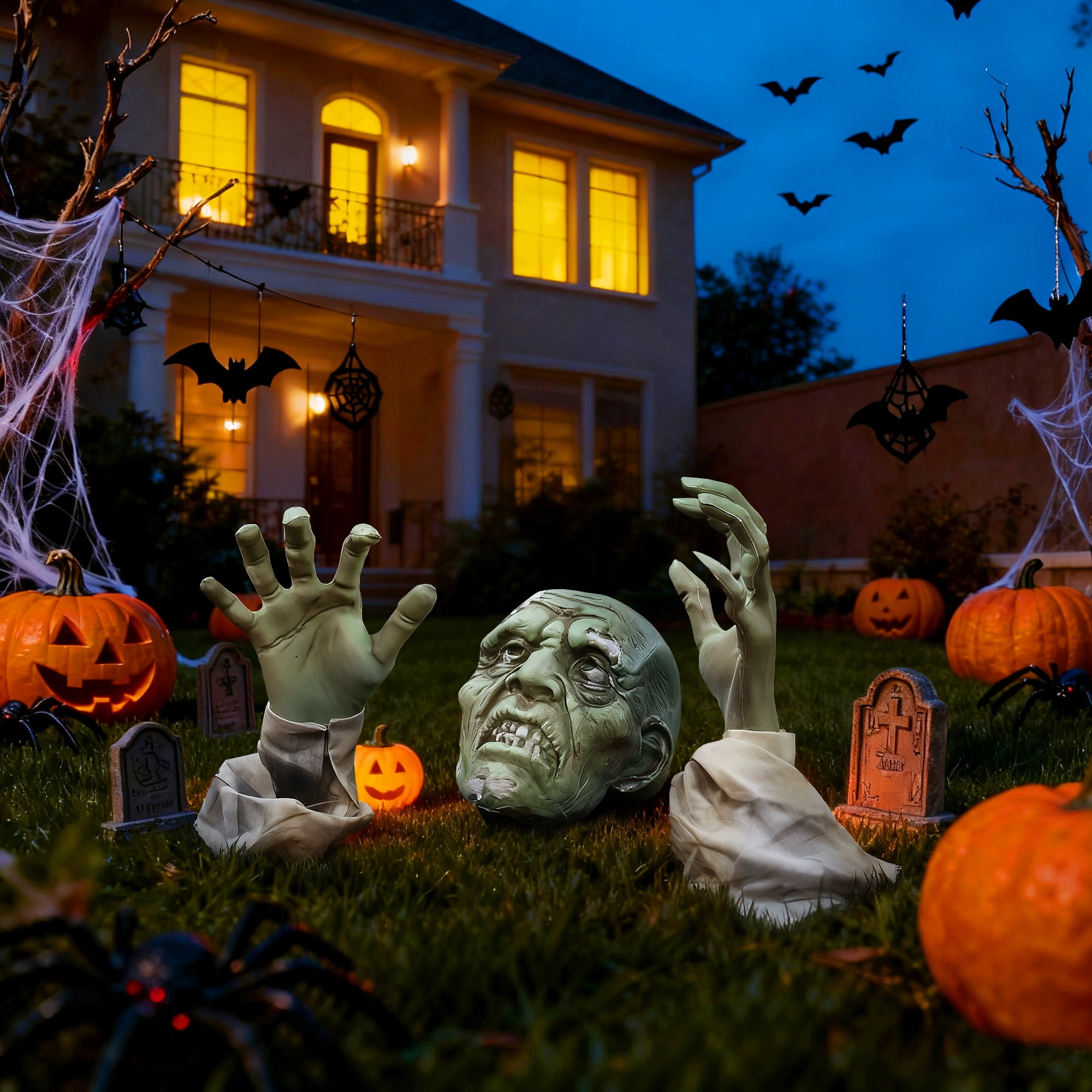
Where you put a zombie figure changes everything about how scary it actually is.
Facing the street? It’s decorative. Hidden partially behind something, only visible from certain angles? Now it’s unsettling.
I learned this after my second year of decorating when I realized I was placing figures in the dead center of displays, facing the walkway like they were welcoming people.
Offset the scary stuff. Tuck a figure partially behind a tree.
Position something so it’s visible from your driveway but not from the street.
The scariest moment is the moment of realization that something is there, not the moment of confronting it head-on.
The same goes for height variation. If all your figures are standing up at the same height, they register as props.
A zombie lying on the ground, one hanging from a branch, one standing at an angle feels more chaotic and purposeful, like something went wrong here.
Be logical with your graveyard

A pile of tombstones scattered across your yard looks unplanned and sad. A graveyard with intention looks like something you’re creating a story around.
Organize tombstones in rows or clusters like an actual cemetery.
Use different heights and angle some of them slightly.
Create a front section and a back section, with spacing that feels real.
This might sound overly fussy, but it’s the difference between looking like someone bought a bulk pack of tombstones and arranged them randomly, versus looking like you thought about this.
Visitors subconsciously notice that difference.
Add elements that suggest a narrative. This can be:
- Some graves slightly disturbed or dug up.
- A figure or skeleton sprawled across a tombstone.
- A path that winds through rather than cutting straight across.
These small decisions make people read the space as a planned scene instead of just decorations.
Make use of scent
Halloween yards almost entirely ignore smell, and that’s a missed sensory element.
The addition of fall scents (smoke, dry leaves, old cardboard) or anything slightly unpleasant creates unease without obvious visual explanation.
I used a subtle fog machine with vanilla scent added to one display, and people commented on the smell before they even got close.
You can also burn some leaves safely in a contained space visible from the yard, use dry ice effects, or add plant materials that smell of decay like straw or peat.
These scents are subtle enough to add to the experience without being overwhelming.
Don’t use artificial “spooky” scents if you can help it. Cheap plastic smell doesn’t read as scary, it reads as chemical. A
Excellent scents to go for include: woodsmoke, damp earth, and the smell of old damp basement.
These smells feel more genuinely unsettling because they’re natural references our brain actually registers as potentially uncomfortable.
Use quality elements
There’s a difference between budget-conscious decorating and letting it show. A $15 skeleton from the store looks fine.
A $15 skeleton from 2003 that’s been sun-faded to baby pink and is missing its jaw looks pathetic.
I maintain a brutal inventory every year.
If a decoration is faded, cracked, bent in a weird way, or just looks worn out, it gets retired or restored.
One damaged element cheapens the whole display because visitors see it first.
A few high-quality decorations create an impression of intentionality. Many cheap, beat-up decorations read as “I grabbed what was on sale.”
You don’t need to spend a lot of money, but what you do put out should be in decent condition.
If it looks damaged outdoors, it looks like you don’t care about the effect you’re creating. And if you don’t care, why should they?
Get rid of your kid’s toys
If there’s a bike leaning against the fence, a basketball hoop visible in the corner, or a sandbox in the middle of your spooky display, you’ve told your visitors that real life is happening here.
That breaks the mood completely.
Clear the entire yard of anything that signals everyday life.
Bikes go in the garage. Move the sports equipment. Put away the toys. Lock the garden tools.
The moment someone sees something that belongs to normal, boring daylight, they’re thinking about daylight, not about your scary display.
Have a clear path

People need to move through your yard.
A path that seems obvious to you (because you own the house) might be unclear to someone seeing it for the first time in low light.
I watched a display that was incredibly designed but put the focal zombie in the center of the most direct walking path, which meant people had to decide to step around it or get uncomfortably close.
Some walked far around it, some walked right at it, and either way the approach felt awkward.
Create a clear path for people to walk. Use lighting or positioning to guide them. The scariness should complement the path, not obstruct it.
Also consider sight lines from the street.
If your driveway or the path to your door is blocked by decorations, people can’t see where they’re supposed to go.
The best yards guide you almost subconsciously toward the focal point and then toward the door.
Tell a Story
This is the difference between scary and memorable. A collection of scary decorations is interesting.
A display where you can sense a story or theme is something people will talk about for a long time.
It doesn’t have to be literal or complex.
A graveyard where some graves are disturbed and bodies are scattered around tells a story.
A yard where everything is themed around a specific monster or scene tells a story. A path that winds past increasingly disturbing elements tells a story.
I decorated one yard entirely around the theme of a haunted scientist’s lab that exploded.
Nothing matched, but everything felt connected to that narrative.
People remembered it not because individual decorations were incredible, but because the whole thing made sense together.
Create a simple story or theme for your yard.
Let it guide where everything goes and how it’s arranged.
Your guests will feel the coherence, even if they can’t articulate exactly what they’re sensing.
Parting shot
Your Halloween yard is a performance, and you’re the director. Every element should serve your overall vision, nothing should clash or undermine something else, and the whole thing should feel like you thought about it.
Start early.
Use light to hide, not reveal.
Guide people’s eyes and feet. Take out the everyday stuff. Polish what you’re keeping.
Test it at night before Halloween. And don’t overcomplicate it.
The scariest displays I’ve seen aren’t complicated, they’re just done well and done on purpose.
Related Posts: