
Halloween Yard Ideas: 17 Spooky Ways to Turn Your Yard into a Showstopper
Last Updated on August 31, 2026 by Duncan
A great Halloween yard does not need to look like a movie set.
It needs a clear idea, a few strong focal points, and enough atmosphere that people slow down when they reach your driveway.
After working on hundreds of Halloween yard decorations, I have seen both extremes.
Some yards have one creepy scene that looks fantastic from the street, while others have 40 decorations fighting for attention like they are all trying to win the same argument.
The difference usually comes down to planning.
You want your yard to tell a story. Maybe a witch has taken over the garden, zombies have escaped from the cemetery, or something sinister is lurking behind the trees.
To help you out, here are the Halloween yard ideas I recommend when you want your outdoor decorations to look intentional, creepy, and memorable.
Build a witch’s garden
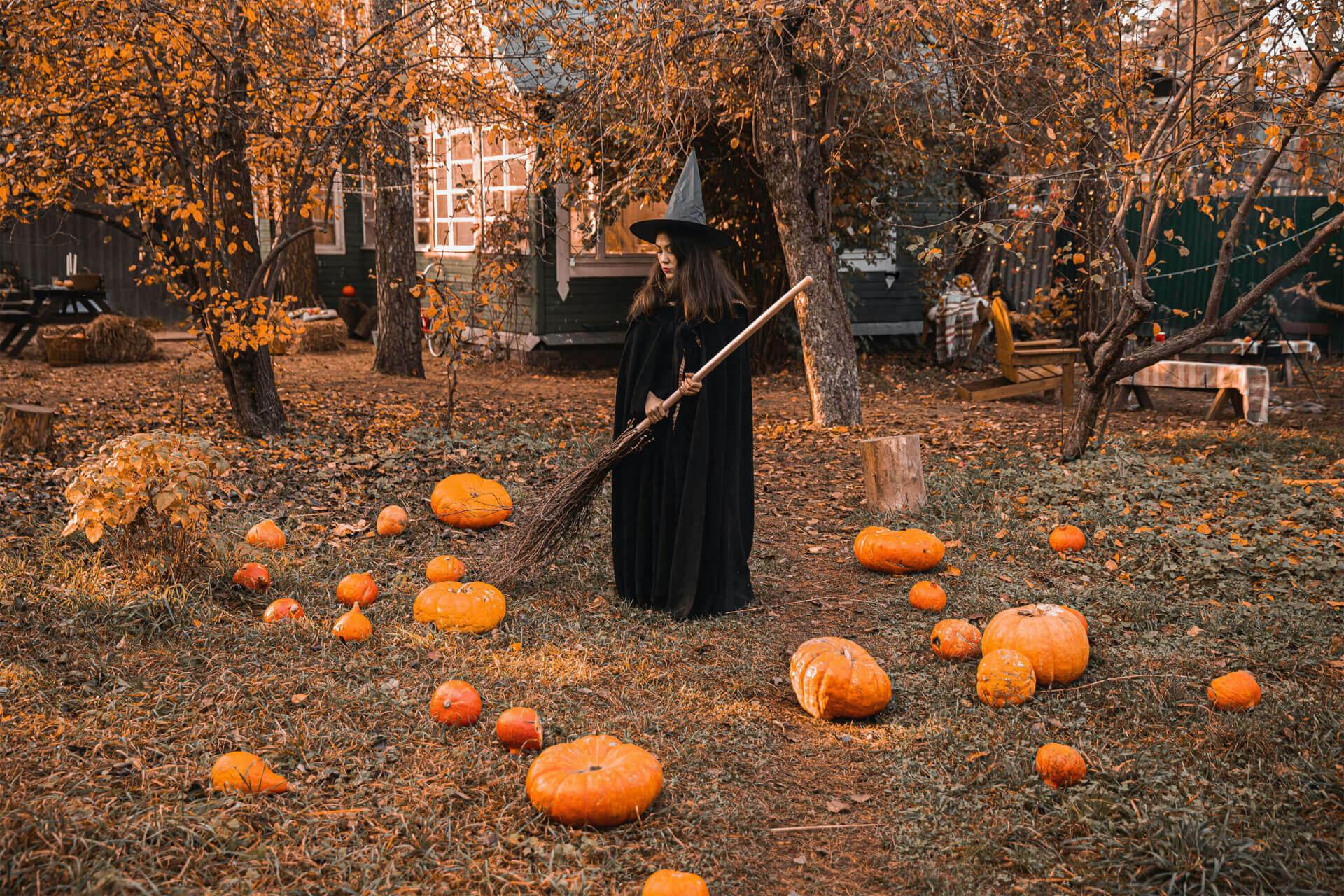
A witch’s garden isn’t just a cauldron with some cobwebs. It’s a space that feels like someone actively practices magic there.
A cauldron sits on a stand with bottles of “potions” around it, maybe a spell book propped open nearby, dried herbs hanging from a low branch if you have one.
A broom leaning against the cauldron or a witch hat on a stake makes it read as active rather than just decorative.
The key is treating it like a functional space, not a storage area.
Light is everything here. A single amber or green light directed at the cauldron makes it mysterious.
Bottles backlit so their contents glow turn them from props into props that feel dangerous.
A shadow cast across the ground behind the cauldron makes it look like something just happened there.
Without light, your witch’s garden is just stuff in your yard.
The mistake I see is people placing everything at the same height and distance from the viewer.
Your bottles should be at different depths, different heights.
The cauldron should be the centerpiece with things arranged around it, not just scattered in a cluster.
Think of it as a shelf that someone put in the work and organized, not a garage sale display.
Turn your front walkway into a haunted path
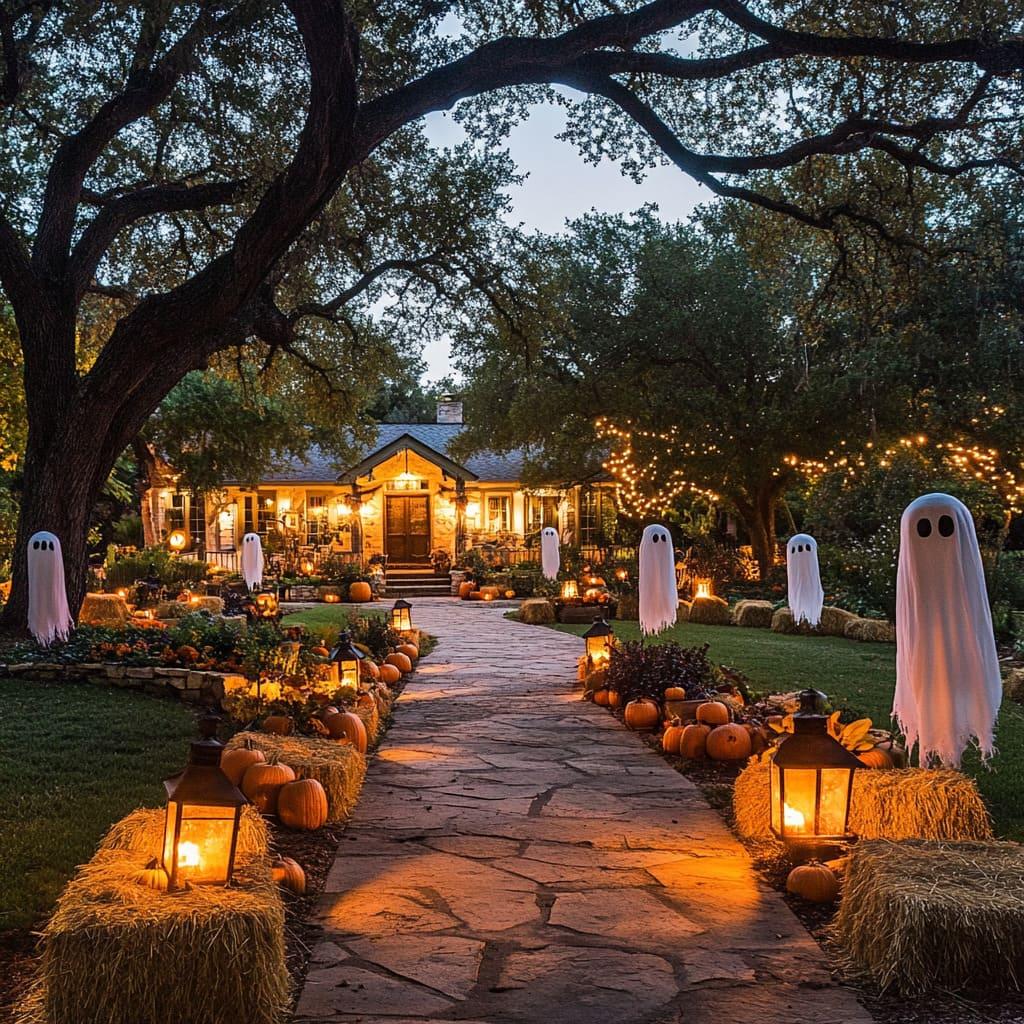
Your front walkway is a guided experience, and most people waste it by leaving it neutral and putting all the decoration at the destination. This is wrong.
The walkway itself is your strongest tool for creating progression and anticipation.
I’ve watched people completely transform their arrival experience just by using that path intentionally.
Start subtle and escalate.
The first thing someone notices as they enter your property should be slightly creepy but not overwhelming, maybe some lights or a fallen decorative element.
Midway through the path, things get weirder.
By the time they reach your door, they’re fully in your world. This progression is what creates atmosphere instead of just surprise.
Lighting along the path guides people both physically and emotionally. Lights on stakes create a pathway while also making the space feel theatrical.
Shadows from overhead create atmosphere without being harsh. A light pointing backward toward the entry creates a sense of returning somewhere dangerous.
Your walkway becomes a tunnel through your world instead of just concrete to your door.
You should avoid making the path too narrow or too cluttered so people feel trapped rather than guided.
Your path should feel intentionally eerie, not like you created a liability.
People should be able to walk it without worrying they’ll trip, even though they’re paying attention to the creepy stuff around them.
Create a mini halloween cemetery
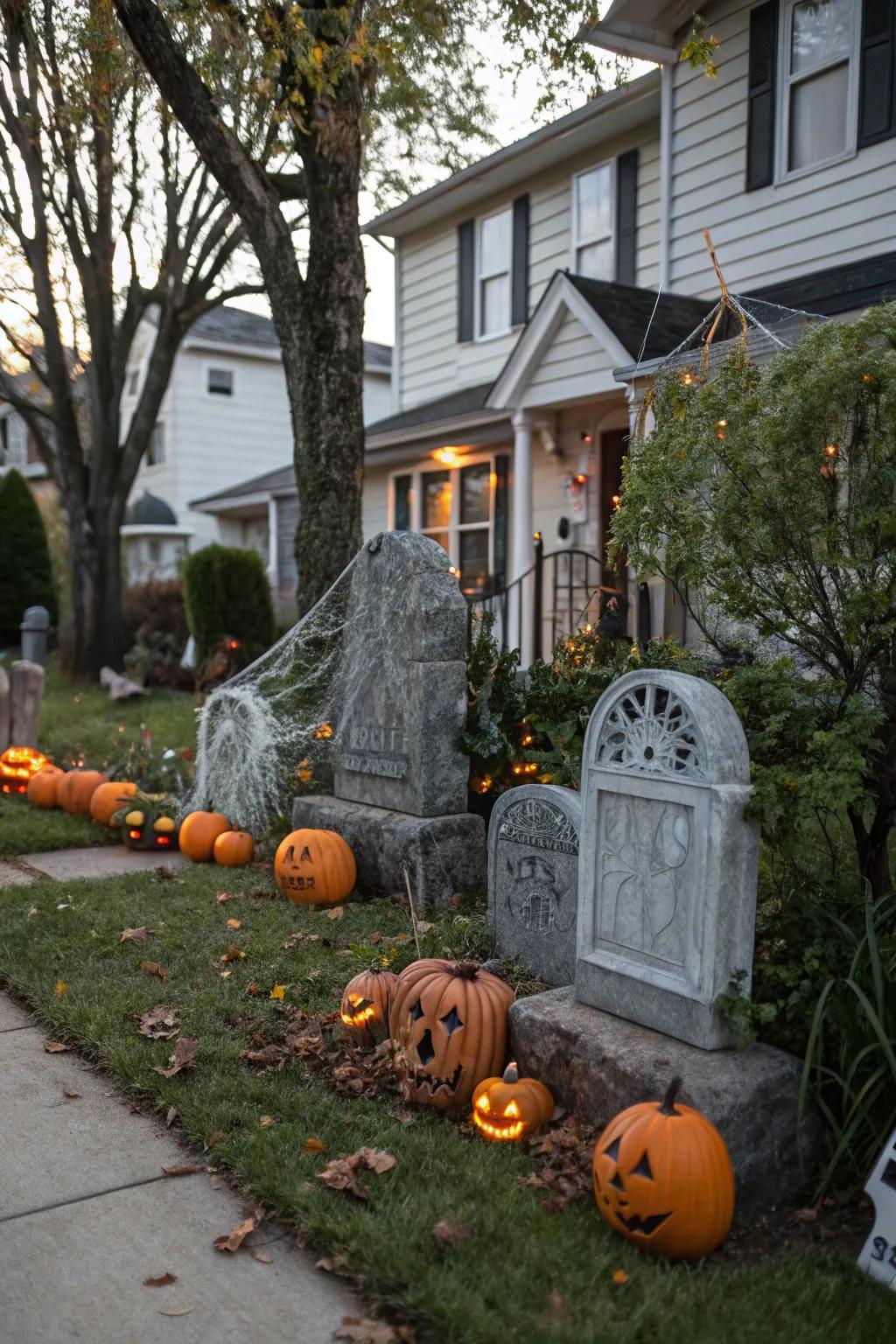
A cemetery only works if it reads as intentional rather than random.
I’ve been to yards with dozens of tombstones that still felt empty because they were just scattered, and yards with six stones that felt deeply atmospheric because they were composed.
Scale and arrangement matter more than quantity.
Grouping is your friend here. Instead of spreading stones evenly across your lawn, cluster them in sections.
Three stones close together, a gap, then two more, another gap, then a single prominent stone.
This creates focal points and visual rhythm instead of visual static.
People’s eyes move around your display instead of glazing over it because there’s something to follow.
Vary your tombstone sizes and styles within reason.
Giant monuments next to small graves next to weathered crosses create believability. All matching tombstones look like inventory.
Mix materials if you can, or at minimum mix heights. A few lying down at odd angles instead of all standing reads as real decay rather than decoration.
Light a cemetery from the side, not from above or directly in front.
A light hitting tombstones from the side creates shadow and definition that makes them look three-dimensional and ominous.
Headlights pointing straight down flatten everything into silhouettes.
Hang ghosts from your trees
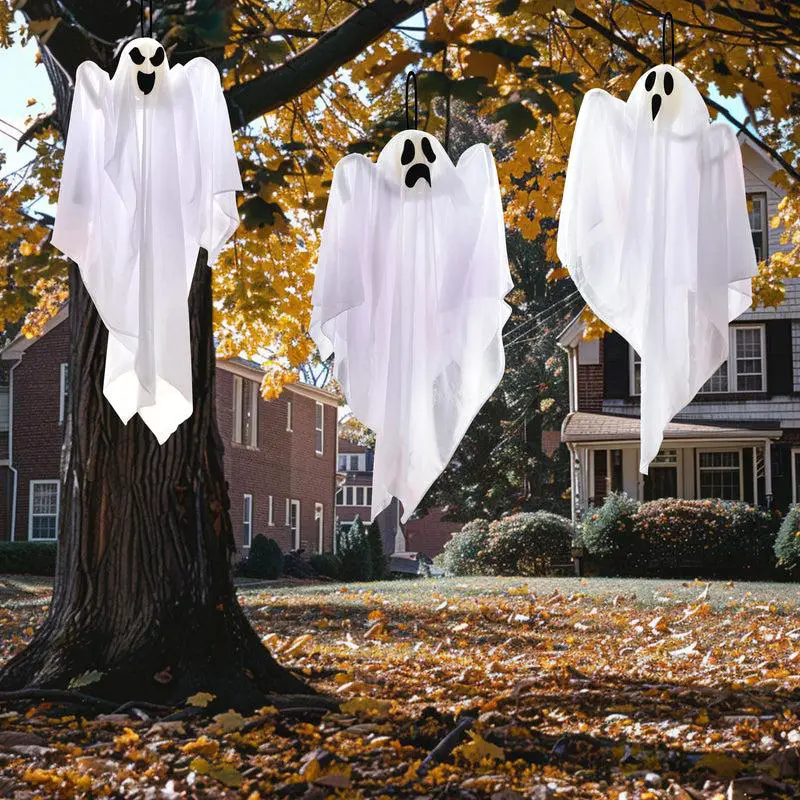
Ghosts hanging from branches aren’t novelty, they’re strategic use of your yard’s architecture.
I’ve seen yards where hung ghosts became the focal point of the entire property without being the most expensive element.
Height and movement matter more than quantity. A single ghost hanging at eye level from a strong branch is more effective than five ghosts clustered together.
A ghost that spins slightly in the breeze is more interesting than one that just hangs. The movement creates life, and the height makes it unavoidable.
Make sure your ghost has structure so it holds that movement. A cheap plastic sheet ghost collapses and hangs limp.
A ghost with something inside it (a wire frame, styrofoam head, or even newspaper stuffed inside) maintains its shape and looks intentional.
It should look like something is actually hanging there, not like you threw fabric on a branch.
The positioning matters for the whole yard.
Ghosts hanging at different heights and different branches create depth and draw your eye through the tree.
Ghosts all at the same level, all the same size, all equally spaced reads as decorating with a ruler instead of with intention.
Space them at least six feet apart so each one has presence.
Make a giant spider take over the house
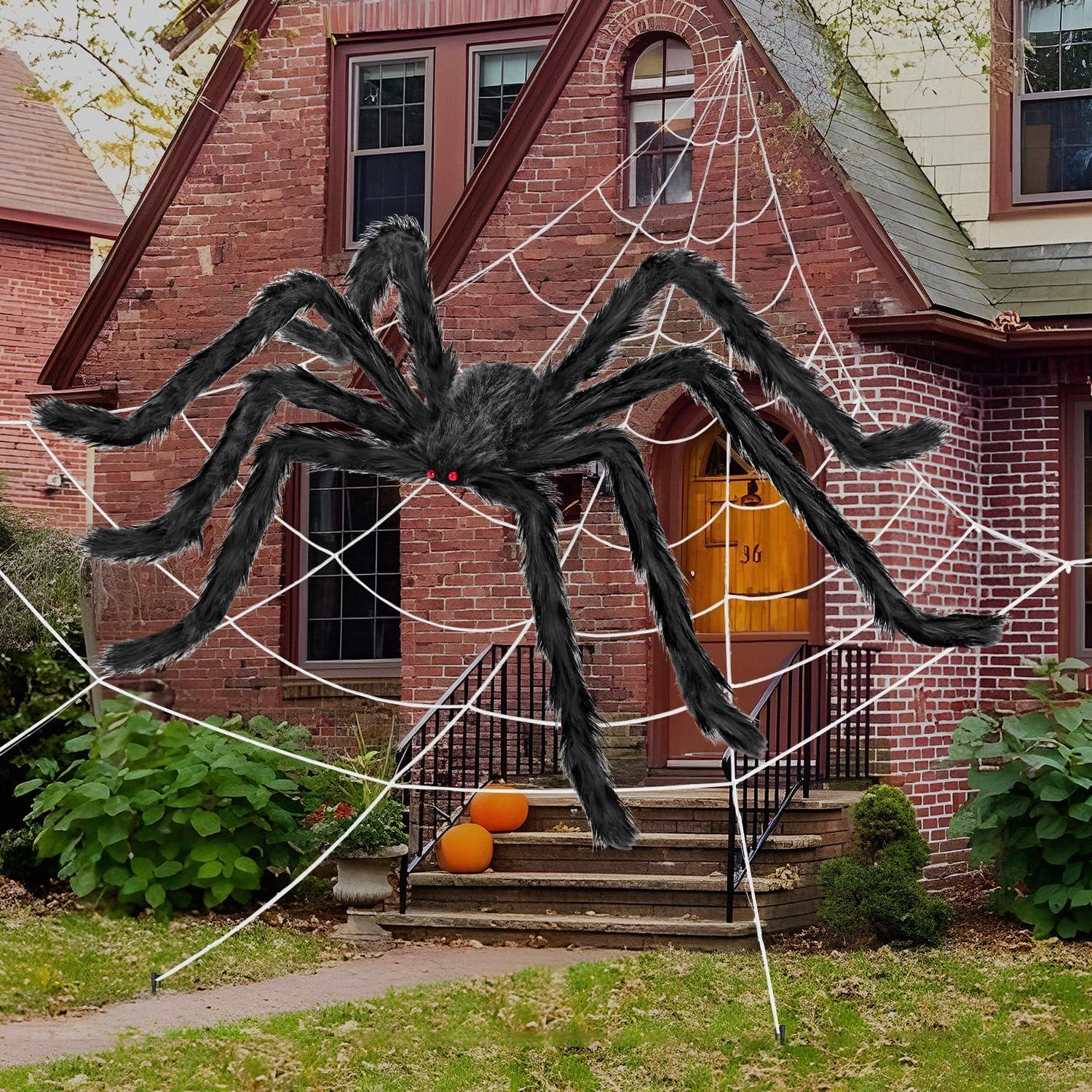
A giant spider works because it’s simultaneously impossible and totally reasonable to your brain, and that cognitive dissonance is what makes it memorable.
I’ve watched single giant spiders become the thing people remember about entire neighborhoods.
They work because they’re simple, unmissable, and inherently unsettling.
Scale is the entire point.
Your spider needs to be genuinely large, at least six feet across if possible, bigger if your house can accommodate it.
A small spider disappears into your roofline and becomes invisible.
A giant spider dominates your architectural space and becomes unavoidable. Think about it like visual judo: you’re using your house’s size against itself.
Position it where it’s impossible to miss, usually crawling up toward the roof line or perched on a corner where it dominates the sight line from the street.
A spider tucked into a corner of your porch is cute.
A spider that appears to be climbing your roof is the thing that makes people stop their car.
Visibility determines impact here.
Legs matter. Spiders with thin, articulated legs (wire or flexible plastic) create an unsettling look because they can bend and move.
Stiff legs look more prop-like.
Add movement if you can by making the legs sway slightly or having sections that can blow in wind.
Create a zombie graveyard
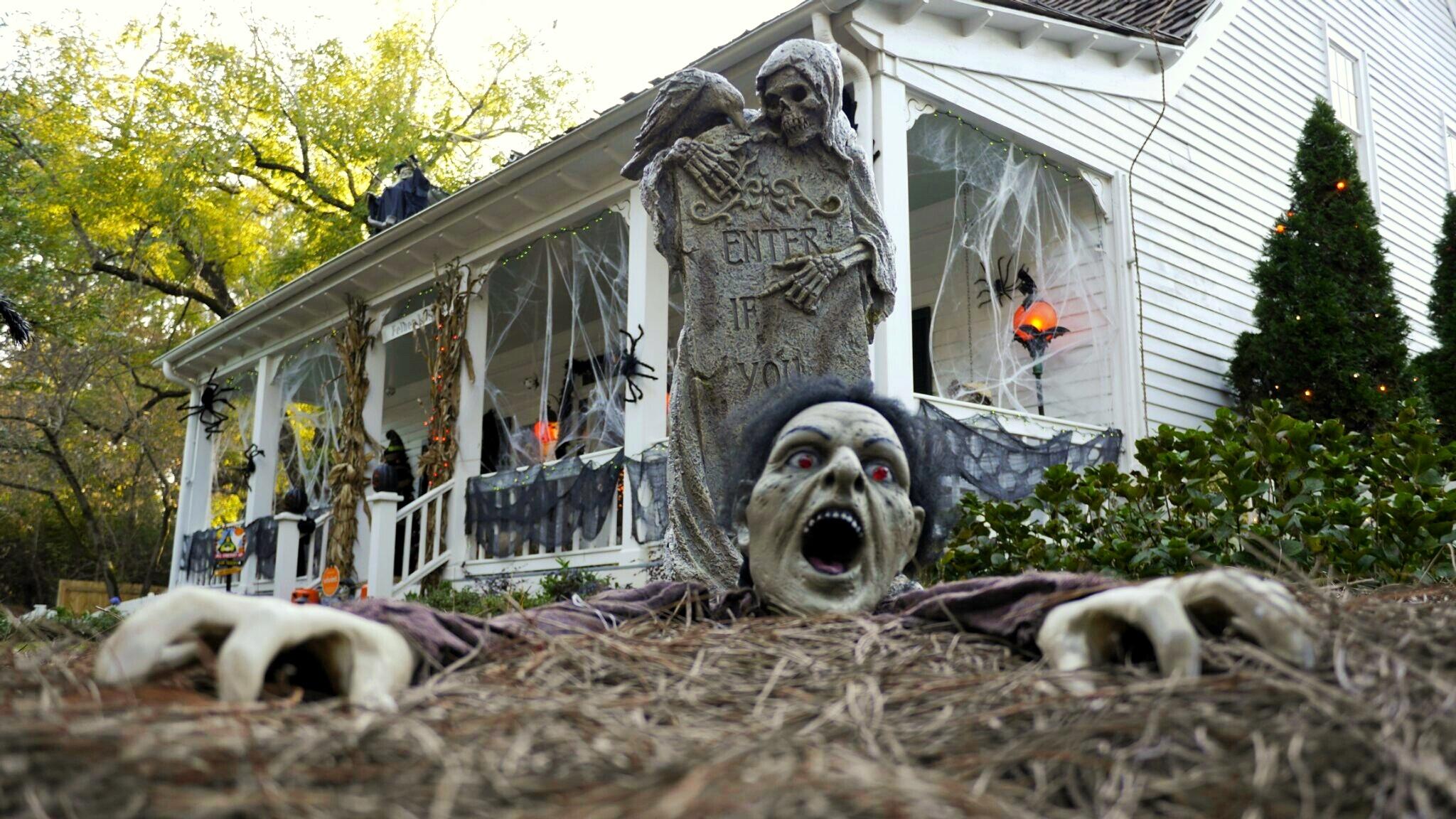
In a zombie graveyard bodies are there, but not in graves, not at rest.
This theme only works if you commit to the narrative, otherwise it’s just a cemetery with weird props scattered around it.
I’ve seen zombie graveyards that were genuinely halloweeny and ones that just looked like someone had too many props lying on the ground.
The key is showing the aftermath of disturbance.
Graves that are open, tombstones knocked over, soil disturbed, bodies positioned as if they’ve crawled out or are in the middle of emerging.
This tells a story.
A regular cemetery with zombie props just standing around tells no story.
Bodies need positions.
A zombie lying face-down reaching toward the camera is exponentially more effective than a zombie standing upright.
One crawling out of the ground, one half-emerged, one rising to walk, these positions create progression and narrative.
You’re not just displaying props, you’re showing an event that happened.
Use pumpkins as a pathway
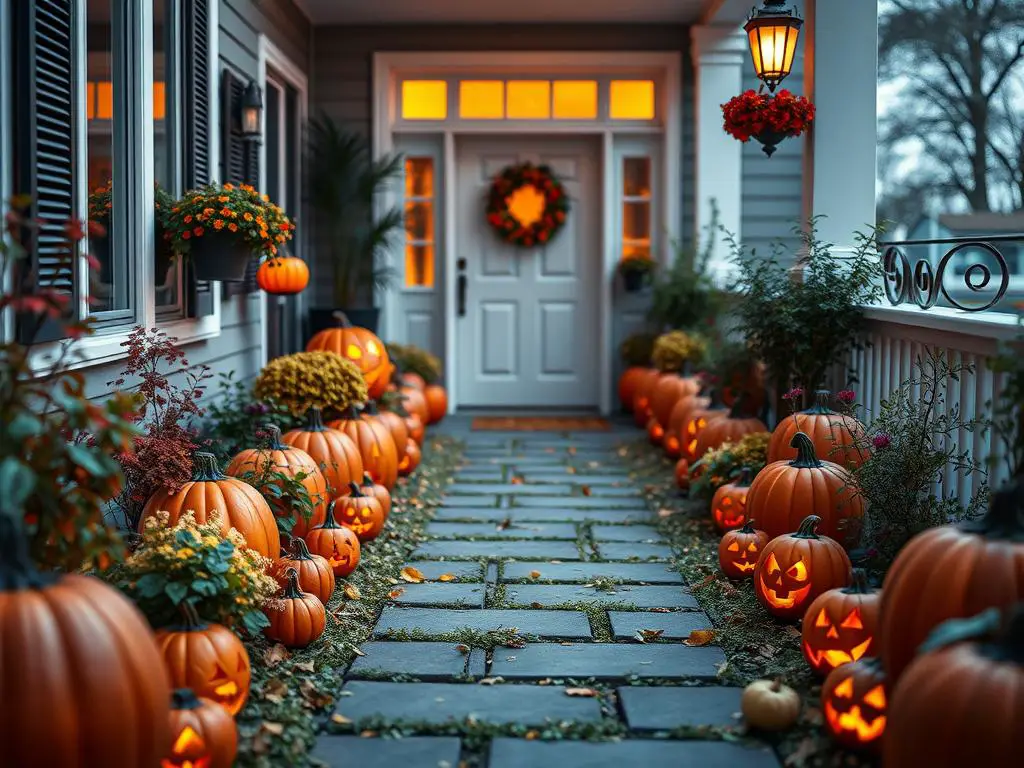
Pumpkins create a functional and beautiful pathway if you treat them as design elements rather than just clustering them randomly.
I’ve watched pumpkins guide people’s eyes and feet through a yard simultaneously, which is powerful because it serves two purposes.
They look good and they work.
Size variation creates visual interest and guides traffic.
Large pumpkins at transitions point people to turn or move forward.
Medium pumpkins create continuation.
Small pumpkins fill gaps and create rhythm.
All the same size, all the same distance apart reads as arranged by measurement rather than with intention.
Color palette matters for impact.
Orange pumpkins on green grass is nice but expected.
Orange and white creates more definition. Orange and green and purple creates visual complexity that’s more interesting.
Mixing pumpkin varieties if you have them (round, tall, ribbed, smooth) creates texture even without color variation.
Light them if you can, even just with a small light placed on or behind a pumpkin at intervals.
An unlit pumpkin pathway works in daylight and early evening but disappears at dark. Lit pumpkins maintain their function and create the halloween atmosphere as the night progresses.
You don’t need to light every pumpkin, just enough to guide the view.
Create a haunted pumpkin patch
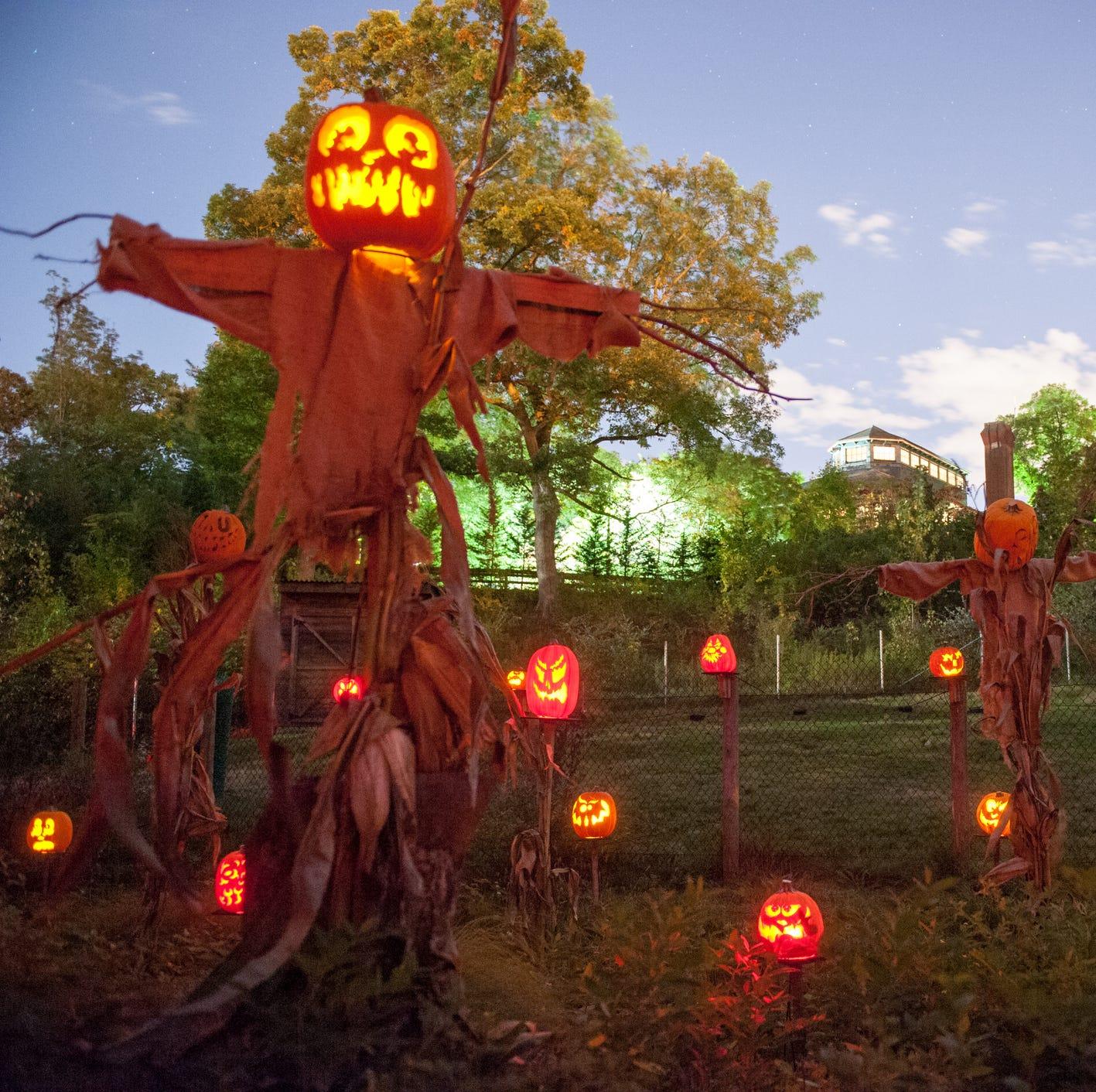
Most people just throw scary things around regular pumpkins and call it haunted, which misses the actual tension you’re creating.
Make the pumpkins themselves unsettling through modification and positioning.
The surrounding space should feel abandoned and wrong.
Hay scattered unevenly, dead vines, decay, things breaking through soil.
A haunted pumpkin patch isn’t just a pumpkin display with fog, it’s a space that has been disturbed and left to rot.
The pumpkins are the victims or the perpetrators, not just decoration.
Lighting here should feel industrial or harsh rather than warm.
Regular pumpkin patch lighting is warm and welcoming.
A haunted patch feels lit by something sinister, cool purple light, sharp shadows, light that emphasizes the wrong elements.
A pumpkin lit from below is more unsettling than one lit from above.
Turn your porch into a haunted entrance
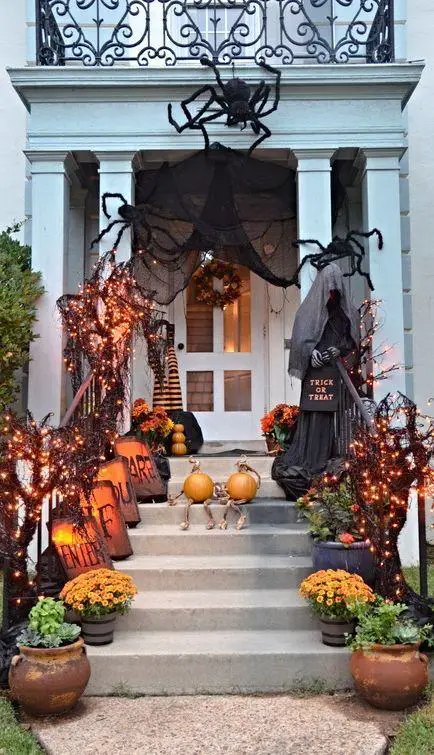
Your porch is your first impression moment, and it’s where people slow down to engage with your yard.
Most homeowners treat their porch as separate from their yard display, which is a missed opportunity.
Your porch should feel like you’re crossing a threshold into a different world.
Make the entry feel dangerous or strange. Something looming above the doorway, something reaching from the sides, light that’s colored rather than normal, sound if you’re using it.
Your porch should make people slightly hesitant before entering, even if they’re just coming for candy.
That hesitation is the entire point.
Depth is critical because your porch has limited space.
Instead of spreading things wide, stack them vertically. Something above, something at head height, something at ground level.
This creates layers in a small space.
Your eye travels up and down instead of just side to side, which makes the space feel more complex than it is.
The door itself should be incorporated into the display, not ignored.
A door that’s partially open with something visible through the crack, a wreath that’s wrong in some way, a threshold that’s marked with a symbol or sign.
Your door becomes part of the story instead of just the place people go to get candy.
Make a skeleton scene
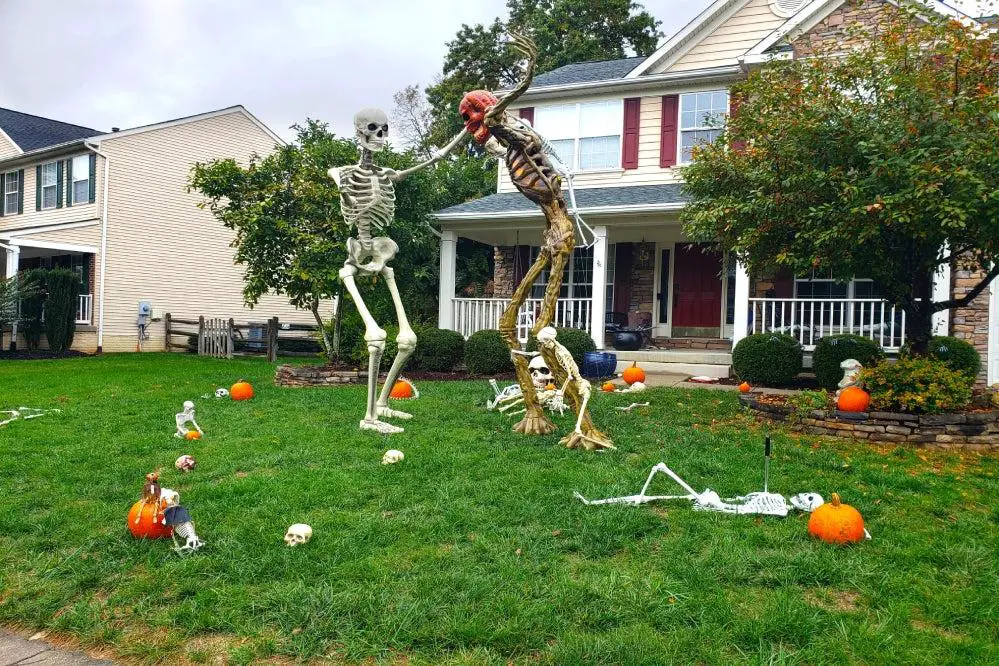
A skeleton scene is a skeleton doing something, not just standing there.
Skeletons just standing are props.
Skeletons positioned as if they’re experiencing something become narrative.
I’ve watched yards where a skeleton sitting in a chair became the entire emotional center of the display because it told a story.
Positioning is everything.
A skeleton reaching for something, a skeleton lying down as if it’s fallen, a skeleton on a bench as if it’s waiting, multiple skeletons in an interaction (one reaching toward another, one appearing to attack another).
This is storytelling with no words. Your viewer’s brain creates the narrative.
Supporting props around the skeleton make the scene coherent.
A skeleton sitting on a bench needs something around it that explains why it’s there.
A skeleton reaching needs a target. A skeleton lying down needs a reason for the position.
These supporting elements turn an isolated prop into a scene.
Light the skeleton in a way that emphasizes the narrative position.
A skeleton reaching should be lit so you see the reaching posture clearly.
A skeleton sitting should be lit to show its position relative to its surroundings.
Harsh overhead light flattens the scene.
Side or angled light creates drama and emphasis.
Add a graveyard fence
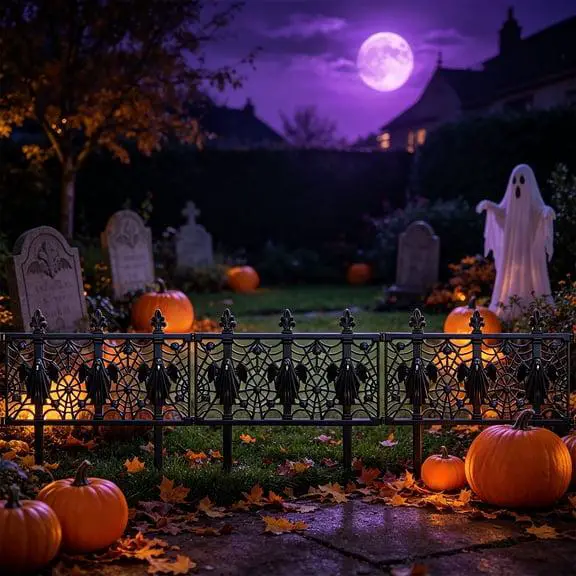
A fence around your cemetery or graveyard serves a dual purpose: it creates a boundary that says “this space is different” and it gives you a structure to build around.
Fences are underused in Halloween displays because people think they’re optional.
They’re not, they create containment and definition.
The fence doesn’t need to be elaborate.
A simple rail fence or even a low fence made from PVC or wood creates the boundary.
The point isn’t to stop people, it’s to say “this space is marked as special.”
A cemetery without a fence is just tombstones on a lawn. A cemetery inside a fence is an actual space.
Decorate the fence itself.
Vines and flowers if you want spooky growth, lights strung along it, signs attached to it.
A bare fence is just a barrier.
A decorated fence is part of the display.
I’ve seen simple rail fences completely transformed just by wrapping them with cloth that looks like burial shrouds.
Gate placement matters psychologically.
A gate implies entry and exit, which creates the sense of crossing into a different space.
Open gates feel welcoming and ominous simultaneously.
A fence without a gate feels like a barrier, which is different but less dramatic.
Use fog around the ground
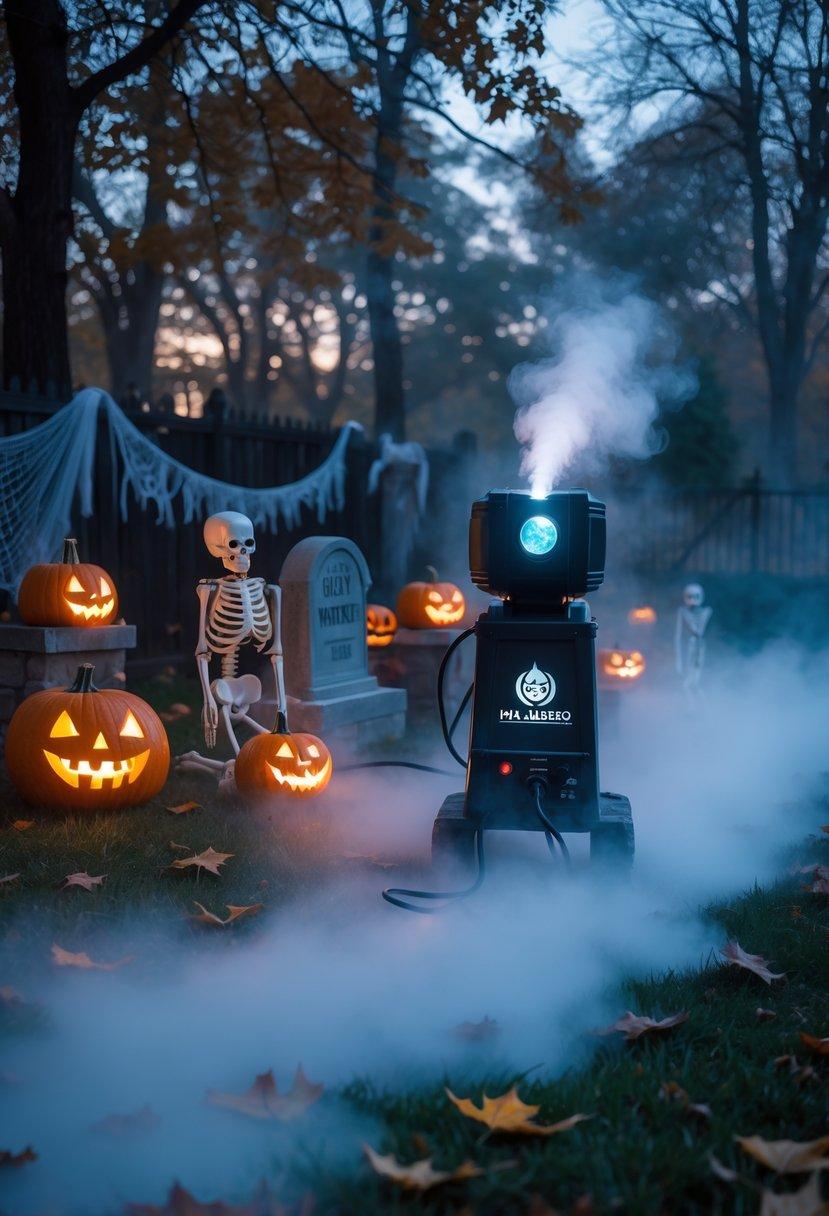
Fog is atmospheric magic, but it’s also a technical challenge that most people underestimate.
I’ve watched expensive fog machines create disappointing results because people didn’t understand how fog works in their specific yard.
Fog doesn’t behave the way most people expect.
Fog settles and moves based on temperature, wind, and drainage.
In some yards it stays perfectly at ground level creating an eerie effect.
In other yards it dissipates in seconds or blows away entirely.
Your yard’s temperature, drainage, and wind patterns determine whether fog works. You might need to test this before committing budget to it.
Having a fog machine at the edge of your yard allows fog to move across and settle naturally.
A machine in the center sends fog everywhere equally.
A machine behind your display creates fog that rises and covers, giving a curtain effect.
Placement determines the effect. Most people just plug it in and hope. Don’t do this.
Timing matters. Fog works best when temperatures are dropping, which is why it’s more effective late evening than early.
It also looks better when it’s lit, an unlit fog bank is just mist.
A fog bank with light underneath creates an otherworldly glow.
A fog bank with light from behind creates silhouettes. The light matters as much as the fog.
Make your decorations look abandoned
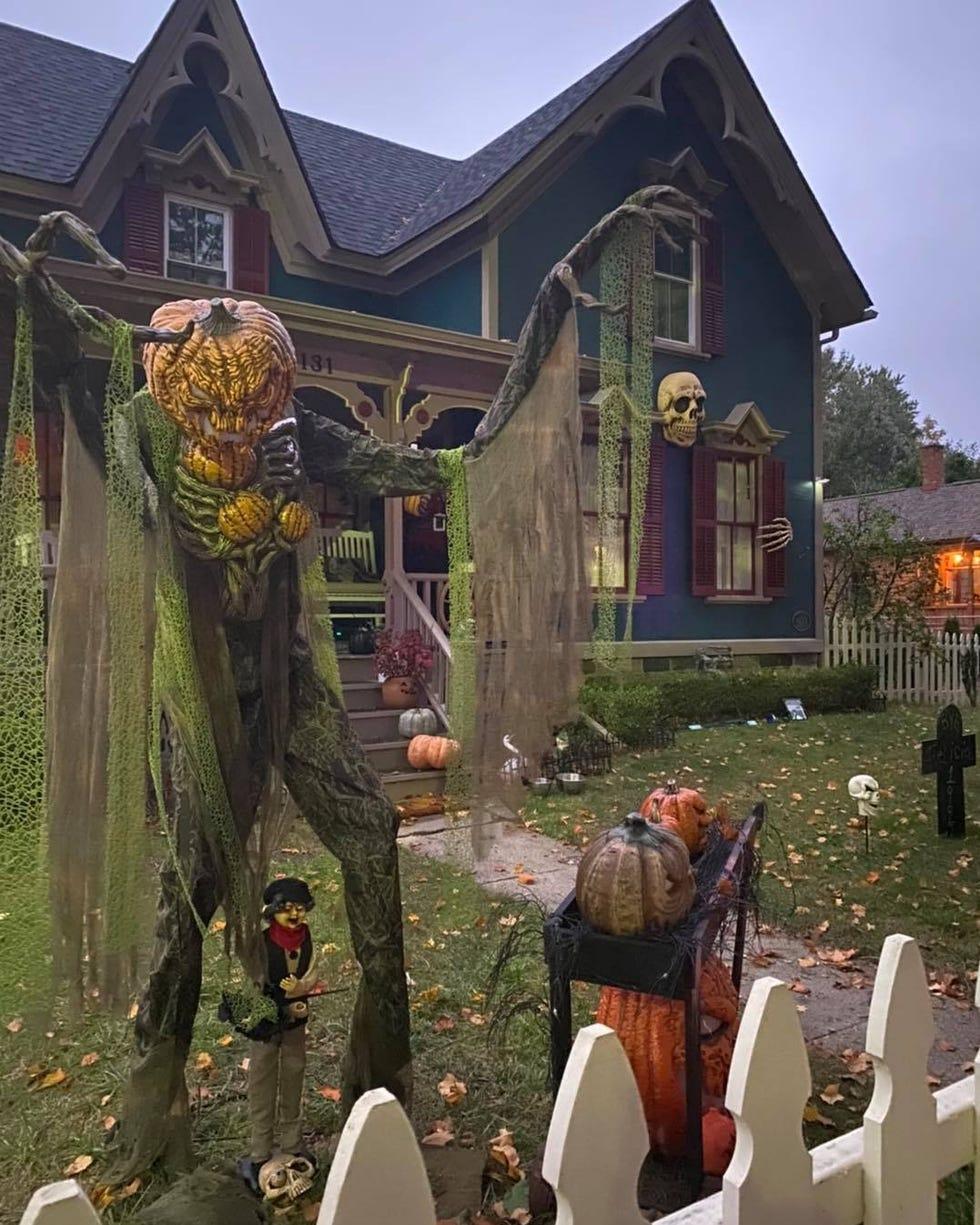
There’s a difference between “decorated for Halloween” and “this place has been abandoned to the darkness.”
The second is unsettling in the right way.
Most decorations read as new and intentional because they’re obviously placed and maintained.
Abandoned decorations look like something happened and nobody came back to fix it.
Weathering and distress age things instantly.
A brand-new prop looks like a new prop, which breaks the illusion.
A weathered prop looks like it’s been through something, which creates story.
This is where staining, fading, and strategic damage become part of your design, not a failure of your display.
Positioning creates abandonment too.
Decorations arranged with precision look maintained. Decorations that are askew, partially fallen, or in unexpected positions look neglected.
A tombstone knocked over looks more real than one perfectly upright. A hanging ghost at an odd angle looks more ominous than one hanging straight.
Decay in your yard itself adds to the abandonment feel.
Dead grass, leaves scattered rather than raked, vines and overgrowth, untended areas.
This contrasts with maintained yards and creates visual authenticity.
Your Halloween space shouldn’t look like you spent all day organizing it.
It should look like something took over and you haven’t reclaimed it.
Create a giant eyeball display
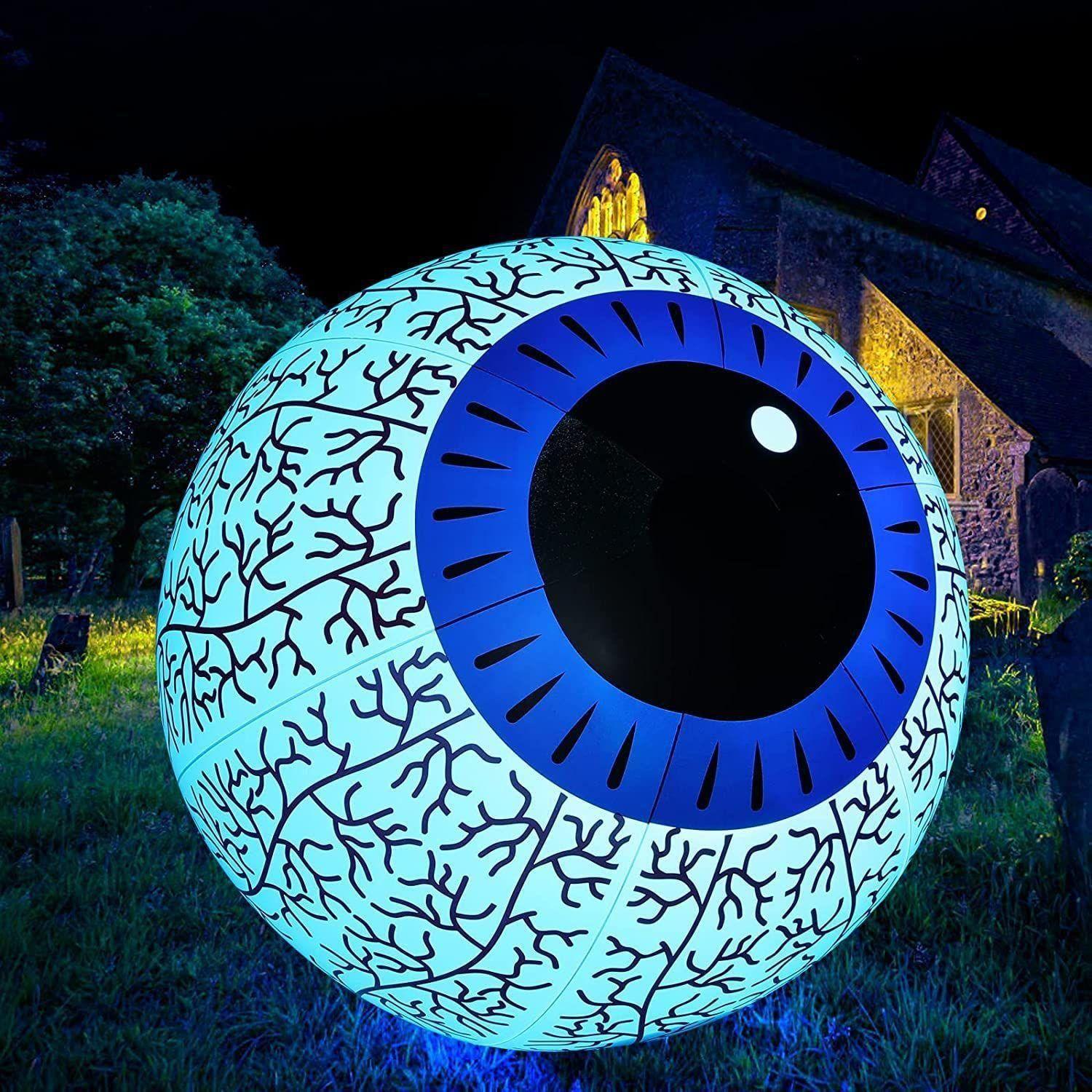
A giant eyeball is a focal point that you can build around, and it’s inherently unnerving because human brains respond to eyes.
I’ve watched a single giant eyeball become the most memorable element of a house display because it’s simple, unmissable, and deeply unsettling in a way that’s hard to articulate.
When putting up the eyeball remember that scale matters.
A small eyeball gets ignored.
A genuinely large eyeball (two feet or more across) dominates whatever surface it’s on.
A porch, a fence, a side of the house, a large eyeball looks like something is watching rather than like decoration.
The size forces your attention.
Realism creates impact.
An eyeball with realistic bloodshot veins, a realistically sized iris, realistic eyelids is more unsettling than a cartoonish eye.
Your brain recognizes it as anatomically correct but contextually wrong, and that wrongness is what creates the feeling.
An eye that looks obviously fake is less effective.
Lighting can make an eyeball haunting or just visible. A light that makes the eye actually glow creates the sense of watching.
Positioning it so it appears to be looking at something creates narrative. An eye looking toward your entrance creates the sense of judgment.
An eye looking down creates the sense of something looming.
An eye looking directly out at the street creates the sense of surveillance.
In short, where the eye looks determines how people emotionally receive it. So, be strategic about it.
Use silhouettes against your windows
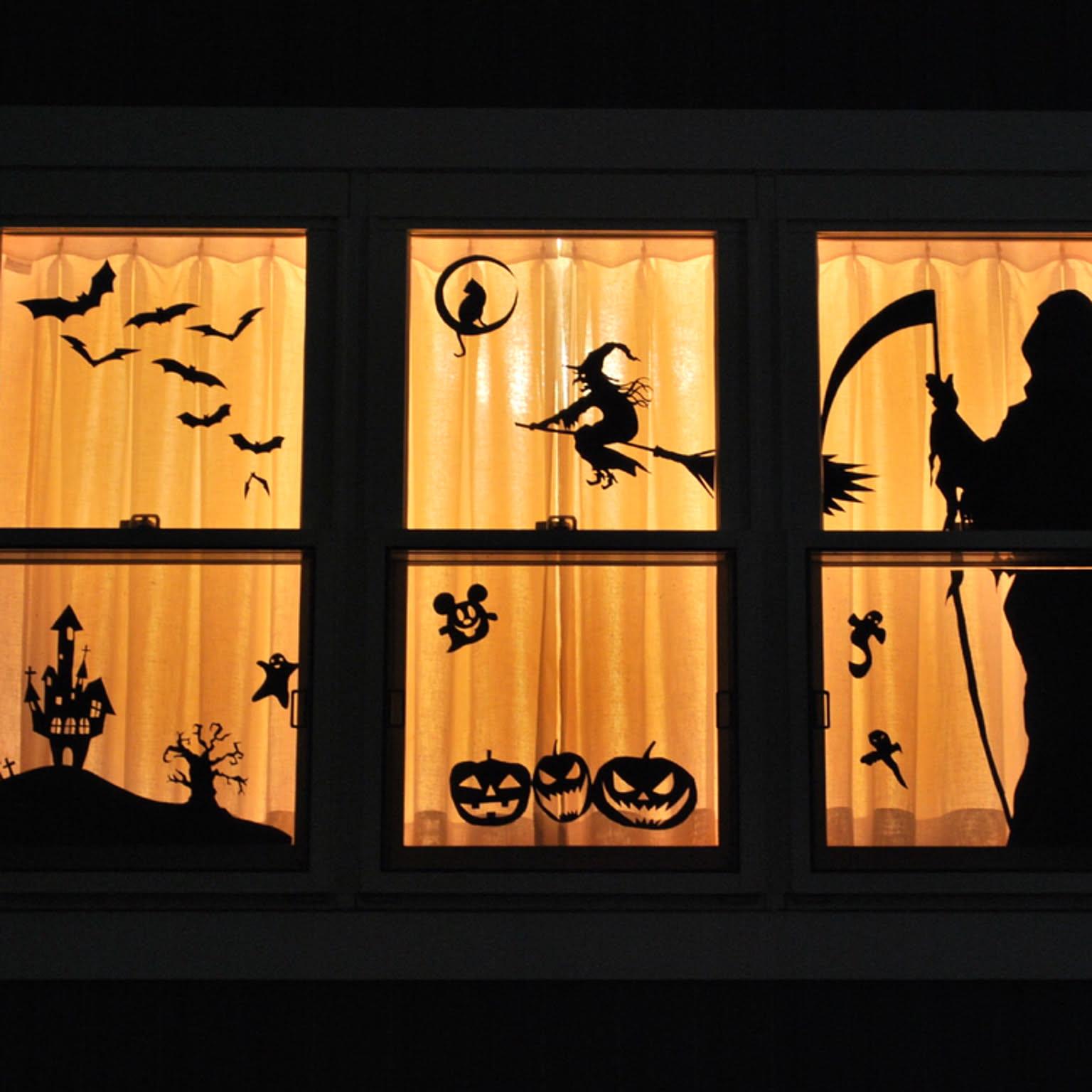
Silhouettes are simple, dramatic, and cheap, which makes them one of my favorite underused decorations.
A person can see your window display from the street at night, and silhouettes against backlit windows create theater without requiring physical props outside.
Here you’re using your house’s interior as part of your display.
Size and clarity matter. A silhouette needs to be distinct enough to read from a distance.
A generic human shape is boring.
A silhouette that’s doing something (reaching, bending, pointing) creates narrative. Multiple silhouettes in different positions create movement and story.
Lighting from inside the window makes silhouettes work.
If your interior light is even slightly bright, the silhouette reads.
Unlit windows with a silhouette against them just look like shadows. You need interior light behind the silhouette to create the effect.
You can create silhouettes with cardboard, cloth, or even carefully positioned people or props.
You can cut shapes and tape them to the glass, or hang shapes in front of the window.
The point is that the window becomes a screen for a story rather than just glass. Your interior becomes part of your display.
Turn your mailbox into a halloween prop
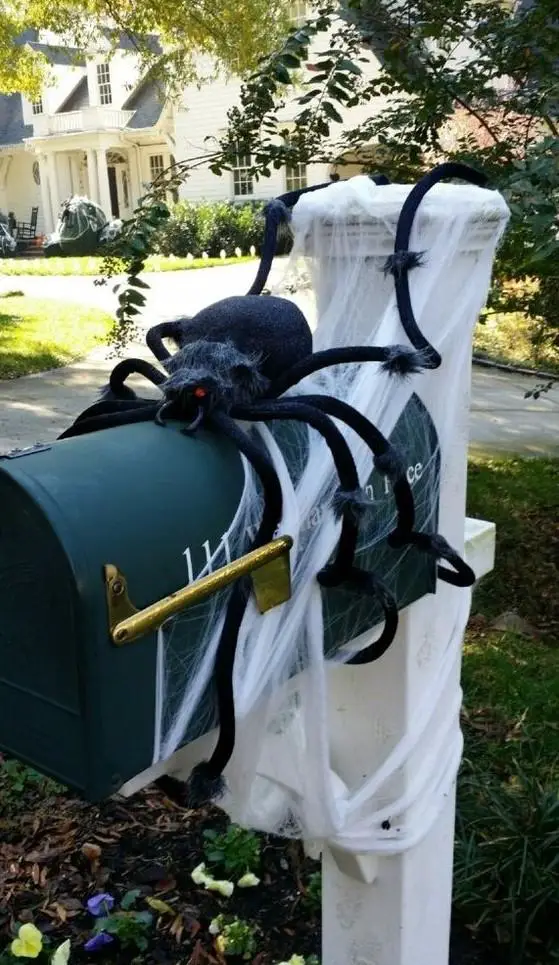
Your mailbox is the personalization that makes your house feel unique, and decorating it makes your yard display feel intentional down to details.
Most people ignore their mailbox, which is why decorating it creates disproportionate impact.
I’ve watched people comment on decorated mailboxes as often as they comment on major displays.
Your mailbox can tell its own story independent of your yard.
A mailbox that’s bloodstained or has a zombie crawling out of it or has a skull as the post creates an entry point to your display.
People notice it and it sets the tone before they even look at your yard.
Make it readable but still functional.
Small details matter disproportionately on a mailbox because it’s a small space.
A single element (a skeleton arm, a wreath of bones, a coffin shape) reads as intentional.
Too many elements crammed onto a small space looks cluttered.
Less is more on a mailbox.
Give your yard one main character
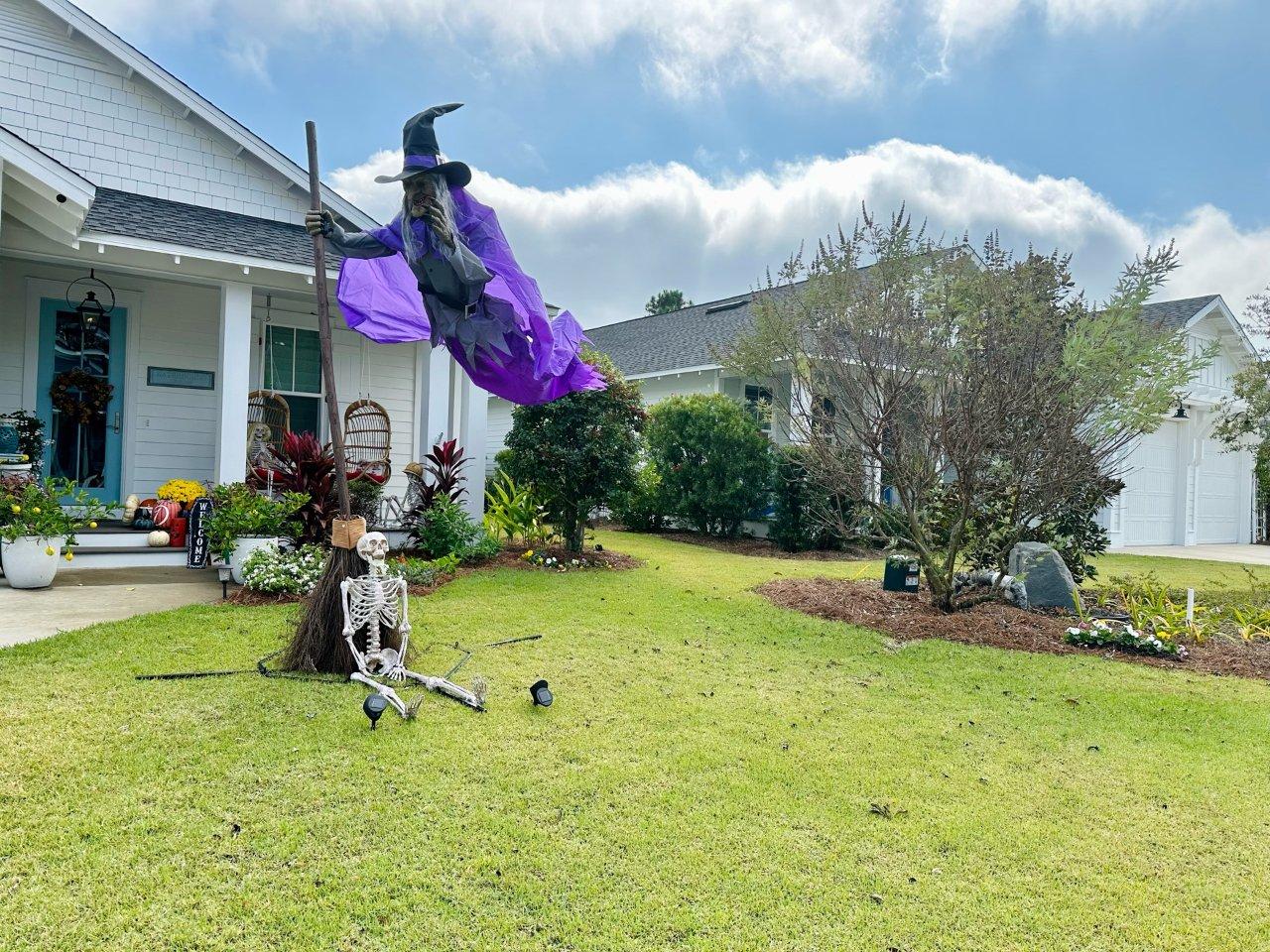
This is the framework that makes everything else work.
Every successful yard display I’ve decorated has one main character, one thing that your entire setup supports.
Without that, your yard is just decorations. With it, your yard tells a story.
Your main character might be a giant spider, a witch, a skeleton doing something, a zombie, a creature inhabiting your porch, whatever makes sense for your space and your theme.
That main character becomes the reason all your other decorations exist.
Everything else in your yard supports or surrounds that character.
Parting shot
Halloween decorating works when you pick a direction and commit to it.
Whether you’re building a witch’s garden, transforming your porch, or making a zombie cemetery, the yards that work are the ones with intention.
Pick your concept from these seventeen, build deliberately around it, light it properly, and watch people stop to look at your yard instead of walking past.