Rock Garden Ideas for a Small Front Yard: 15 Beautiful Ways to Create a Stunning Entrance
Last Updated on October 13, 2026 by Duncan
Small front yards get a bad rap. You think you’ve got nothing to work with, but a tiny patch is the perfect canvas for a rock garden.
Less space means every stone counts and that’s a good thing.
If you have a small front yard and you think you have nothing to work with, well, you are wrong.
Here are excellent small front yard ideas you should consider:
Create a curved rock garden along the front walkway

Straight lines in a small yard make it feel like a parking strip. A gentle curve along your walkway makes it feel like a garden.
Lay your garden hose on the ground and shape the border before you dig. Then walk to the street and look at it the way a visitor would.
Let the curve swell wider in one spot and narrow in another. Put your biggest boulder at the widest point so the eye has somewhere to land.
If you wouldn’t want to follow that curve with your eyes, change it.
Add stepping stones through a small gravel garden

Gravel alone looks flat and a little bleak. Stepping stones give it a purpose and tell guests exactly where to walk.
Choose flat stones at least eighteen inches wide, or your guests will wobble like they’re crossing a creek.
Set each one on a bed of compacted sand so it sits flush with the gravel and doesn’t rock.
Space them one stride apart, which is about two feet center to center. Walk the path yourself in your everyday shoes before you commit.
Want a bonus? Tuck creeping thyme into the gaps between stones, and every step releases a little herbal smell.
Choose thyme over moss for sunny spots, since moss in full sun just turns crispy and gives up. You don’t want this, do you?
Build a dry riverbed through a narrow front yard

A dry riverbed is a curving channel of river stones that looks like a stream, minus the water. In a narrow yard, it does something clever.
It pulls the eye along its curve, so the space feels longer and more interesting than a plain strip.
Run it on a diagonal if you can, and let it widen as it nears the street.
It also solves a real problem.
If your downspout dumps water in the same sad spot every storm, start the riverbed right there so the stones slow the flow and your mulch stays put.
Mix rounded stones of different sizes, with the biggest ones along the banks. Uniform pebbles make a riverbed look like a gray ribbon.
Replace a patchy lawn with a gravel and rock garden

You know the lawn I mean. Brown in July, mossy in the shade, and a weekend chore you never wanted.
Skip the tilling.
Mow it as low as it goes, cover it with cardboard or heavy fabric, and pile gravel on top. The grass dies in the dark and you’ve saved yourself a sore back.
Then add your boulders and plants on top of that fresh blank slate.
Start with the boulders so you know where the plants go.
Keep the layer of gravel at least two inches deep. Thin gravel shows soil in a few months, and then you’re back to a patchy yard.
Use white gravel to make a small front yard feel brighter

A shady, cramped front yard can feel like a cave. White or pale gravel bounces light back up and makes everything feel bigger.
Picture it at dusk. The pale stone glows softly while the rest of the street fades to gray.
Be careful in full sun, though. Bright white gravel can throw glare right into your front windows.
If that worries you, go for warm cream or light gray instead. You get the brightness without the squint.
Use dark rocks to make green plants stand out

Here’s the flip side. Dark stone makes green plants look almost electric.
Black basalt or deep charcoal rock behind chartreuse sedum or silver blue fescue looks like a magazine cover. The same plants against pale gravel look washed out and tired.
Dark stone also makes pink, yellow, and blue blooms pop.
Before you buy, set a plant pot beside the stone sample at the nursery and see how they get along.
Keep in mind that dark rock soaks up heat. Pick plants that love a hot seat, like sedum and ice plant.
Create a layered rock garden against the house

A bed against your house wall can look like a flat stripe if you plant it all one height. Think of it as a staircase instead.
Put tall plants or a big boulder at the back, medium plants in the middle, and low creepers at the front.
Let a few stones peek through each layer.
Leave at least a foot between the garden and your foundation.
That gap keeps splashing water and damp soil off your siding, and it lets you get behind there with a hose or a ladder.
Check your eaves too. If the roof drips right where your plants sit, that spot needs tough plants or a gravel drip strip.
Frame your front door with matching rock gardens

Two matching beds, one on each side of your door, tell visitors where to go. It’s the landscaping version of an arrow.
Make them mirror each other in shape, but not in every detail.
Use the same stone and the same plants, and vary the placement of the boulders so it doesn’t look stamped out.
Keep them low enough that they don’t block your door light or your view of who’s on the porch.
Nothing creates a jump scare like a delivery driver you couldn’t see coming.
Size matters here.
Each bed should be about as wide as your door, or a bit wider, so the entry feels welcoming and not squeezed.
Design a rock garden around your front steps

Steps are awkward. They create hard corners, odd gaps, and a spot where mulch and gravel love to collect.
Let your rock garden hug the steps instead. Nestle a boulder against the side of the bottom step so it looks like it was there first.
Soften the sharp edges with low plants that spill, like creeping phlox or thyme. Plant them far enough from the tread that nobody brushes through wet leaves on the way in.
Keep the first step clear of loose gravel. Small stones on a stair are a slip waiting to happen.
Turn an awkward corner into a small zen inspired rock garden

Every front yard has a dead corner. Maybe it’s the strip beside the garage or the triangle by the fence.
Fill it with fine gravel and rake it into soft lines or ripples.
Add one or two upright stones, a small moss patch if you’ve got shade, and a single sculptural plant like a dwarf pine.
That’s it. Less is the entire point here.
A Zen corner looks best when you leave a lot of empty gravel around the stones. The emptiness is what makes it feel calm.
Rake it once a week with a small hand rake.
Try a miniature alpine rock garden
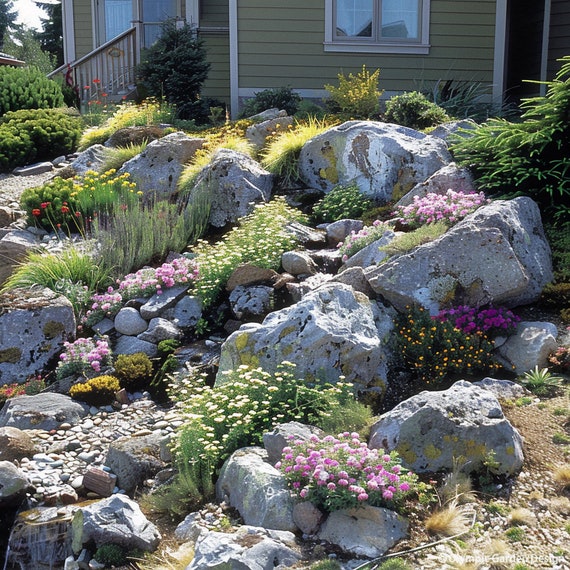
Alpine plants grow in tough mountain conditions, so they’re built for sharp drainage and poor soil. That makes them perfect for a small rock garden.
Mix grit or small crushed stone into your soil, about half and half.
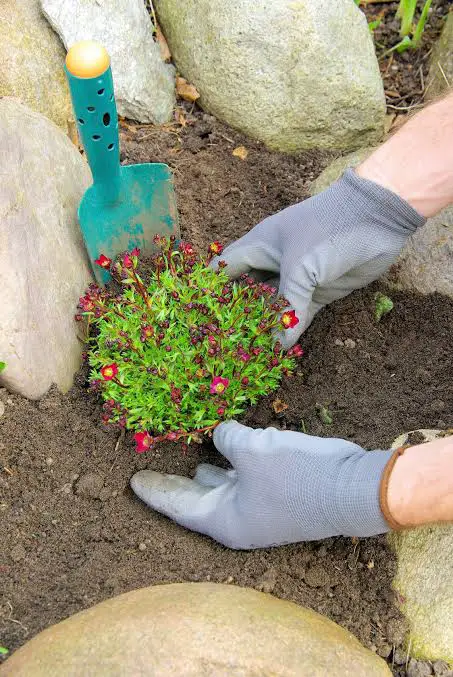
Then tuck in tiny plants like saxifrage, dianthus, and sempervivum between your rocks.
Place rocks at angles, like a little mountain outcrop, so water runs away from the plant crowns.
Alpine plants hate wet feet far more than they hate cold.
A bed just three feet wide can hold a dozen of these little gems.
Build a tiered rock garden on a slight slope

A gentle slope is a gift. You can step the garden down in two or three low terraces and make it look like a mini hillside.
Stack flat stones for each little wall, tilting them slightly back into the slope so they lean on the soil.
Fill behind each wall with soil and plant right at the edge so foliage drapes over the stone.
Keep each tier under about eighteen inches tall.
Higher than that and you’re building a retaining wall, which needs real engineering and probably a permit.
Water runs downhill, so plant the thirstiest things at the bottom. The top tier should hold your toughest, driest plants.
Plant creeping ground covers between rocks

This is how you make a rock garden look softer and finished. Creeping plants knit the stones together and hide the bare gaps.
Try creeping thyme, woolly thyme, blue star creeper, or ice plant. Plant them right up against the stones so they flow over the edges.
Give them a season and they’ll start to look like they grew out of the rock.
You can skip most of the weeding, because a dense carpet leaves weeds no room.
Don’t plant aggressive spreaders like mint or goutweed. They’ll escape your garden and head straight for your neighbor’s.
Combine a rock garden with compact flowering plants

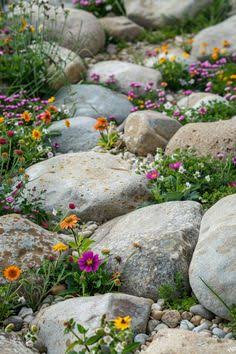
Rocks alone can feel cold. A few compact bloomers bring in color without taking over.
Pick tough ones that like heat and neglect. Dwarf lavender, catmint, coreopsis, dianthus, and sedum all fit the bill.
Aim for blooms in different seasons so something is always happening. Spring phlox, summer lavender, and fall sedum will carry you from March to October.
Skip anything that needs weekly babying. You built a rock garden so you could stop dragging the hose around all the time, right?
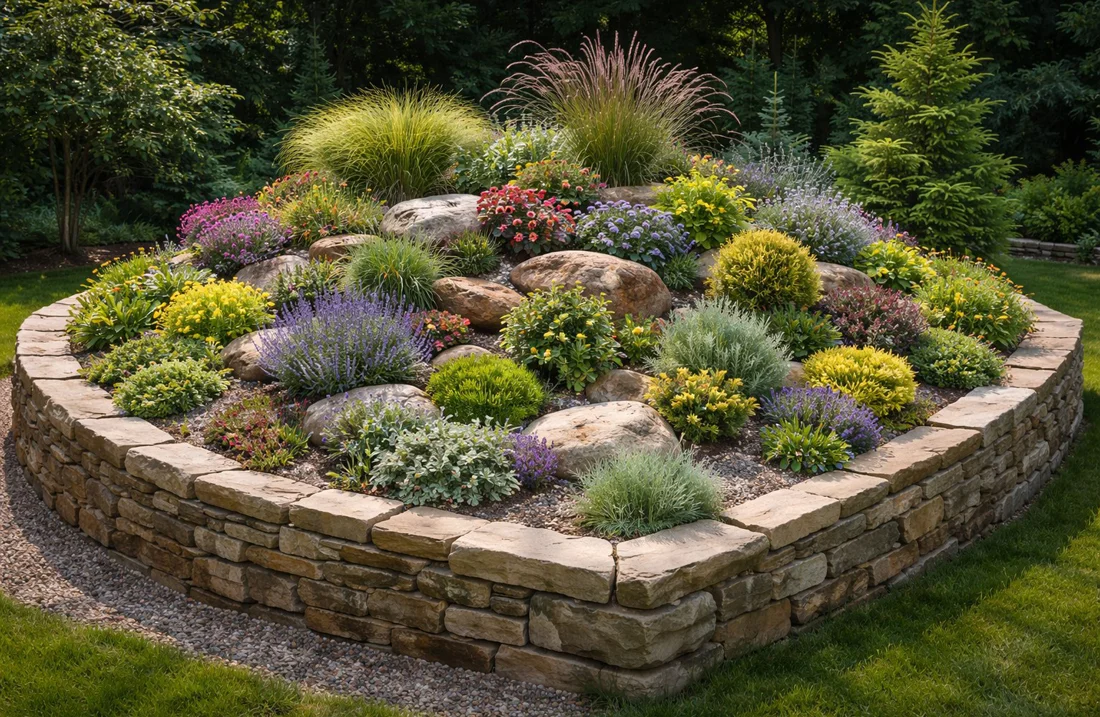
Mix rock sizes

Once you have your star boulder, give it a supporting cast.
Add two or three medium rocks and a handful of small ones.
Nature never sorts stones by size. A hillside has a big one, a few middle ones, and a spill of little ones at the bottom.
Copy that, and your garden looks like it grew there. Use identical stones and it looks like a display at a hardware store.
Tips to Consider When Designing Your Small Front Yard
Use one statement boulder instead of a dozen small rocks
Walk past any sad rock garden and you’ll see the same thing. A scatter of fist-sized stones, all about the same size, looking like a gravel truck sneezed.
Pick one big anchor boulder instead. Make it the star and build everything around it.
In a small yard, a single boulder the size of a beach ball looks planned. Twenty softballs look like leftovers.
Raise it up if your yard is flat
A flat front yard makes rock gardens look pasted on. A gentle mound fixes that fast.
Pile up soil into a low hill, about two feet tall at the highest point, then set your boulders into the slope. Plants tumble down the sides and look natural from the street.
Mounds also give you better drainage. Roots love that, and you’ll lose fewer plants to soggy feet.
Bury a third of every stone
This is the secret nobody mentions. A rock sitting on top of the soil looks like it was delivered yesterday, because it was.
Dig a hole and sink each stone so about a third sits below the surface. Now it looks like the earth pushed it up a thousand years ago.
Your neighbors will wonder if you hired a designer. You’ll just know you did some digging.
Think about snow and the plow
If you get winter weather, remember where the shovel and snowblower go. A boulder right at the edge of your driveway becomes an expensive target.
Keep stones a couple of feet back from the pavement. Mark loose edges with a stake for the first season.
Install landscape fabric the right way, or skip it
This one starts fights, so here’s my opinion. Cheap fabric under decorative gravel turns into a mess within two years, once soil blows on top and weeds root right through it.
Use heavy duty woven fabric and overlap the seams, or skip fabric and lay a thick layer of rock over cleared, compacted soil. Either way, pull weeds the moment you see them.
A weed in gravel pulls out in two seconds. A weed that’s been there for a season grips like it pays rent.
Light it up
You’ll spend a lot of time building this garden, so show it off at night. A few solar spotlights aimed at your big boulder turn it into a sculpture.
Aim the light up from the ground at a low angle. That casts dramatic shadows across the stone.
Skip the string of tiny path lights. They look like an airport runway for gnomes.
Finish the garden with clean edging and a simple planting pattern
Edging is what separates a rock garden from a pile of rocks. A crisp line says “I did this on purpose.”
Use steel edging, set stone, or a trench cut cleanly into the soil.
Angular crushed stone also stays put better than round pea gravel, which rolls into your lawn and under your mower blade.
Nothing ruins a Saturday like picking gravel out of your grass by hand. Ask me how I know.
Keep your planting pattern simple. Repeat the same three plants in drifts of three or five, and don’t buy one of everything at the nursery.
Leave room for growth
Those little plants at the nursery look tiny and sweet. A year later your creeping phlox has swallowed a boulder.
Read the tag and space plants at their mature width. It will look sparse for the first season, and that’s normal.
Fill the gaps with temporary annuals or decorative gravel. By year two you’ll have a full, lush garden.
Keep a clear path
Your front yard isn’t just a display. It’s where the trash cans go, where guests arrive, and where the dog does laps.
Leave a clear route from the street to your door and a spot for the bins. Test it by carrying a few bags of groceries along the path.
A garden that blocks your daily routine gets ripped out. A garden that works with it gets loved.
Start small, then expand
If you’re nervous, build a four by four corner first. Live with it through one season.
You’ll learn how the sun hits it, where water pools, and which plants survive. Then you can grow the garden with confidence.
Every great rock garden I’ve seen started as a small experiment and ended as the best thing on the block.
Final thought
A small front yard is not a limitation. It’s a chance to make every stone, every plant, and every curve count.
Grab a hose, walk outside, and sketch your curve today. By next weekend you could be standing in front of the prettiest little rock garden on your street.
Related Posts: