How to Build a Dust Bath for Birds That Birds Will Use
Last Updated on August 10, 2026 by Duncan
A good dust bath looks deceptively simple.
You put dry material in a shallow area, give birds room to move around, and wait for them to discover it.
But if you have ever built one and watched birds ignore it completely, you already know there is more to the job.
The substrate can be perfect and the bath can still fail.
Why?
Because birds are not only looking for somewhere to dust their feathers.
They are looking for somewhere that feels dry, comfortable, visible, and safe from surprise attacks.
After years of working around outdoor habitats and watching how animals respond to their surroundings, I use one rule when designing a bird dust bath:
Build for the bird’s behavior, not for the appearance of the garden.
That single change in thinking solves many of the problems people run into.
What does a bird dust bath do?
A dust bath isn’t decoration.
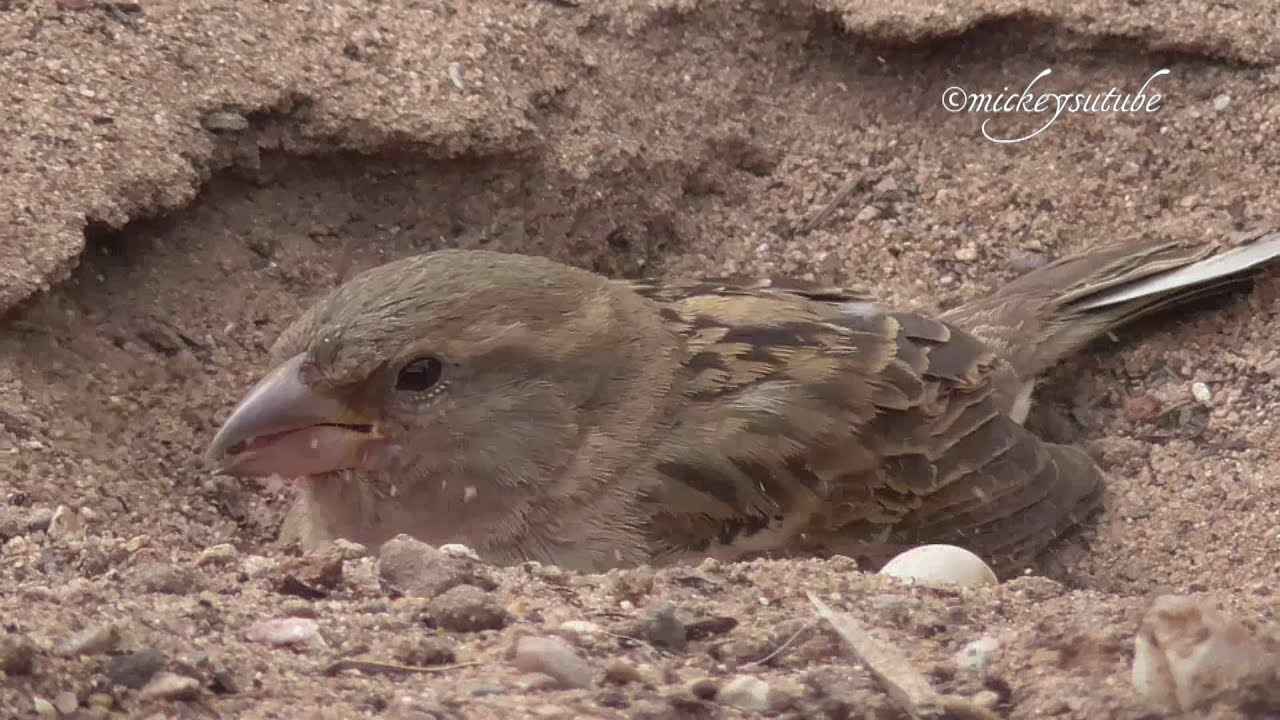
It’s a bird’s version of a shower, a spa day, and pest control all rolled into one.
Birds work fine dirt down into their feathers to soak up extra oil and suffocate mites and lice.
Why should you build a dust bath for birds?
A dust bath gives birds a dedicated place to perform a natural behavior without forcing them to search through your garden for suitable dry soil.
It can also become an interesting wildlife feature because you may notice birds using it at different times of the day.
And there is something oddly satisfying about watching a bird suddenly throw itself into a patch of dust like it has completely forgotten every responsibility it has ever had.
If you are building a bird-friendly garden, a dust bath is one of those small additions that can make the space feel much more alive.
How large should a bird dust bath be?
You don’t need to build a giant pit.
For a backyard installation, a practical starting point is approximately:
24 to 36 inches wide by 24 to 36 inches long.
That gives birds enough room to move around without turning the project into a major landscaping job.
A shallow, broad bath is usually preferable to a narrow, deep one.
Birds need surface area for rolling and scratching.
They don’t need a miniature swimming pool made of dust.
What is the best shape for a bird dust bath?
A bowl shape feels intuitive. It’s wrong.
Birds want something shallow and saucer shaped, almost like a flattened plate instead of a mixing bowl.
Steep sides mean the bird spends its energy just trying not to slide around instead of actually bathing.
Mound your dirt gently in the center, no higher than about two inches, and let it taper down toward the edges. Picture a tiny sand dune, not a crater.
And skip anything raised way up off the ground on legs.
Birds like feeling solid earth underneath the loose dirt. It gives them something to push against when they’re digging in.
How deep should a dust bath be?
Aim for approximately 4 to 6 inches of loose bathing material.
That gives birds enough depth to work through the substrate while keeping the bath easy to maintain.
If the layer is too thin, birds quickly expose the soil beneath.
If it is unnecessarily deep, you are simply buying and maintaining material you don’t need.
For most backyard situations, a few inches of loose, dry substrate is enough.
How to build a bird dust bath on the ground
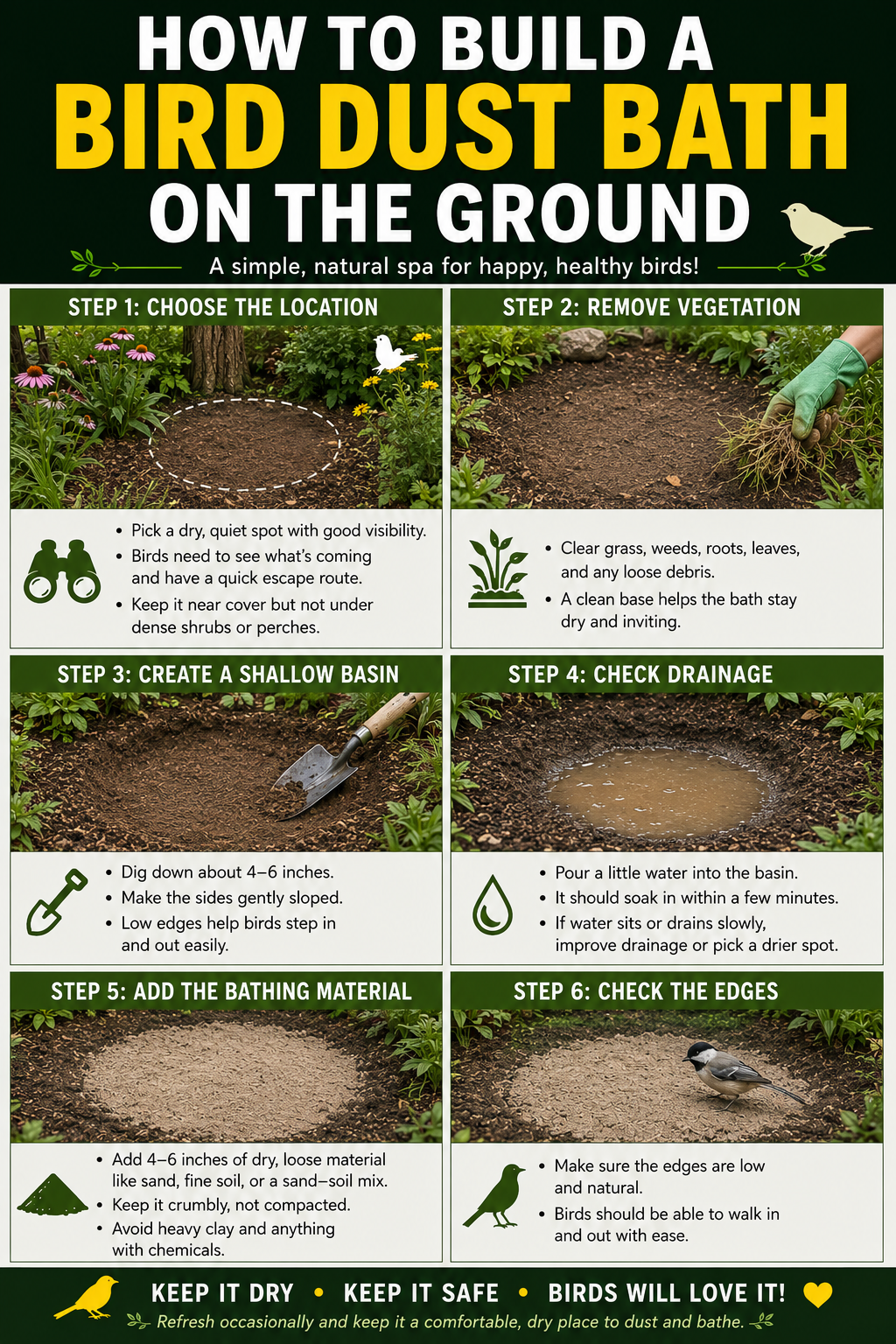
This is one of the simplest approaches.
Step 1: Choose the location
Find a dry area with good visibility and nearby escape cover.
Run the 360° Escape-Cone test before digging.
Step 2: Remove vegetation
Clear grass, weeds, roots, and thick organic material.
You want the bathing area to remain loose rather than turning into a miniature compost bed.
Step 3: Create a shallow basin
Excavate approximately 4 to 6 inches, depending on the depth you want.
Don’t create a deep hole with steep sides.
Birds should be able to walk in and out easily.
Step 4: Check drainage
Pour a small amount of water into the area.
Watch where it goes.
If water sits there for a long time, you have found a future problem.
Improve drainage or choose another location.
Step 5: Add the bathing material
Fill the area with clean, dry, loose material.
Don’t compact it.
The birds will do the mixing for you.
Step 6: Check the edges
The transition between the surrounding ground and the bath should be easy to cross.
A bird shouldn’t need to climb over a tall wall to reach its spa.
How to build a raised bird dust bath
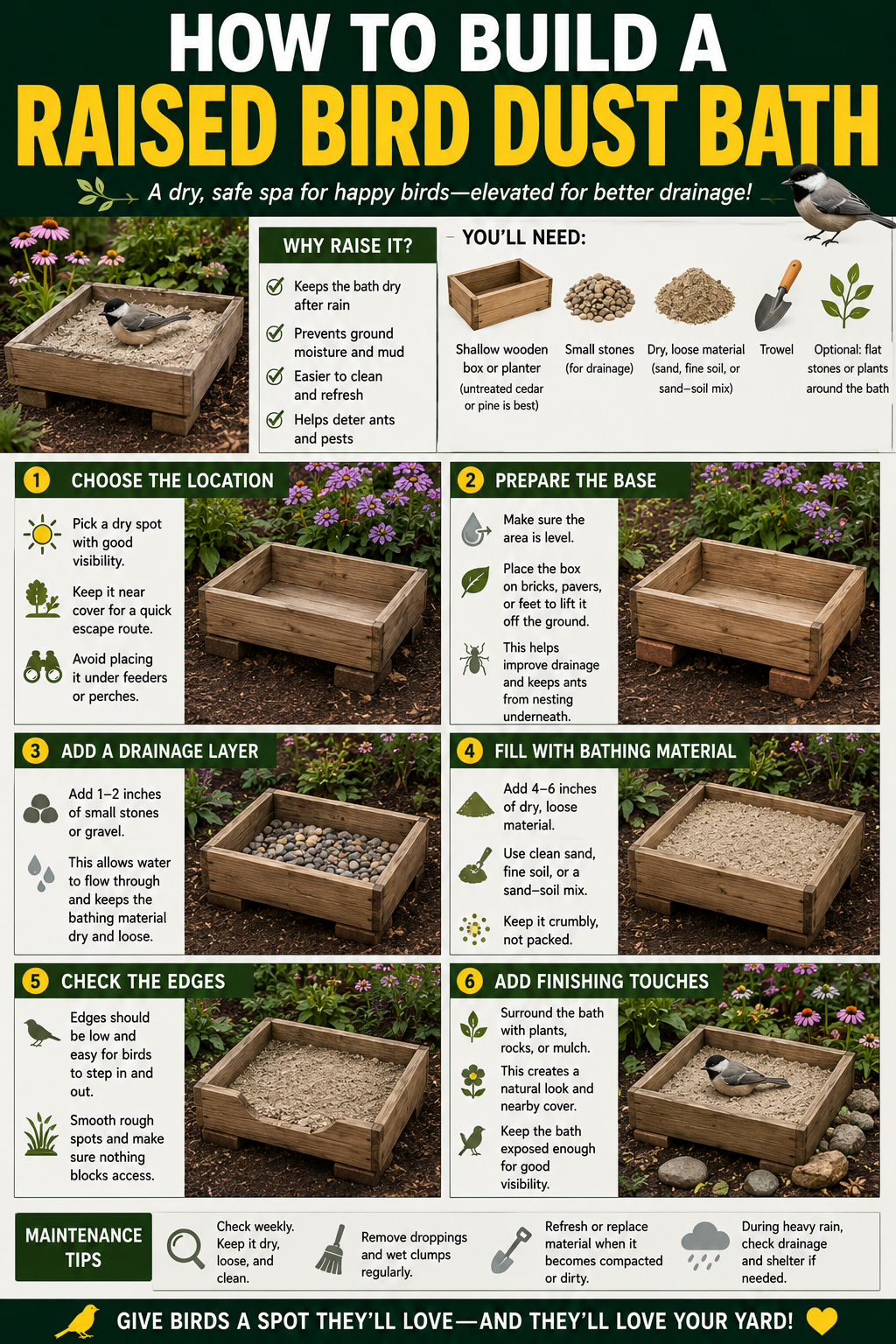
A raised bath can be useful when your garden soil stays damp.
You can build a shallow frame from suitable untreated material or use a sturdy container.
The important thing is to provide drainage.
If you use a container, make sure it has drainage holes.
Then raise it slightly so water can escape instead of collecting underneath.
A raised design also makes cleaning and refreshing the substrate easier.
What should you put in a bird dust bath?
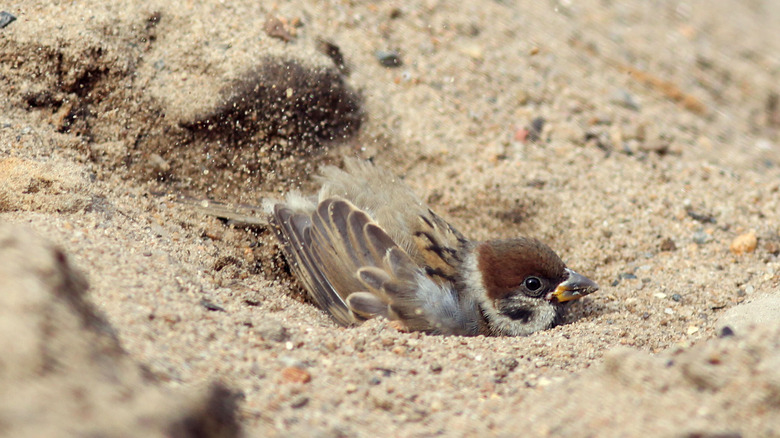
The key characteristic is dry, loose, clean material.
Suitable materials include clean sand and dry, crumbly soil that does not turn into sticky mud when wet.
You can create a mixture rather than relying on one material.
A mixed texture often remains easier to work with because different particles create air spaces and prevent the entire surface from becoming compacted.
Skip the playground sand
Here’s where almost everyone goes wrong right out of the gate. You grab a bag of sand from the hardware store, dump it in a dish, and call it done.
Birds hate it.
Regular sand is too chunky.
Birds want dirt closer to powder, fine enough to actually get worked into their feathers instead of just sitting on top like gravel in a fish tank.
Think about it from their side.
Would you rather roll around in flour or in a pile of pebbles?
Sift your dirt through an old window screen or a fine mesh colander before you use it.
It takes five extra minutes and it means the difference between a bird bath birds fight over and one they walk right past.
What about garden soil?
Ordinary garden soil can work if it is:
- Dry
- Loose
- Free of chemical contamination
- Not dominated by heavy clay
- Free of sharp debris
- Not waterlogged
The problem is that garden soil varies dramatically.
One handful may be beautifully crumbly.
Another may turn into a brick after rain.
Test it before committing a large amount to the bath.
Should you add wood ash?
This is one area where I recommend restraint.
You will find plenty of advice suggesting that wood ash belongs in every bird dust bath.
It doesn’t.
If you choose to include a small amount, use only clean ash from untreated, unpainted wood.
Never use ash from:
- Painted wood
- Treated lumber
- Coal
- Charcoal briquettes
- Trash
- Unknown materials
Ash is not a substitute for good habitat management.
Don’t use it as a cure-all for parasite problems.
A clean, dry, well-designed bathing area matters far more than chasing a magic ingredient.
Should you use diatomaceous earth?
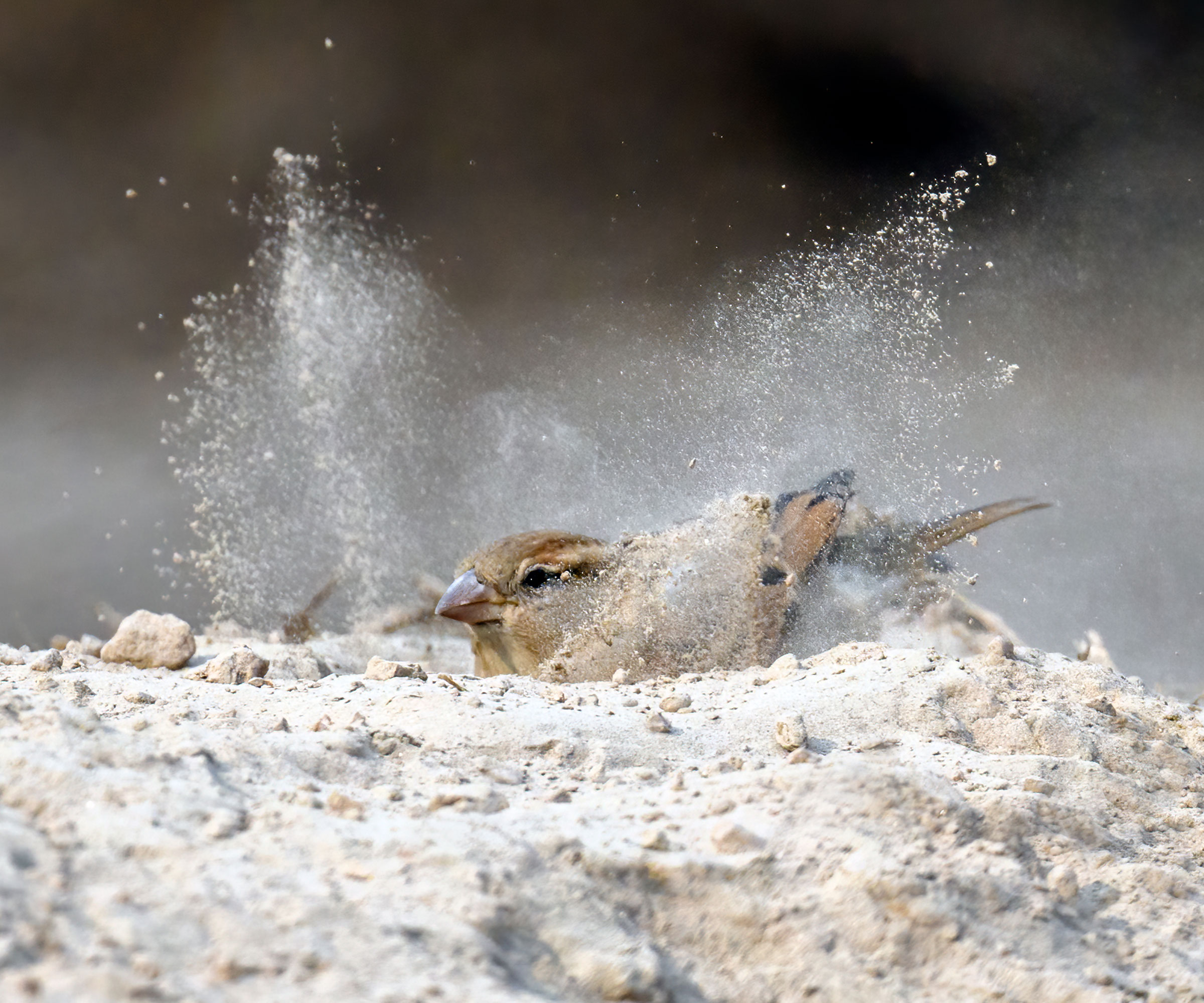
Diatomaceous earth gets recommended constantly for “extra bug protection.” Skip it in an open dust bath.
Birds kick up clouds of dust when they bathe, and they breathe that cloud in.
Bird lungs are not built like ours. Particles stay in contact with their lung tissue longer, which means anything abrasive causes significant irritation over time.
Save the diatomaceous earth for nesting boxes if you’re using it at all.
What should you never put in a bird dust bath?
Avoid adding substances simply because someone online claims they make the bath healthier.
Do not casually add:
- Pesticides
- Insecticides
- Chemical powders
- Fertilizers
- Construction dust
- Unknown fireplace ash
- Treated wood products
- Paint-contaminated material
- Sharp gravel
- Broken glass
- Artificial fragrances
Birds will be contacting this material with their bodies and feathers.
Keep the recipe boring.
Best practices when building a dust bath for birds
Choose the right location
This is the part that makes or breaks the whole project, and it’s the part nobody talks about enough.
Picture yourself taking a bath in your front yard with no walls.
You’d want to see anyone coming, and you’d want somewhere close to bolt if trouble showed up.
Birds want the exact same thing.
Put the dust bath within about five feet of a bush or some low cover, but make sure the approach in front of it stays wide open.
That way birds can dash to safety in a heartbeat, but they can also see danger coming from a distance while they’re mid bath.
Tuck the bath too close against a wall or deep inside thick bushes and you’ve basically built a trap in their eyes. They’ll avoid it completely, no matter how nice the dirt is.
Avoid too much sun
Full blazing sun all day sounds cozy, but it works against you here.
Hot direct sun creates rising heat that keeps dust hanging in the air too long after a bird starts kicking it up.
That cloud blocks their view, and a bird that can’t see a predator coming isn’t sticking around to finish bathing.
Go for partial shade instead.
Somewhere that gets dappled light through tree branches works perfectly, and honestly it’s a great excuse to plant something nearby anyway.
Don’t put the bath under a popular perch
This is a small detail with a big effect.
Birds love convenient perches.
If your dust bath sits directly underneath a favorite branch, fence rail, or bird feeder perch, you may end up with a steady supply of droppings falling into the bathing area.
That creates a maintenance problem quickly.
Look upward before choosing your location.
If you see a heavily used perch directly above the proposed bath, move the bath a few feet away.
Your future self will appreciate the decision.
Ensure you have good drainage
If you’ve ever left dirt out in the rain, you already know what happens. It turns into a solid crusty mess.
A dust bath with no drainage becomes completely useless after one good storm.
Birds cannot break through caked mud with their feet and feathers, no matter how determined they are.
Layer a couple inches of small gravel underneath your fine dirt before you fill it in.
Water drains through, the top layer dries out fast, and you’re not starting from scratch after every rainstorm.
Watch out for ants
Nobody warns you about this one and it’s honestly the most common reason a perfectly good dust bath goes cold.
Ants love moving into dry loose dirt, and once they do, birds figure it out within one visit and vanish for weeks.
You won’t even notice the ants unless you’re specifically looking for them.
Give your dust bath a quick rake through once a week.
This disrupts any colony trying to move in and keeps things loose enough for birds to work with.
Don’t clean it too well
This one surprises people every time I bring it up.
Fully replacing the dirt every week actually makes your bath less attractive.
Birds are drawn to spots where they can smell that other birds have used it successfully.
Only fully swap the dirt out when it’s visibly clumped or dirty. Otherwise leave it be and let it build up that lived in quality.
Don’t let the bath become a bird feeder
Keep food away from the bathing area.
Bird feeders create a lot of debris.
They can also attract droppings and concentrate bird activity.
If you have both features, separate them enough that the dust bath stays clean.
You want the bird to have different zones for different activities.
What if birds ignore your dust bath?
Sometimes you will do everything right and still the birds ignore your bird bath. When this happens, don’t immediately rebuild it.
First, investigate.
Check the location.
Is it too exposed?
Check the substrate.
Is it damp, hard, dusty, or uncomfortable?
Check the temperature.
Does the surface become extremely hot?
Check nearby activity.
Are cats, dogs, children, ants or heavy foot traffic disturbing the area?
Check the approach.
Can birds land and leave easily?
Check the surroundings.
Are there natural bathing areas nearby that birds already prefer?
Sometimes the birds are giving you useful information.
Listen to them.
FAQs
How often should you replace the substrate?
Inspect first.
If the material remains dry, loose, and reasonably clean, you may only need to remove contaminated sections and top up the bath.
If it becomes compacted, muddy, foul, heavily contaminated, or persistently damp, replace it.
There is no prize for keeping the same dusty material forever.
Can you put a dust bath on a patio?
Yes.
A patio can work well if you use a shallow container and manage drainage.
It also gives you easy access for cleaning.
But patios can become hot, and surrounding hard surfaces may increase heat and glare.
Watch the temperature and consider partial shade.
Also make sure the bath isn’t positioned where pets can easily disturb it.
Can you use an old container?
Yes, provided it is clean, structurally sound, and suitable for outdoor use.
Avoid containers that previously held chemicals or unknown substances.
A shallow planter, sturdy tray, or similar container can work just as well.
The best recycled container is one whose previous life doesn’t create a new problem for your birds.
Can you build a dust bath under a bird feeder?
I wouldn’t.
It’s convenient, but convenience isn’t the same as good design.
Feeders create concentrated bird activity, spilled food, feathers, and droppings.
Give the dust bath its own space.
How do you make a dust bath look good in your garden?
You don’t have to choose between wildlife habitat and attractive landscaping.
Use a simple border.
Natural stone can work beautifully.
A low timber frame can give the bath a finished appearance.
You can also surround the area with low-growing plants while keeping the actual bathing surface open.
Just remember the rule:
Decorate the perimeter, not the bathing surface.
Birds need functional space.
Not aesthetically pleasing space.
Related Posts: