
18 Genius Hanging Basket Ideas for Small Kitchens That Fix the Chaos
Last Updated on June 17, 2026 by Duncan
Let me set the scene. You open your cabinet to grab an onion and three things fall out.
You close it, pretend it didn’t happen, and use a spatula to scoop something off the counter because there’s no room to actually chop anything. Sound familiar?
That was my kitchen for two full years. Not because I lacked storage. Because everything I owned was in the wrong place doing the wrong job.
The counter held things that should have been hanging. The cabinets held things I touched every single day. The floor held my dignity.
Hanging baskets fixed this. Not decorative hanging baskets that look good in a photo and collect dust in real life.
Specific baskets, in specific spots, doing specific jobs. Here’s every idea that actually held up under real daily use.
1. The Three-Tier Produce Basket (Your New Best Friend)
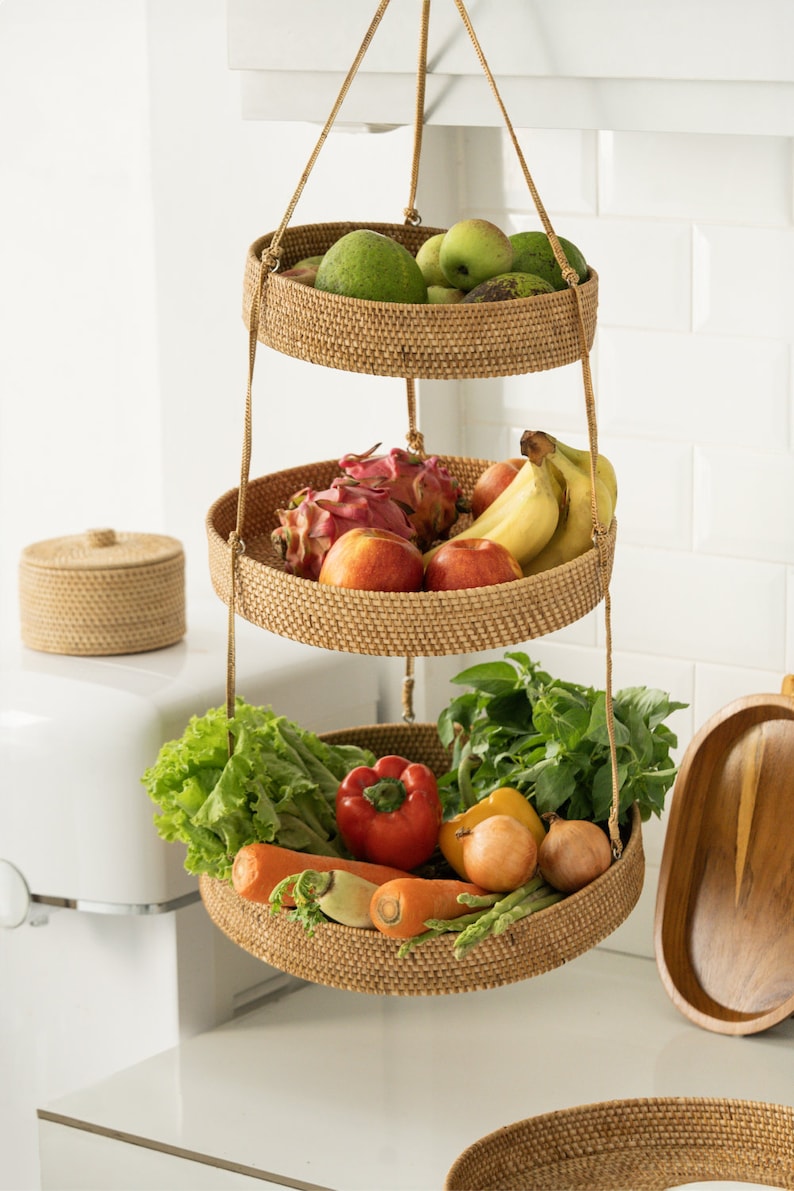
A three-tier hanging basket filled with your daily produce is the cornerstone of every small kitchen that actually functions.
This is the single idea I give every friend who tells me they have no counter space.
Here’s the layout that works: Potatoes or onions on the bottom tier, garlic and shallots in the middle, lemons and limes on top.
You’ll reach into this thing fifteen times a day and wonder how your counter ever felt clear before.
The positioning is everything. Hang it so the bottom basket sits right around your waist. Not eye level, not shoulder height.
Waist height means one motion, no reaching, no thinking.
The moment it requires effort to retrieve something, you’ll stop using it within two weeks. I’ve watched this happen to friends who ignored this exact detail.
2. The Shallow Basket (Deep Baskets Are a Trap)
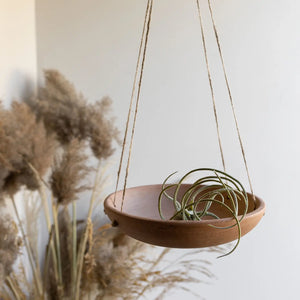
Every time a friend shows me their kitchen and complains that their hanging basket “isn’t really working,” I look inside and find the same thing: it’s too deep.
They bought a beautiful deep woven basket and now everything past the top layer is effectively lost forever.
Out of sight genuinely means out of mind when it comes to produce.
I once found a sweet potato in the bottom of a deep basket that had been there so long it had started to form what I can only describe as a root system. We don’t talk about it.
The rule is simple: If you can’t see every single item in the basket from standing height, the basket is too deep.
Wide and shallow beats tall and deep every single time. Aim for no more than four inches of depth for anything that goes off within a week.
3. A Separate Basket Just for Bananas
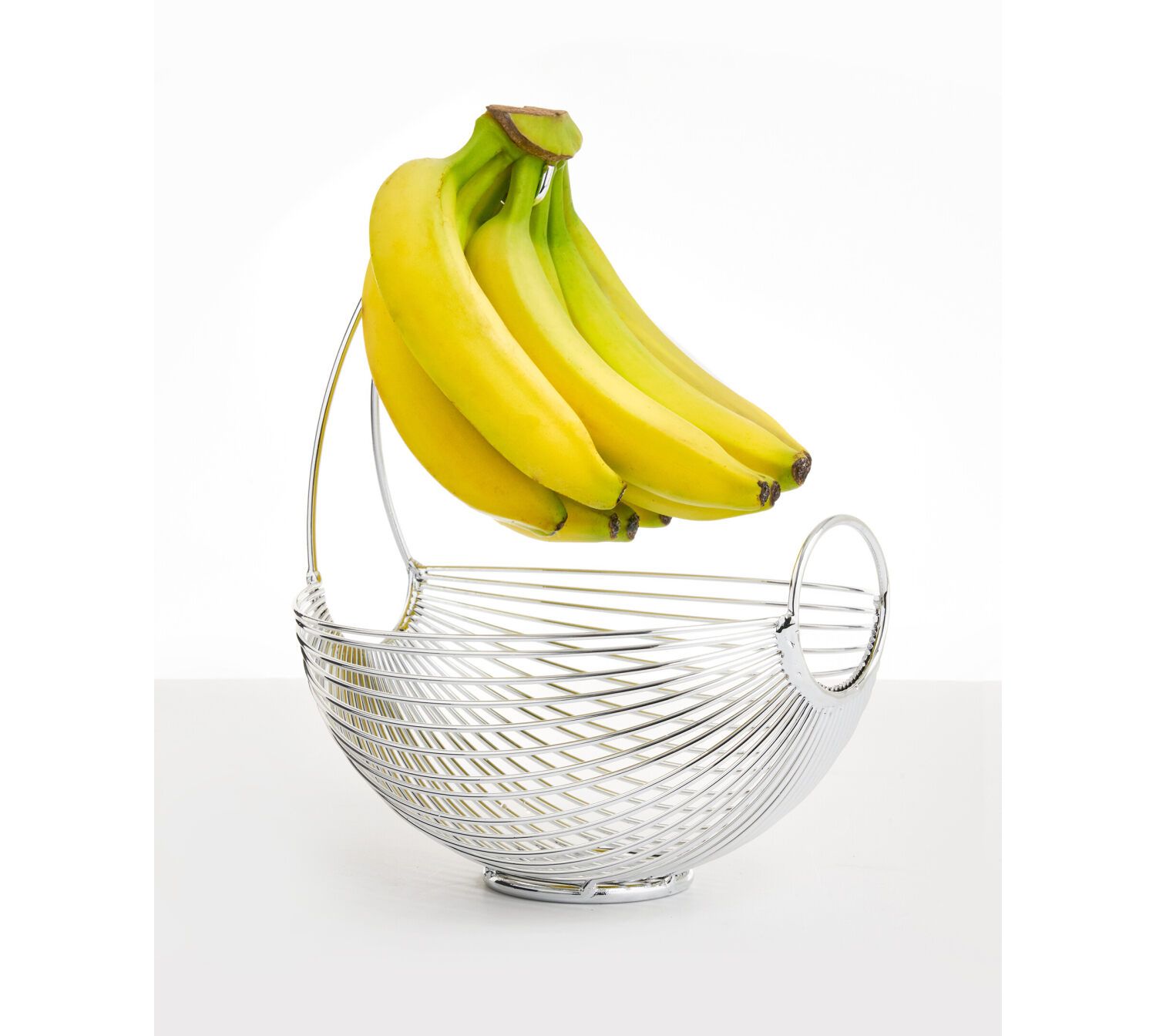
Bananas need their own hanging basket, separated from your other produce.
This sounds unnecessarily specific until you understand why. Bananas release ethylene gas constantly, and ethylene gas accelerates the ripening of everything around them.
I spent two months wondering why my avocados were going mushy faster than they should.
Then I moved the bananas to their own small basket on the other side of the kitchen and the problem stopped immediately. Embarrassingly simple fix.
Get the cheapest small hanging basket you can find, dedicate it solely to bananas, and hang it somewhere that isn’t touching your main produce setup.
Your avocados will thank you in the only way that matters.
4. The Corner Tension Rod Basket Station

If you have a dead corner in your kitchen, which almost every small kitchen does, run a sturdy tension rod across it and hang two or three baskets from it.
That corner has been contributing nothing to your life. Make it work.
Corner tension rods are more stable than single-wall tension rods because the opposing walls create lateral resistance.
Your baskets aren’t going anywhere.
No drilling, no damage to walls, no landlord conversations.
I put mine in on a Sunday morning and it looked deliberate rather than desperate.
This spot works best for less-frequently-grabbed items such as backup onions, seasonal citrus, root vegetables that don’t need daily access.
5. A Hanging Mesh Basket for Root Vegetables

Potatoes and sweet potatoes need airflow to stay firm and not sprout.
A hanging mesh basket gives them exactly that while keeping them completely off your counter and out of your cabinets where they’d be forgotten.
The mesh matters here specifically.
A solid-sided basket traps moisture around root vegetables and you’ll be dealing with soft, sad potatoes within a week.
Mesh keeps air circulating and adds at least three to five extra days of shelf life in my experience.
Hang this one somewhere with decent air circulation, not right next to the stove where heat will accelerate the whole process.
Inside a pantry with the door left open works surprisingly well.
6. A Small Herb Basket at the Window

A hanging basket with small potted herbs near your best kitchen window turns wasted vertical space into a genuinely useful growing station.
Basil, parsley, chives, and mint all grow happily in small pots at window height.
The practical payoff is real: Fresh herbs on demand without taking up counter or windowsill space, plus it makes your kitchen smell remarkable.
I’ve had guests comment on the herb basket before they comment on anything else I’ve done to the room.
Start with two or three herbs you actually cook with regularly, not ten varieties you’re hoping to inspire yourself with.
I made the ten-herb mistake and spent two months running a small struggling herb hospital before admitting defeat.
7. A Hanging Basket for Bread Storage
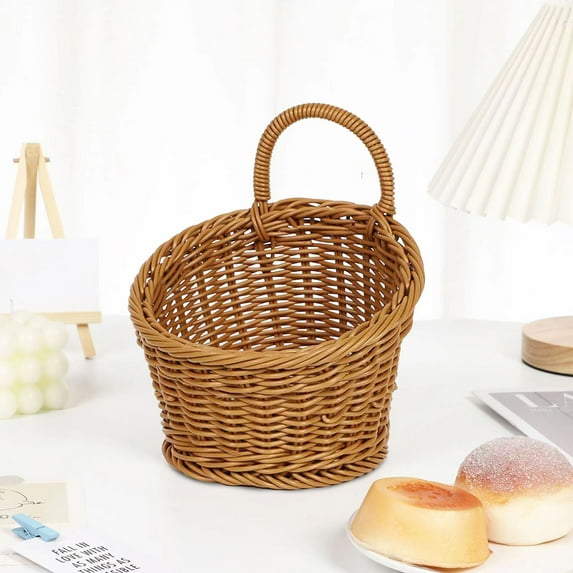
Bread kept with airflow stays fresh meaningfully longer than bread sealed on a counter or stuffed in a cabinet.
A hanging wicker or open-weave basket dedicated to bread gives it the circulation it actually needs.
My sourdough used to last three days on the counter.
In a hanging basket with decent airflow, I’m regularly getting five to six days.
That’s not a tiny difference when you’re paying good money for a decent loaf.
Keep this basket away from the stove and out of direct sunlight.
Both will dry your bread out faster than almost anything else.
A spot on the opposite wall from heat sources is ideal.
8. Hanging Basket for Snacks and Grab-and-Go Items
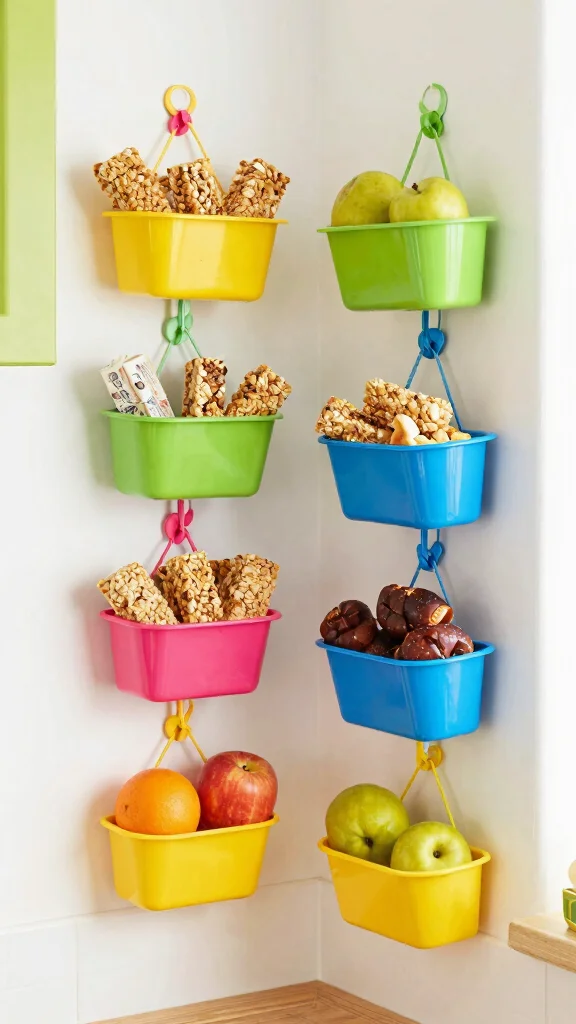
If you have a household with multiple people, or honestly just a functional human appetite, a dedicated hanging snack basket is one of those ideas that sounds too simple to matter until you’ve had it for a week.
Then you can’t imagine not having it.
The psychology is straightforward: Visible food gets eaten. Hidden food gets forgotten, replaced, and eventually discovered in a sad state at the back of a cabinet.
A basket at an accessible height filled with grab-and-go snacks reduces the “there’s nothing to eat” problem dramatically.
I hang mine at around the 48-inch mark, which is accessible for adults and tall enough for kids without being a constant presence in the sightline.
Fill it on grocery day, let it self-regulate the rest of the week.
9. A Labeled Basket System for Baking Supplies

If you bake even occasionally, your baking supplies are probably scattered across three different cabinets and you spend five minutes gathering them every time.
A hanging basket labeled clearly for baking supplies keeps everything in one retrievable place.
The critical detail most people miss: Label the front-facing side at eye level on your approach angle.
Not the top, not the back.
You read labels on the side you see when you’re walking toward them. It sounds obvious but almost nobody does it correctly on the first attempt.
I keep a basket with my most-used baking items: vanilla extract, baking powder, baking soda, and chocolate chips.
Everything else stays in the cabinet.
The basket holds only what I reach for in an average week.
10. A Hanging Basket for Onions and Garlic (Separate from Other Produce)

Onions and garlic deserve their own basket, separate from the rest of your produce.
Like bananas, both release compounds that accelerate the deterioration of neighboring produce, particularly anything delicate.
This doesn’t need to be elaborate.
A simple wire or mesh basket hung at a slightly lower position keeps them accessible, dry, and not actively ruining your other produce.
I hang mine below my main three-tier basket with about a foot of separation.
The added bonus is that onions and garlic in open hanging storage actually last longer than onions and garlic in a cabinet or drawer where moisture accumulates.
A cool, dry, airy basket will get you weeks of shelf life out of a good onion.
11. A Small Basket for Everyday Cooking Staples
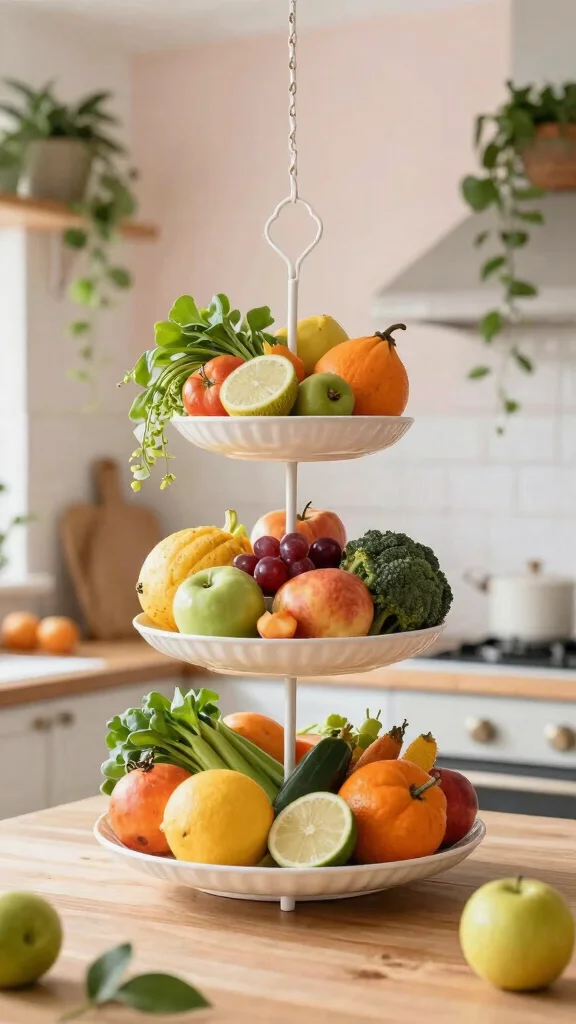
Your olive oil, salt, and whatever bottle or jar you reach for multiple times every single cooking session shouldn’t be in a cabinet.
They should be hanging within arm’s reach of where you cook.
A small, sturdy hanging basket positioned near your prep area holds your daily cooking staples at the exact moment you need them, without occupying a single inch of counter space.
This was the change that made cooking feel smooth instead of like an obstacle course.
The key is keeping it strictly limited to daily-use items.
The moment you add things you use once a month, the system loses its purpose.
If you haven’t touched something from this basket in a week, it goes back in the cabinet.
12. A Hanging Basket for Coffee and Tea Supplies
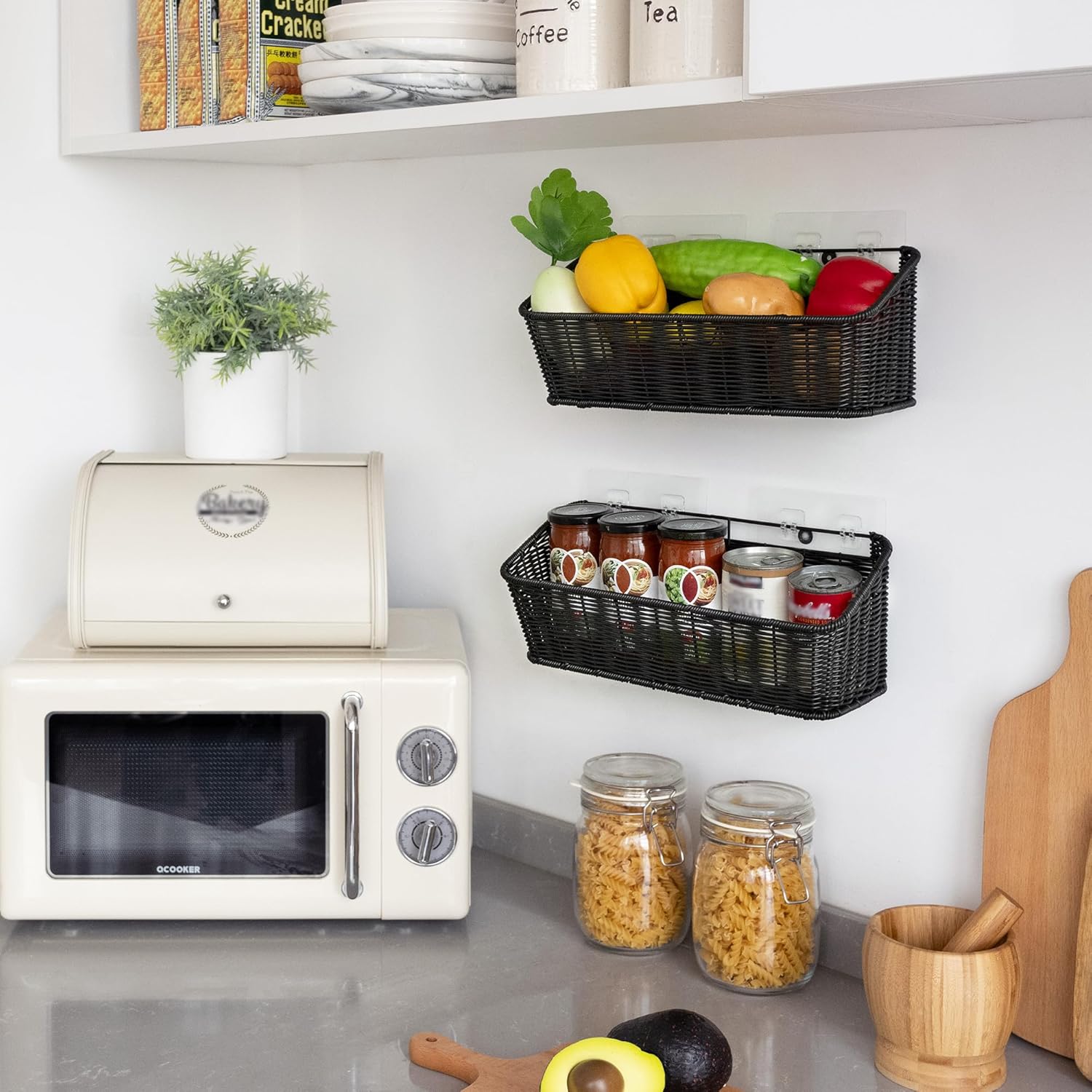
If you have a coffee or tea station, a small hanging basket above or near it keeps your most-used supplies vertical instead of sprawled across the counter.
Tea boxes, coffee pods, sugar packets, sweetener, all of it can live in a basket that frees up the horizontal space around your kettle or machine.
This works particularly well in kitchens where the coffee station is in a corner with overhead space that’s otherwise going unused.
A ceiling hook or a cabinet-door mounted basket keeps the whole setup contained in one zone.
I went from having coffee supplies spread across two different areas of the kitchen to having everything in one small basket directly above the kettle.
Mornings got measurably less frustrating.
13. The Over-Cabinet-Door Basket for Spices

If your spices are currently in a drawer or a crowded cabinet shelf, you’re losing cooking time every single day.
An over-cabinet-door hanging basket organizer that sits on the inside of your spice cabinet door organizes them at eye level and makes selection instant.
The setup that works: Organize spices by frequency of use, not alphabetically.
Your everyday spices go at the top of the basket where they’re immediately visible.
The specialty spices you bought for one specific recipe two years ago go at the bottom.
I reorganized my spices this way and stopped buying duplicate jars of things I already owned within the first month.
That alone paid for the basket several times over.
14. A Hanging Basket Inside a Deep Cabinet

Every kitchen has at least one cabinet that’s inconveniently deep, where things get pushed to the back and vanish.
A hanging basket mounted to the inside of the cabinet door brings whatever you put in it to the front every single time you open the door.
This is particularly useful for the cabinet under the sink, which tends to become a black hole for cleaning supplies and random items.
A basket on the inside of that door puts your most-used products immediately accessible without reaching into the dark back corners.
The installation is usually simpler than it looks.
Most of these baskets use over-door hooks or simple adhesive mounting that works fine for lighter items.
15. A Basket System for the Inside of Pantry Doors

If you have a pantry, every inch of door space is storage space you probably aren’t using.
A vertical series of small hanging baskets on the pantry door can hold a remarkable amount: snacks, small dry goods packages, foil, plastic wrap, and anything else that’s awkward to stack on a shelf.
The rule I follow for pantry door baskets is that everything at eye level when the door is open should be items I reach for daily.
Lower baskets hold less frequent items. The top of the door holds things I access once a week or less.
You’ll be genuinely surprised how much a well-organized pantry door adds to the functional storage of a small kitchen. It’s essentially a free cabinet once you start using it properly.
16. A Hanging Fruit Basket with Separation

A single-level hanging fruit basket with interior dividers or separate smaller baskets grouped together is better than one large open basket for mixed fruit.
Different fruits have different airflow and ethylene needs, and keeping them loosely separated preserves everything longer.
Think of it as a small ecosystem.
Citrus can be grouped together and is relatively inert. Stone fruits need airflow and space. Bananas, as we covered, are a solo act.
A basket system that allows some separation rather than one big communal pile treats each type of fruit more appropriately.
You don’t need anything fancy for this. Two or three small baskets hung at the same height with a few inches between them does the job perfectly.
17. A Hanging Basket for Paper Bags and Reusable Bags

Reusable grocery bags are wonderful in principle and completely chaotic in storage.
A large hanging basket near your kitchen exit point gives them a permanent home that you’ll actually use because it’s on your path out the door.
Position matters here more than almost anywhere else. A basket inside a cabinet or at the back of a pantry means you’ll forget to grab your bags every single time.
A basket you physically walk past on the way out is a basket you’ll actually use. I put mine at the back door and my forgotten-bags rate went to nearly zero.
For paper bags, a hanging basket where you can stuff them in loosely and pull from the bottom eliminates the avalanche situation completely.
18. A Hanging Basket for Pot Lids Only

Pot lids are arguably the most chaotic objects in any kitchen.
They don’t stack cleanly, they slide everywhere, they take up disproportionate space for their actual purpose.
A hanging basket specifically for lids, mounted somewhere accessible near your cooking area, fixes this completely.
The positioning that works best is inside a cabinet door near your stove, or in a hanging position at roughly waist to hip height.
You pull a lid during active cooking, which means you need it fast and you need both hands free.
A basket you can grab from without looking works better than a rack you have to carefully navigate.
This single change improved my cooking experience more than several upgrades that cost significantly more money.
Hanging Basket Ideas for Small Kitchens Best Practices
Coordinate Your Baskets by Material and Color
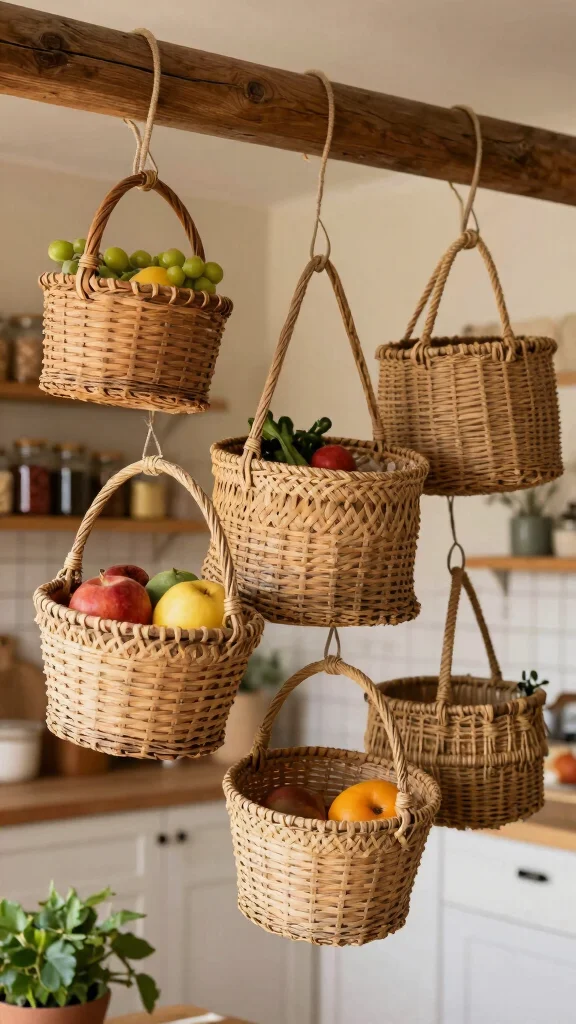
The difference between a kitchen that looks purposefully organized and one that looks improvised often comes down to whether the hanging baskets match each other.
Six different basket styles in six different finishes reads as chaotic regardless of how well the contents are organized.
Six baskets in two cohesive materials reads as intentional.
Before you buy a single basket, decide on a material palette.
Natural woven materials like seagrass or jute have a warmth that works in almost any kitchen.
Matte black wire baskets look clean and modern.
Powder-coated metal in a consistent finish ties everything together.
Pick one direction and stick to it.
I spent a year with mismatched baskets before I replaced everything with a consistent set and the entire kitchen felt calmer immediately. Same items, same positions, different visual coherence.
Have a Statement Hanging Basket as a Focal Point
One large, beautiful hanging basket positioned at the visual center of your kitchen does something that purely functional storage can’t do: it makes the space feel designed.
Not “designed” in the expensive renovation sense, but in the “someone thought about this” sense.
I hang a large woven seagrass basket above my prep area filled with seasonal produce, whatever is in season and looks good.
In fall it’s squash and pomegranates.
In summer it’s citrus and a small potted herb.
It functions as storage and as the visual anchor of the whole kitchen.
The rule is one statement basket, not five.
One large beautiful basket draws the eye upward and makes a small kitchen feel bigger.
Five statement baskets is just a ceiling full of baskets.
Have A Tiered Hanging Basket with Visual Separation Between Tiers
When you’re using a multi-tier hanging basket, the spacing between tiers matters for both function and appearance.
Too close together and you can’t comfortably retrieve items from the lower tiers.
Too far apart and the whole thing looks disconnected and awkward.
The spacing that consistently works well is about eleven to thirteen inches between tiers.
This gives you comfortable hand clearance into each basket, creates a visual rhythm that looks deliberate, and keeps the whole structure compact enough not to dominate the space.
If you’re buying a pre-made tiered basket, measure the tier spacing before purchasing.
This is the specification most product listings don’t clearly state and most buyers don’t check until it’s too late to return.
Hang Matching Baskets at Each End of Your Kitchen
If your kitchen is a galley or has two distinct work zones, hanging a pair of matching baskets at each end creates a visual frame that makes the space feel considered.
The baskets don’t need to hold the same things. They just need to look like they were chosen together.
This is one of those design ideas that costs almost nothing but photographs well and impresses visitors.
I have two matching woven baskets, one at each end of my narrow kitchen, and people routinely comment that the kitchen feels “put together.”
They’re baskets.
They hold onions and paper towels.
But they match.
Tricks to Continue Enjoying Your Hanging Basket
Do a Thorough Audit Before You Buy Anything
Before spending money on any hanging basket, spend five days paying attention to what you actually reach for in the kitchen.
Just notice it.
What do you grab daily?
What do you grab weekly?
What do you own but could honestly not name the last time you used it?
Your daily-use items are the only things that belong in hanging baskets.
Items you use weekly can go in an easily accessible cabinet.
Items you use monthly or less can live at the back of a shelf without costing you anything in daily friction.
I call this the Gravity Audit and it stops you from building a beautifully organized system that somehow still feels wrong to use because the basket positions don’t match your actual behavior.
Don’t Store Too Much Than You Need To
Every hanging basket has a natural capacity.
The moment you exceed it, the basket stops functioning as organized storage and becomes visual clutter, which is somehow worse than clutter on the counter.
The rule that keeps this from happening is simple: one item in means one item out.
When your produce basket starts to overflow, you work through what’s in there before you add more.
When your snack basket gets crowded, something comes out.
Review your baskets every Sunday when you grocery shop. It takes four minutes.
It keeps everything functional, visible, and worth the effort you put into setting it up in the first place.
Never Hang Baskets Based on Looks Alone
Here’s the trap that catches almost everyone.
You see a beautiful hanging basket in a photo or in a shop and you buy it because it looks great.
Then you get home, hang it somewhere that looks right, fill it with something that fits, and wonder two months later why it’s not actually helping.
Baskets should solve a specific problem.
What is currently crowding your counter that has airflow and visibility requirements?
That’s your first basket.
What dry goods are buried in a cabinet you avoid because it’s inconvenient?
That’s your second basket. Start with the problem, then find the basket.
Every basket I’ve bought because it looked lovely without a clear purpose in mind has ended up being eventually removed.
Every basket I’ve bought to fix a specific annoyance has stayed in place for years.
Undertake aThermal Column Check Before Mounting
This is the detail that almost no one talks about and that I learned the hard way: don’t hang baskets too close to your stove.
Not because of fire risk, though obviously maintain sensible clearance, but because of heat and steam.
Kitchens generate rising columns of warm humid air above the stove and even around the refrigerator compressor.
Hanging baskets in these zones experience more humidity, more temperature fluctuation, and in the case of natural materials like woven grass or rattan, more expansion and contraction that shortens the life of the basket significantly.
Aim to keep your hanging baskets at least eighteen inches laterally from any active heat source.
It sounds like a lot until you realize how far a stove’s heat zone actually extends when you’re cooking at full heat.
Have a Weekly Reset
No system runs itself. The baskets you install this week will drift toward chaos within a month without a brief weekly reset.
This doesn’t need to be a full reorganization. Five minutes on Sunday morning is enough.
Check that items are in their correct baskets. Remove anything that’s past its best.
Wipe out any basket that’s accumulated debris. Confirm that nothing has migrated onto the counter that belongs in a basket.
The kitchens that maintain their function over years are the ones where the person using them spends five minutes a week keeping the system honest, not the ones where someone did a massive organization overhaul and then left it to gradually return to chaos.
Small consistent maintenance beats occasional heroic reorganization every time.
Parting shot
Your kitchen doesn’t have a space problem. It has a gravity problem.
The wrong things are sitting in the wrong places doing the wrong jobs, and the friction that creates adds up across every single meal you make.
Hanging baskets don’t magically create storage space.
What they do is move the right things to the right height with the right visibility and the right access speed, so that cooking feels like cooking instead of a retrieval operation.
Start with three of these ideas.
Get those three working. Then add more.
The kitchens that stay functional are the ones built incrementally from real daily behavior, not the ones that get completely overhauled in a weekend and then gradually drift back to the original problem.
You know your kitchen better than any article can.
Use these ideas as prompts, not prescriptions. The goal is a kitchen that works for you specifically, every single day, not one that photographs well and frustrates you in practice.