What Will Grow Quickly Up a Trellis? 7 Fast-Growing Climbers for a Stunning Garden
Last Updated on July 2, 2026 by Duncan
You bought the trellis.
It’s leaning against your fence looking hopeful and empty.
And you’re standing there wondering why nothing is climbing it yet.
I’ve been gardening for 15 years, and I promise you this: the trellis isn’t the problem.
What you plant and how you set it up is everything.
So let’s fix that.
Here’s exactly what to grow, how to plant it, and the small mistakes that quietly ruin your climbing dreams every season.
Here are some of the fastest climbers that you can go for:
1. Morning Glory

This is the plant that made me fall in love with vertical gardening.
It can climb six feet in a single summer, and the blooms are the kind of blue that makes your neighbors stop and stare.
Why it climbs so fast: Morning glory doesn’t wait around for tendrils to find something.
The whole stem twists and wraps itself around anything skinny it touches, so once it makes contact it just keeps spinning upward like it’s on a mission.
That’s what makes it feel like it grows overnight.
The catch is that it needs something to wrap around.
Give it a wide flat panel with nothing skinny to grab and it will just sit there sulking, no matter how fast it’s capable of growing.
How to get the best from it: Soak the seeds overnight before planting.
The seed coat is tough, and skipping this step is why so many people watch their seeds sit in the dirt for three weeks doing absolutely nothing.
Once it germinates, give it string, wire, or thin wooden slats to wrap around, not wide panels.
And once it starts twining, resist the urge to redirect it.
Morning glory does not like being untwisted and retrained.
Just let it climb where it wants to go.
2. Sweet Peas

If you want something that smells as good as it looks, this is your plant.
And the story of how it climbs is honestly kind of impressive once you understand it.
Why it climbs so fast: Sweet peas grow little curly tendrils at the tip of each leaf, and those tendrils are constantly sweeping through the air searching for something to grab.
The second one touches a piece of twine or mesh, it coils around it within hours and locks in tight.
That grip is what pulls the rest of the plant upward so quickly.
The problem is those tendrils are tiny and can only grab something skinny. A wide wooden panel is invisible to them.
How to get the best from it: Give sweet peas mesh, netting, or twine with small openings so those little tendrils have plenty to grab close together.
Plant early, as soon as the ground thaws, because sweet peas prefer cool weather and will slow down or stop blooming once summer heat rolls in.
Here’s the part nobody tells you.
If you don’t pick the flowers regularly, the plant thinks its job is done and stops producing new blooms.
So cut them often.
Fill vases with them.
Give them to your mom.
You’re not just decorating your house, you’re keeping the plant productive.
3. Hyacinth Bean Vine

It grows fast, tolerates heat like a champ, and the purple pods look like something out of a fairy tale.
Why it climbs so fast: It’s a twiner just like morning glory, but with a much sturdier stem that doesn’t slow down or wilt when the temperature spikes.
While other vines are basically taking a heat nap in the middle of July, hyacinth bean keeps twisting upward without missing a beat.
That heat tolerance is the whole secret to its speed.
How to get the best from it: Plant it somewhere with strong, direct sun, because this vine performs better the hotter it gets.
Give it vertical wire or narrow wood to twine around, same as morning glory.
Let the pods stay on the vine if you want seeds for next year, but if you’re growing purely for looks, pinch off a few early pods and the plant will redirect its energy into more flowers instead.
If you live somewhere with brutal summers where other vines struggle, this is your plant.
4. Cucumbers

Yes, cucumbers.
This is one of my favorite tricks for people who want a trellis that feeds them.
Why it climbs so fast: Cucumbers send out tendrils just like sweet peas, and those tendrils grow at a pace that honestly surprises most people the first time they grow this vegetable.
Once a tendril grabs on, the vine puts most of its energy into reaching upward toward more light instead of sprawling sideways across the ground, which speeds up the whole process.
How to get the best from it: Use mesh, netting, or a lattice style trellis with small gaps for those tendrils to catch onto.
Keep the soil consistently moist, because cucumbers are thirsty plants and inconsistent watering is the number one reason people get stunted, slow growing vines with bitter fruit.
Growing them vertical instead of letting them sprawl on the ground also means straighter cucumbers, way less rot, and far fewer bugs snacking on fruit sitting in the dirt.
Win, win, win for everybody and everything.
5. Climbing Nasturtium
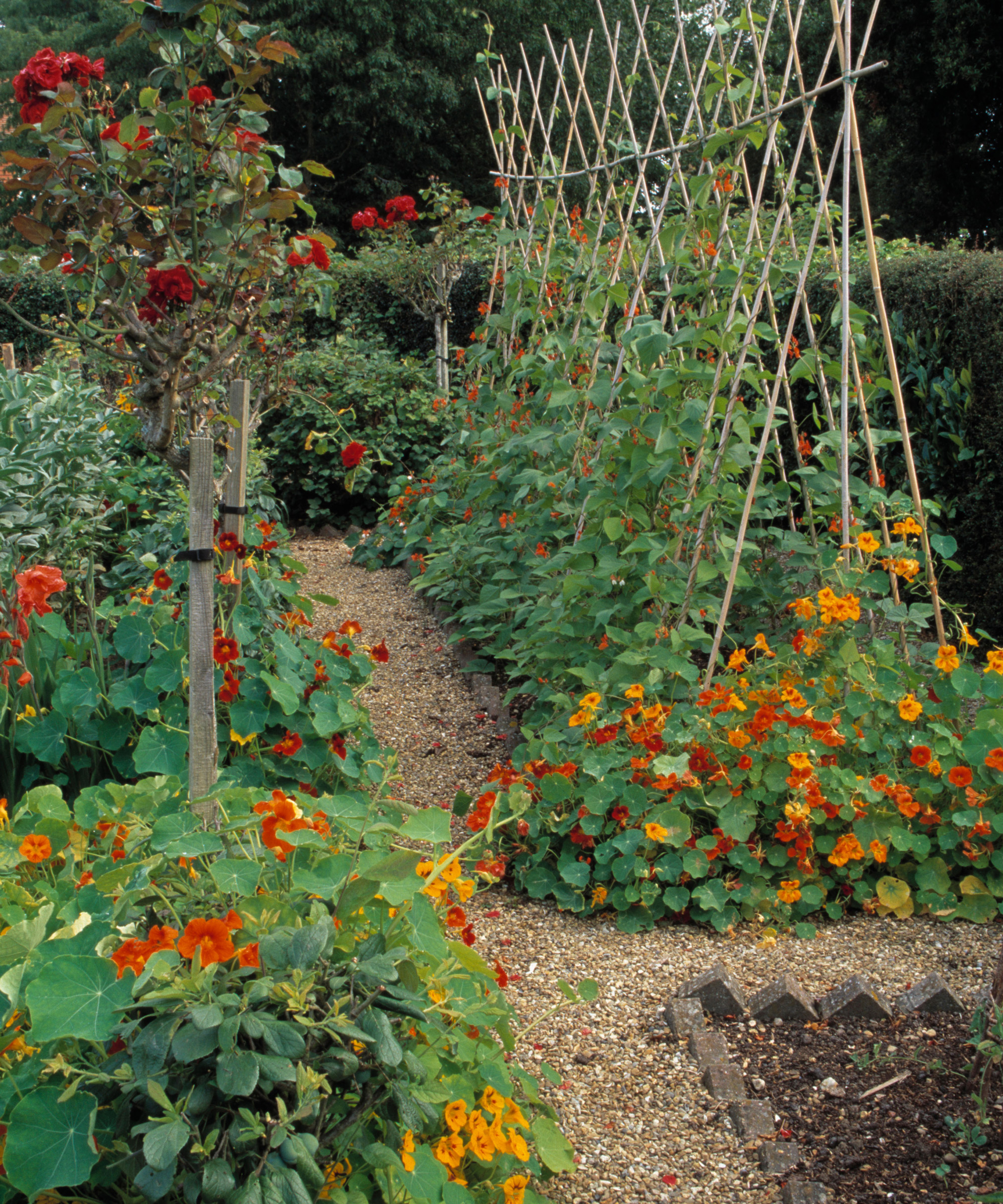
This one grows fast, looks gorgeous cascading down a trellis, and the flowers are edible.
Toss them on a salad and watch your dinner guests be impressed.
Why it climbs so fast: Nasturtium wraps its leaf stems around anything nearby in a twining motion, and it does this with almost no effort, which is why it thrives even when you forget about it for a week.
It also prefers poor, slightly neglected soil, so it isn’t wasting energy fighting rich soil the way other plants do.
Less internal struggle means more energy going straight into growth.
How to get the best from it: Resist the urge to fertilize it heavily.
Rich soil and extra feeding make nasturtium grow more leaves and fewer flowers, which is the opposite of what most people want.
Give it thin support to wrap around and let it be a little neglected.
It’s also nearly impossible to kill, which makes it perfect if your track record with plants is a little rocky.
6. Black Eyed Susan Vine

Smaller flowers, but this vine is a climbing machine once it gets going.
Why it climbs so fast: It twines tightly around thin supports and branches out in multiple directions at once instead of just growing one single leader stem straight up.
That branching habit is what makes it feel like it’s covering the trellis so quickly, because you’re really watching several stems climb at the same time instead of just one.
How to get the best from it: Plant it somewhere warm with strong sun, since this vine slows down noticeably in cooler or shadier spots.
Pinch back the growing tips early on to encourage even more of that branching, which fills out your trellis faster and fuller instead of one thin stem racing straight to the top with nothing underneath it.
It loves warmth and will happily cover a trellis in a single season if you give it enough sun.
Reasons your climbers aren’t growing fast enough
:max_bytes(150000):strip_icc():format(webp)/GettyImages-1394791716-3b0ed13521144152824a02f5787bd51e.jpg)
It’s not the plant that’s slow. It’s the distance between your plant and your trellis.
If you plant your seedling even a few inches away from the structure, the vine has to physically find it first.
Think of a toddler reaching for something just out of grasp.
That’s your vine right now, and it’s wasting precious growing time flailing around in open air.
Plant it close.
Like, close enough that the stem is almost touching the trellis.
I know it looks a little silly at first, practically hugging the structure, but you’ll thank me in three weeks when it’s already climbing instead of still searching.
Know what you are dealing with: Twiners vs Tendrils vs Ramblers

This is the part that separates a thriving trellis from a sad, empty one.
Plants climb in different ways, and if you mismatch the plant with the wrong structure, it simply won’t climb.
It’ll just grow sideways and flop over like it gave up on life.
Twiners (morning glory, beans, honeysuckle) wrap their whole stem around something. They need thin vertical pieces like string, wire, or narrow wood.
Tendril climbers (sweet peas, cucumbers, passionflower) send out little curly fingers that grab onto skinny things.
They need mesh, netting, or lattice with small openings.
Ramblers (climbing roses, bougainvillea) don’t actually climb on their own at all.
You have to tie them to the trellis yourself with soft garden twine.
If you plant a climbing rose and expect it to figure it out like a vine, you’ll be waiting forever.
Match the plant to the mechanism.
This one tip alone will save you more frustration than anything else in this article.
Manually train your climbers
Want to know the little secret experienced gardeners use? Manually train the first few inches.
When your vine has grown four or five inches, gently drape or wrap the tip around the trellis yourself. Just once.
It sounds too easy to work, but that first physical contact triggers something in the plant, and it takes over from there like it finally understood the assignment.
I do this with every single vine I plant now.
It makes the difference between a plant that climbs confidently by July and one that’s still sprawling on the ground in August wondering what its life purpose is.
When to plant for maximum speed

Timing matters and it depends on your climate.
For warm season vines like morning glory, hyacinth bean, and cucumbers, wait until after your last frost date and the soil has warmed up.
Cold soil basically puts these seeds into a stubborn standoff where nothing happens.
For cool season vines like sweet peas, plant as early as you can work the soil.
They prefer the chill, and heat will shut down their blooming fast.
If you’re starting from seed indoors, give yourself a four to six week head start before your outdoor planting date.
Just don’t let those seedlings get leggy and weak sitting on a windowsill.
A floppy, thin seedling won’t have the strength to climb once it hits the trellis.
Give it real light, not just a sunny corner that looks bright but isn’t strong enough.
Where to put your trellis for the best results
Sun matters, obviously.
Most fast climbers want six or more hours of direct sunlight.
But here’s something people miss.
If your trellis is against a wall, check what kind of wall it is.
Brick and stone soak up heat and radiate it back out, which can stress out young, tender vines and slow them down instead of speeding them up.
A freestanding trellis out in the open with good airflow often outperforms one crammed against a hot wall.
It sounds backwards, but I’ve seen it happen in my own garden more times than I can count.
Why there are no climbers on your trellis

If you’re staring at bare trellis wondering what’s wrong, it’s usually one of three things.
The plant and structure don’t match.
The seedling started too far away.
Or you’re just impatient, and I say that with love because we’ve all been there.
Give it three to four weeks after that first real contact with the structure.
Vines have a slow, quiet start and then suddenly explode with growth once the roots settle in.
It’s the plant version of overnight success that took months of work behind the scenes.
FAQs
What plants climb a trellis fast?
Morning glory, sweet peas, hyacinth bean vine, and cucumbers are your top picks.
Morning glory and hyacinth bean twine around thin supports, while sweet peas and cucumbers grab on with little tendrils.
Give any of these the right support and close planting distance and you’ll see real movement within a couple of weeks.
What grows up a trellis quickly?
Anything that either twines or uses tendrils, paired with warm weather and a trellis it can actually grab onto.
Morning glory tends to be the quickest overall, but hyacinth bean catches up fast once the real heat of summer hits.
What is the fastest growing vine for a trellis?
Morning glory usually wins this one.
It can climb six feet in a single season once it gets going.
Just remember it needs something skinny to wrap around, not a wide flat panel, or all that speed goes nowhere.
What grows easily on a trellis?
Nasturtium is about as easy as it gets. It tolerates neglect, doesn’t need rich soil, and climbs without much fuss at all.
Cucumbers are a close second if you keep the soil consistently moist.
What is a good climbing plant for a trellis?
It depends what you want out of it.
Sweet peas for scent, hyacinth bean for heat tolerance, cucumbers if you want something you can actually eat, and morning glory if you just want fast, dramatic coverage.
What is a low maintenance climbing plant?
Nasturtium, hands down. It grows in poor soil, doesn’t want to be fertilized, and practically climbs on its own.
Black eyed susan vine is a close second once it’s established.
What can I plant to grow up a trellis?
Pick based on your climate and what mechanism your trellis supports.
Thin wire or string calls for twiners like morning glory or hyacinth bean.
Mesh or lattice calls for tendril climbers like sweet peas or cucumbers. Match the plant to the structure and you’ll get climbing, not sprawling.
Related Posts: