8 Front Yard Flower Ideas That Will Make Your Neighbors Stop and Stare (No Landscaper Needed)
Last Updated on May 27, 2026 by Duncan
My neighbor Margaret has this front yard that genuinely makes the rest of us on the street feel a little embarrassed.
Last summer I finally walked over and asked her what she planted. I expected some complicated answer involving Latin plant names and expensive landscaping contractors.
She laughed. “Honey, I just know which flowers go where.”
That conversation changed how I think about front yards entirely. It’s not about spending more.
It’s not about working harder. It’s about understanding a few simple principles and then letting the right flowers do the rest.
This is everything Margaret taught me, plus a few things I learned the hard way over three seasons in my own yard.
Why Curb Appeal Actually Matters

When I was house-hunting four years ago, I drove past a property and dismissed it before I even parked the car.
Overgrown, no color, nothing welcoming. My realtor told me later the inside was completely renovated. I never saw it.
That’s how powerful first impressions are. Studies show strong curb appeal can add up to 10% to a home’s value but the real cost of a neglected front yard is harder to measure.
Flowers are one of the fastest, most affordable ways to rewrite that impression. I spent under $80 on plants my first season and had three neighbors ask who did my landscaping.
If only they knew.
Pick Your Colors First (Most People Skip This)

The result looked like a toddler had been given a crayon box and told to go wild.
Margaret saw it and kindly said “it’s very cheerful.” I knew what she meant.
Before you buy a single plant, decide on your colors. Pick two or three and commit to them.
Two or three colors done well beats six colors done randomly every single time.
Combinations that always look intentional:
- Purple + white + silver — elegant and timeless
- Yellow + orange + red — warm, bold, eye-catching
- Pink + white + green — soft, romantic, classic
- Blue + white + yellow — fresh and cheerful
I switched to purple, white, and silver in year two. My yard instantly went from “cheerful” to genuinely beautiful.
The 8 Flowers And How to Use Each One
1. Roses: Use Them as Your Anchor Plant

The first time I tried to grow roses, I killed them within a month. I planted them in a shady corner because I thought they looked pretty there, watered them every day, and then wondered why they turned yellow and gave up on life.
The fix was embarrassingly simple: roses need sun. Six hours minimum. Move them somewhere they actually get it and they will surprise you.
Use roses as your anchor plant as they define the whole look.
A climbing rose on a trellis beside your front door is one of the most welcoming sights in residential gardening. It tells visitors that the person living there pays attention.
Margaret has a pale pink climber that frames her entrance from May to September. It’s the reason I stopped my car in the first place.
Best for beginners: shrub roses — hardier, bushier, and far more forgiving than climbers.
Care tips:
- Water deeply once a week, not a little every day
- Give them room — crowded roses get diseases fast
- Plant in full sun, always
2. Lavender: The Low-Maintenance Showstopper

I planted lavender three years ago half expecting it to die. It didn’t. It came back bigger the next year. And the year after that.
Now it’s the plant I recommend to literally everyone because it asks for almost nothing and gives so much back.
Those purple spikes are beautiful from the street, but the fragrance is what gets people. Last summer a woman walking her dog actually stopped in front of my yard, closed her eyes, and just stood there for a moment.
That’s what lavender does.
Plant it along your front path or as a low border in front of taller plants. The silvery-green foliage looks good even when it’s not blooming — which means it’s doing its job year-round.
Two non-negotiables: full sun and well-drained soil. It will rot in soggy ground — plant on a slope or in a raised bed if your yard holds water.
3. Salvia: The Background Builder

Salvia is the unsung hero of the front yard. Nobody gets excited about it at the nursery.
Nobody posts photos of it on Instagram. But every beautiful front yard I’ve ever admired up close has had it somewhere in the background, quietly making everything else look better.
My neighbor across the street, a retired biology teacher who’s been gardening for forty years told me salvia is what separates a “planted” yard from a “designed” one. I didn’t understand what he meant until I added it. And then I immediately understood.
Those tall purple-blue spires add height and structure. They’re the backdrop that makes your roses and coneflowers pop. Plant them in the middle or back of your border and let the shorter plants shine in front.
Bonus: it blooms from late spring through fall if you deadhead it. Bees never leave it alone, which I consider a great feature.
4. Black-Eyed Susans: The Cheerful Workhorse

There’s a house at the end of my street that’s been empty for two years.
And yet every August, a huge cluster of Black-Eyed Susans blooms along the front fence like clockwork. Nobody waters them. Nobody tends them. They just show up.
That’s the kind of plant we’re talking about.
Bright yellow petals, dark brown center, nearly impossible to kill. They bloom from midsummer well into fall when a lot of prettier flowers have given up for the year. Over time they spread, filling in gaps and saving you money on new plants.
For maximum impact: plant in clusters of five or seven — they read much better from the street in odd-numbered groups.
Drought-tolerant, butterfly-friendly, and genuinely cheerful. I’ve never once had a bad season with them.
5. Marigolds: The $12 Hero

When I first started gardening I thought marigolds were beneath me. Too common. Too basic. The kind of flower you see outside every petrol station and supermarket entrance.
Then I spent $12 on two trays, lined them along my front path, and had more compliments that summer than from anything else I’d planted.
Sometimes the obvious choice is obvious for a reason.
Marigolds stay low and compact, bloom all season without much fuss, and come in the warmest oranges and yellows you’ll find in any garden center. Use them as edging plants along a walkway or at the very front of your border.
Hidden benefit: marigolds repel aphids and other pests — plant them near your roses every year and watch what happens.
Care: pinch off dead flowers regularly and they’ll keep blooming right up until the first frost.
6. Hydrangeas: The Volume Flower

A few years ago I visited a friend who had just moved into a new house. The front was pretty bare — just lawn and a few scrubby bushes.
The following summer I drove past and nearly didn’t recognize it.
Three hydrangeas under the front windows had grown into enormous, lush mounds covered in white and pale blue blooms. The house looked like it cost twice as much.
That’s what well-placed hydrangeas do.
No other plant adds that kind of volume and lushness for the money. The blooms last for months, and even as they dry on the plant they hold a beautiful papery form that looks good well into fall.
Plant them against the house or as a low hedge along the front. Space at least three to four feet apart and water consistently — they’ll reward you for years.
Worth knowing: on some varieties, acidic soil gives you blue blooms and alkaline gives you pink. Check your soil pH before you plant if the color matters to you.
7. Coneflowers: The Wildlife Magnet

My daughter is five.
The main reason I started growing coneflowers is because she screamed with delight the first time a Monarch butterfly landed on one in our front bed and stayed long enough for us to really look at it.
That’s what coneflowers do. They make the yard feel alive in a way other flowers simply don’t.
Butterflies, bees, and birds are drawn to them constantly through summer.
When the petals drop in fall, the seed heads become a winter food source that keeps birds coming back through the cold months.
They’re also one of the toughest plants on this list drought-tolerant, heat-resistant, and they spread and multiply over time.
I started with five plants three years ago and now have what I can only describe as a coneflower situation.
They come in purple, pink, white, orange, and yellow.
Let the seed heads stand through winter rather than cutting them back. It looks beautiful in a moody, structural way and the birds will thank you.
8. Petunias: Your Secret Weapon at the Door

Petunias are my cheat flowers. When I want the front of the house to look great with minimal effort and maximum color, I grab two or three trays and fill my entrance pots.
They bloom from spring to the first frost. They come in every color imaginable.
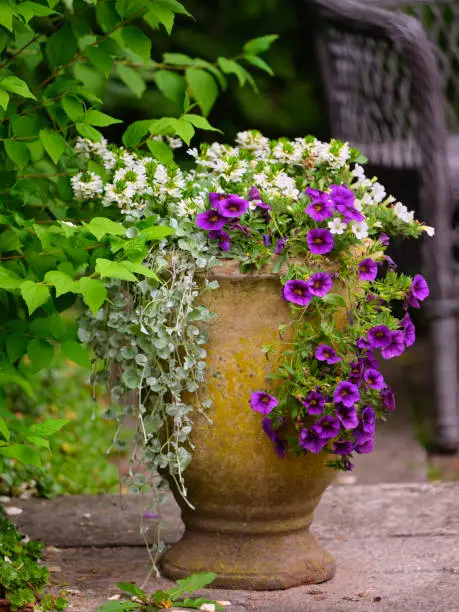
They cascade beautifully over the edges of containers, softening hard lines and adding instant life. And they’re cheap enough that if you lose a few, it’s not the end of the world.
The easiest upgrade you’ll make: place two matching pots of cascading petunias on either side of your front door. That’s it. Instant improvement.
Care: water consistently and feed every couple of weeks. If they get leggy mid-season, give them a hard trim — within two weeks they’ll look brand new.
How to Arrange Them for an Elegant Look

Here’s what nobody tells you about front yard gardening: the plants matter less than the arrangement.
I’ve seen expensive, exotic flowers look like a mess and simple, common ones look like a professional designer was involved. The difference is almost always how they’re placed.
The Layering Rule: Tall, Medium, Short
This single principle changed my front yard more than any plant purchase ever did.
Arrange everything in three layers, back to front, like seats in a theatre — so every plant is visible from the street and nothing hides behind something taller.
| Layer | Plants | Purpose |
|---|---|---|
| Back (tallest) | Hydrangeas, Salvia | Structure and height |
| Middle | Roses, Black-eyed Susans, Coneflowers | Main color and interest |
| Front edge | Lavender, Marigolds, Petunias | The finishing border |
The first year I planted without this rule, everything was a jumble.
The second year I rearranged using this system and people started stopping to look. Same plants. Completely different outcome.
Always Use Odd Numbers
This comes from basic design theory but it works just as well in a garden. Groups of 3, 5, or 7 look natural and alive.
Groups of 2 or 4 look stiff and formal.
My biology teacher neighbor explained it to me once: even numbers create symmetry the brain reads as static.
Odd numbers create a slight visual tension that keeps the eye moving. In the garden, you want the eye to move.
Simple rule: never plant two of anything side by side. Always three.
Create One Focal Point Near Your Entrance

Everything, the lavender border, the salvia in the back, the marigolds along the path, leads your eye toward the rose and the door.
Every elegant front yard has one place the eye naturally lands. For almost every home, that place should be your entrance.
Use a climbing rose on a trellis, a pair of large hydrangeas framing the door, or a dramatic pot of mixed flowers on the front step.
Pick one and make it the clear star. Then let everything else play a supporting role.
Repeat Plants and Colors for Rhythm
The first time I visited a proper show garden I couldn’t figure out why it looked so much more expensive than anything I’d seen in real yards. A gardener explained it: repetition.
The same plants appeared at intervals throughout the whole design, creating a visual rhythm that made everything feel unified and intentional. You don’t need a show garden budget to do this.
If lavender appears at one end of your border, plant it at the other end too.
If marigolds line the left side of your path, mirror them on the right. Your yard starts to feel planned rather than assembled.
3 Color Combinations That Always Work
Cool and romantic Purple salvia + pink roses + white hydrangeas + purple coneflowers This is what Margaret grows. Soft, cohesive, and it photographs beautifully.
Warm and bold Yellow black-eyed susans + orange marigolds + red roses + yellow petunias High energy and impossible to miss from the street.
Soft and natural Lavender + white coneflowers + pale pink hydrangeas + white petunias Understated and elegant — the kind of yard that makes people slow down without knowing why.
The Complete Layout (Copy This)
If you want one arrangement to follow without overthinking it:
| Position | What to plant |
|---|---|
| Against the house | Hydrangeas every 4 ft, alternating with salvia |
| Middle of the bed | Roses near the entrance; black-eyed susans + coneflowers in groups of 5 on either side |
| Front border | Continuous lavender with clumps of marigolds every few feet |
| At the door | Two matching pots of cascading petunias, one on each side |
One Last Thing
The summer after I talked to Margaret, I replanted my entire front border using everything she’d told me. By August it still looked thin and bare. I almost pulled it all up.
I didn’t. The following June it was unrecognizable. Full and layered, with the lavender spilling over the front edge and the hydrangeas enormous against the wall and the climbing rose finally reaching the top of its trellis.
A woman stopped on the pavement, looked at it for a moment, and said: “Whoever planted that really knows what they’re doing.”
I thought of Margaret. I thought of my biology teacher neighbor. I thought of the one season of patience it took to get there.
If this feels like too much, start small. Get your hydrangeas and salvia in the ground — just the back layer. See how they settle. Add the middle layer next season. Finish the edges after that.
By year two, you’ll have a front yard that stops people. And you’ll know exactly why it works.
Related Posts: