Caged Bird Feeder Ideas That Keep Squirrels Out and Small Birds In
Last Updated on June 4, 2026 by Duncan
Imagine this. You filled the feeder on Sunday and by Tuesday, it was empty.
And the sad part is that a squirrel was chilling nonchalantly on the pole above, looking hefty, sunflower seeds dribbling from its mouth.
These critters are bold. Then again, if it’s not the squirrels causing trouble, it’s those grackles, ganging up, noisy, greedy bunch leaving zilch for the timid chickadees hovering about.
If you don’t want this to go on, you have a solution. Caged bird feeders. Just wrap the feeder in wire mesh.
This leaves bullies out while letting tiny birds in. Finch or wren? No sweat, they slide right through. But a squirrel? Hits the cage, and physics keeps them out.
Are caged bird feeders good?

Yes, but with a tiny catch. Caged feeders deliver on their promise. They stop squirrels and big birds with that wire mesh, only slightly annoying the tiny songbirds you want to attract.
Anyone who’s struggled with feeder troubles, whether it’s pole greasing, buying so-called “squirrel-proof” feeders that fail, or just giving in and overfilling, finds caged feeders way more effective. They seem almost too good at doing what they’re supposed to.
They also cut down on seed waste significantly. Large birds like starlings and grackles are messy, frantic eaters.
They fling seed everywhere, attract more of their kind, and can drain a feeder in a single sitting.
Smaller birds feed more deliberately, and with the cage keeping the big ones out, your seed goes further and your feeder stays fuller for longer.
Wondering what is the catch? Cage size matters.
A standard cage with openings around 1.5 inches will welcome chickadees, finches, wrens, and nuthatches, but may turn away a cardinal, which is a bird many backyard birders specifically want to attract.
If cardinals are a priority for you, look for adjustable cage designs or wider-gap mesh before committing.
Cleaning is another thing. You’ve got to take apart the cage to really scrub everything properly, and letting it pile up makes that task pretty dreary. This is something you should be aware of before setting it up.
Overall, caged feeders are a smart addition for anyone into backyard birding. They aren’t fancy or complicated; they just quietly work well.
Why should you use caged bird feeders?
If a squirrel emptying your feeder was the only problem, a baffle on the pole might be enough.
But the reasons people turn to caged feeders run a little deeper than that and bird feeders come in to the rescue with their many benefits that include:
They stop squirrels without a fight
Squirrels are persistent, creative, and frankly impressive problem-solvers. They’ve defeated spinning mechanisms, weight-sensitive perches, and pole grease with equal enthusiasm.
A cage doesn’t try to outsmart them. Instead it simply makes the seed physically unreachable.
There’s nothing to defeat. The squirrel hits the mesh, realizes it’s not getting through, and moves on. It’s less of a battle and more of a closed door.
They give small birds their space back

Bully birds such as starlings, grackles, pigeons, house sparrows in large numbers don’t just eat your seed, they dominate the space.
Smaller birds like chickadees and goldfinches won’t compete and in most cases simply leave and not come back.
A caged feeder flips that dynamic entirely. Suddenly the feeder belongs to the small birds, and they know it. You’ll notice them lingering longer, feeding more calmly, and returning more often.
They stretch your seed budget
Bird seed adds up, especially through winter. When a feeder is open to every creature in the neighborhood, you’re essentially running a free buffet with no guest list.
The cage narrows the list considerably, and the seed you put in on Monday is far more likely to still be there on Thursday.
They offer quiet weather protection
This one often goes unmentioned. The mesh cage creates a partial buffer around the feeder, breaking wind and deflecting light rain.
It won’t survive a downpour on its own, but your seed stays drier longer than it would on an exposed open feeder.
They reduce ground mess
As mentioned above, they reduce the ground mess. Less mess below the feeder means fewer rats, fewer ants, and less of that soggy decomposing seed pile that nobody wants to deal with in summer.
Which birds can use caged feeders?

The beauty of a caged feeder is that the birds it welcomes tend to be exactly the ones worth watching.
These are often the quick, acrobatic, vividly colored little creatures that make backyard birding worthwhile in the first place. They include:
Chickadees
They are made for caged feeders. Bold, curious, and completely unbothered by new objects in their environment. In most cases, they’ll investigate a caged feeder within hours of it going up.
Black-capped and Carolina chickadees both fit easily through standard mesh openings and will shuttle back and forth between the feeder and nearby branches all day long.
Finches
Goldfinches, house finches, and purple finches are slim, agile birds that slip through cage gaps without breaking their stride.
Goldfinches in particular are a delight to watch up close, and a caged nyjer feeder will bring them in reliably through spring and summer.
Wrens and nuthatches
These are small enough to enter with ease and acrobatic enough to feed at odd angles. They can feed upside down, sideways, and event when clinging to the cage itself.
Nuthatches are especially entertaining where they walk headfirst down the mesh like it’s nothing.
Downy woodpeckers
They are the smallest of the woodpecker family and can fit through wider cage openings and will happily work a suet feeder enclosed in mesh.
Their larger cousins, the hairy woodpeckers, red-bellied woodpeckers will be stopped by the cage, though they’ve been known to cling to the outside and fish for seed with their long tongues, which is honestly worth watching.
Titmice and sparrows
These round out the regular visitors. They are both comfortable navigating the cage and content to share the space with other small species.
What you won’t see inside the cage and this is the point, are starlings, grackles, pigeons, jays, and squirrels. You should note that this doesn’t mean they won’t visit your yard.
They will even perch on top of the cage and look indignant about the whole situation. But the seed? They won’t access it. That’s not for them anymore.
How to Build a Caged Bird Feeder

Building your own caged feeder is one of those satisfying projects that costs very little, takes an afternoon, and pays off every single day you look out the window. And the beauty is that you don’t need woodworking skills or a garage full of tools.
In most cases, just wire mesh, a few basic supplies, and a feeder to wrap it around, and you are good to go.
What you’ll need:
- An existing tube or hopper feeder
- Hardware cloth or hex wire mesh (1.5-inch openings for most small songbirds)
- Wire cutters
- Pliers
- Zip ties or thin gauge wire for fastening
- A measuring tape
- Optional: a metal ring or embroidery hoop to frame the top and bottom
Step 1: Measure your feeder.
Start with wrapping the tape around the widest point of your feeder and note the circumference.
Add about three inches to that measurement to give the cage enough clearance. You want a gap between the feeder and the mesh so birds have room to perch inside and feed comfortably.
Step 2: Cut your mesh.
Roll out the hardware cloth and cut a rectangle tall enough to cover the full height of the feeder, and wide enough to wrap around with a couple of inches of overlap.
You should cut carefully taking care as the edges are sharp. Gloves are worth wearing here.
Step 3: Form the cage.
Bend the mesh into a cylinder around the feeder. Use pliers to crimp the overlapping edges together, or thread zip ties through the mesh at several points along the seam to hold the shape. The cage should sit around the feeder without touching it on all sides.
Step 4: Close the top and bottom.
Cut two circles of mesh for the top and bottom caps, or use metal rings to frame the openings. Fasten them securely with zip ties or wire. Leave the top loose enough to lift off when it’s time to refill or clean.
Step 5: Hang it.
Thread the feeder’s existing hook or chain up through the top of the cage and hang it from your usual spot. Give it a gentle shake to make sure everything is secure before you walk away.
A few tips before you finish
Avoid plastic-coated mesh if you can as the squirrels will chew through the coating and eventually compromise the wire underneath. Galvanized or stainless steel hardware cloth lasts far longer outdoors.
You should keep the cage openings between 1.5 and 2 inches for most small songbirds. You should note that anything wider starts letting in birds you may not want.
At the same time, anything narrower may frustrate even the small ones.
You should position the feeder inside the cage so that the feeding ports align with gaps in the mesh. If you don’t do this, you will have built an elaborate system to starve your birds. And you don’t want this.
What if you don’t want to build? Best caged feeders you can buy
Not everyone wants to spend a Sunday wrestling with wire mesh and pliers and that’s completely fair. The good news is that commercial caged feeders have come a long way.
The best ones are sturdier than most DIY builds, easier to clean, and designed with small details that take years of trial and error to figure out on your own.
Some have advanced features such as removable cage panels, drainage holes in the seed tray, and rust-resistant coatings that actually hold up through winter.
The options below cover different budgets, feeder styles, and yard setups, so whether you’re feeding a small apartment balcony or a sprawling garden, there’s something here worth considering.
One thing to check before buying: cage opening size. Not all manufacturers list it clearly, but it matters more than the brand name or how good it looks in the product photo.
The options you have include:
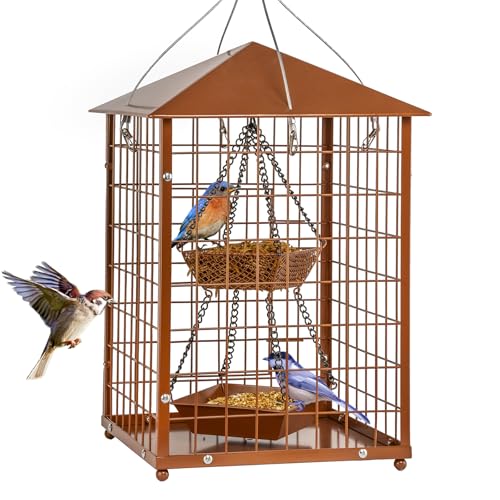
Maansfy Mealworm Caged Bird Feeder for Bluebirds
Last update on 2026-07-04 / Affiliate links / Images from Amazon Product Advertising API
If you’re specifically trying to attract bluebirds, this feeder earns its place.
Most caged feeders are built around seed but this one leads with mealworms, which bluebirds strongly prefer and which most generalist feeders completely ignore.
The two interior cups sit well inside the cage, meaning squirrels and starlings can see the food but have no realistic way to reach it through the 1.3 x 1.8 inch grid openings.
The cage itself is heavy-duty metal.
Not the lightweight wire that bends out of shape after one determined squirrel and the roof lid does a decent job of keeping rain off the food, which matters a lot with mealworms since they go bad quickly when wet.
At 13 x 13 x 19.5 inches it’s a generously sized feeder, and the detachable assembly makes cleaning straightforward rather than a project.
One honest note: bluebirds can be slow to discover a new feeder, sometimes taking several weeks to start visiting regularly.
That’s not a flaw in the design but bluebird behavior. Place it in an open area with a clear sightline, keep the mealworms fresh, and patience will do the rest.
Best for: Backyard birders specifically targeting bluebirds who want a ready-made, no-assembly-required solution that keeps squirrels and larger birds completely out.
Kingsyard Dual-Use Metal Mesh Wild Bird Feeder with Weatherproof Dome

Last update on 2026-07-04 / Affiliate links / Images from Amazon Product Advertising API
Earlier in this article we mentioned that cardinals are the one bird a standard caged feeder tends to shut out.
This is because its too wide-bodied for most mesh openings. In most cases these birds hover at the edge and move on.
This Kingsyard feeder is a direct answer to this problem.
The metal mesh design is open enough to welcome cardinals, finches, chickadees, nuthatches, and titmice, while the dome on top does double duty where it shields seed from rain and snow, and can be adjusted low enough to block larger birds from swooping in from above.
The dual-feeder setup is a genuinely useful feature where you can run two different seed types at once, which means attracting a broader mix of species without putting out a second feeder entirely.
At 2.5 lbs seed capacity it won’t need refilling every other day, and the all-metal construction means squirrels will chew on it with zero success.
It holds a strong 4.4-star rating from over 1,500 reviews, which for a bird feeder says something.
Best for: Birders who want the protective benefits of a caged-style feeder without locking cardinals out of the equation.
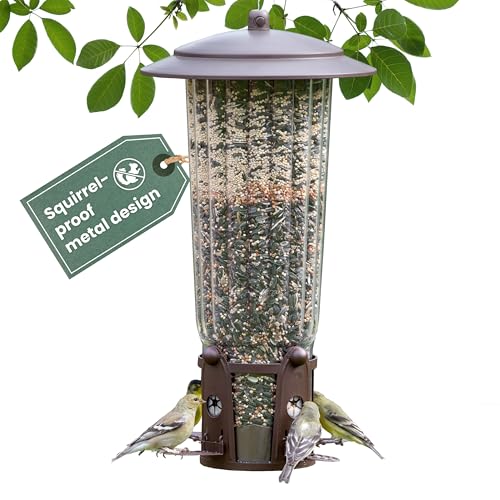
Perky-Pet Squirrel-Be-Gone Max Bird Feeder (334-1SR)
Last update on 2026-07-04 / Affiliate links / Images from Amazon Product Advertising API
Most of the feeders in this list stop squirrels with a cage.
This one takes a different approach and it’s worth including because it solves the same problem in a way that also works for larger birds like cardinals that a standard cage would turn away.
The Squirrel-Be-Gone Max uses a weight-activated Seed Shield: the perches are calibrated to hold the weight of a small bird comfortably, but the moment something heavier such as a squirrel, a grackle, a pigeon lands on them, the shield drops and closes off access to the seed ports entirely.
No cage gaps to worry about, no mesh sizing calculations. The squirrel sits down, the feeder shuts, the squirrel leaves confused.
The four patented Flexports are designed to be four times more shake-resistant than standard ports, which matters because squirrels often try to rattle seed loose even when they can’t reach it directly.
At 9 x 9 x 17.5 inches, it needs about 18 inches of clearance on all sides to work at its squirrel-proof best, so placement away from branches and fences still applies.
One honest caveat worth flagging: some long-term owners report that the Flexports begin to degrade after a couple of years, and replacement parts aren’t easy to source.
This is a real limitation on an otherwise well-designed feeder which is something to factor in if you’re looking for a decade-long setup rather than a two-to-three year solution.
It carries a 4.0-star rating across over 6,200 reviews which is a large enough sample size which means the rating means something.
Best for: Birders who want squirrel protection without excluding cardinals or larger songbirds, and who are comfortable replacing the feeder every few years if needed.
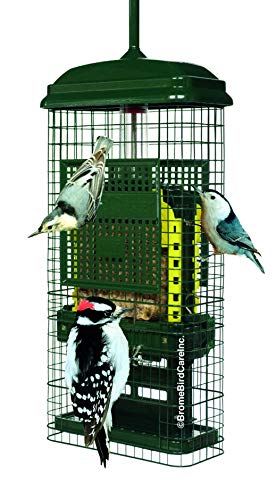
Squirrel Buster Suet Squirrel-Proof Suet Bird Feeder
Last update on 2026-07-04 / Affiliate links / Images from Amazon Product Advertising API
Suet is a different game from seed. It attracts a different crowd made up of woodpeckers, nuthatches, wrens, titmice, jays and it comes with its own set of problems, namely squirrels who will tear through a suet cake in a single sitting and raccoons who will simply pull the whole feeder down.
The Squirrel Buster Suet is built specifically for this challenge, and it handles it well.
The mechanism is the same weight-activated shroud system that the Squirrel Buster range is known for which is a patented spring adjusts to support the weight of birds but triggers the closing mechanism the moment anything heavier lands on it.
A squirrel jumps on, the shroud drops, access denied.
Every part of the feeder exposed to squirrels is made from either chew-proof metal or RoxResin, a 100% chew-proof, waterproof, and UV-stabilized material so there’s no plastic edge for a determined squirrel to work through over time.
A couple of details separate this from cheaper suet feeders. The mess-free suet loading means no greasy fingers when refilling, which sounds small but makes a real difference when you’re handling suet in winter.
There’s also a crumb port at the base that catches falling suet fragments so birds can recycle them rather than losing them to the ground which is a genuinely clever touch that cuts waste without any extra effort on your part.
It holds two full suet cakes and carries a 4.5-star rating from over 1,200 reviews, which puts it among the better-reviewed suet feeders in this category.
Best for: Anyone specifically trying to attract woodpeckers and clinging birds with suet, who’s tired of squirrels dismantling cheaper cages to get at it.
FAQs
Why aren’t small birds using my new caged feeder?
You need to be patient. If you replaced an existing feeder with a caged one, the birds may simply be spooked by how different it looks.
Small birds that were previously bullied away from that spot may also need time to realize the dynamic has changed and it’s now safe to approach.
Give it a week, keep the feeder full, and place it in the same spot as before so the location still registers as a food source.
Shelter nearby such as a shrub or tree within a few feet comes in handy at helping timid species feel confident enough to visit.
Will a caged feeder stop all squirrels?
Most of them, most of the time. A cage is far more reliable than weight-sensitive perches or spinning mechanisms, but how you place the cage still matters.
If the feeder hangs within jumping distance of a tree, fence, or roof, a determined squirrel may land on top and find a way in from above.
The best way out is to position the feeder at least five feet from any structure and you’ll close that loophole.
Can cardinals use a caged feeder?
Standard cages with 1.5-inch openings will turn cardinals away as they’re simply too wide-bodied to fit through comfortably.
If cardinals are important to you, look for feeders with adjustable cage spacing, or run a separate open tray feeder alongside your caged one to keep everyone happy.
How often should I clean a caged feeder?
Every one to two weeks is a reasonable routine, and more frequently during wet weather when seed can mold quickly.
The cage adds a step to the process, but most designs allow the outer mesh to detach or hinge open for access.
A bottle brush, warm soapy water, and a good rinse is all it takes. Let everything dry fully before refilling.
What’s the best mesh size for a DIY caged feeder?
A 1.5-inch hex opening is the sweet spot for most small songbirds.
This mesh is wide enough for chickadees, finches, wrens, and nuthatches, and at the same time tight enough to exclude starlings and grackles.
If you want to also allow downy woodpeckers, you can go slightly wider at 1.75 inches. Anything above 2 inches starts letting in birds the cage was meant to exclude.
Will a caged feeder harm the birds?
No. The birds enter and exit freely and the cage doesn’t trap them. The mesh openings are large enough that there’s no risk of a bird getting stuck, provided you’re using the right gap size.
The cage actually makes feeding safer for small birds by shielding them from larger, aggressive species while they eat.
Parting shot
Backyard bird feeding is supposed to be simple. Put seed out, watch birds arrive, repeat. But anyone who’s dealt with a squirrel-hollowed feeder or a grackle takeover knows how quickly it stops feeling simple.
A caged feeder doesn’t fix everything, but it fixes the most frustrating parts, and it does so without complicated mechanisms, batteries, or a weekly battle of wits with a rodent.
What you’re left with is a feeder that works quietly in the background.
One where the chickadees actually stay long enough for you to watch them, where your seed lasts the week, and where the smaller, shyer species that usually get pushed out finally get a seat at the table.
Whether you buy one or spend a Sunday afternoon building your own from hardware cloth and zip ties, the investment is modest.
The return is a calmer, fuller, more interesting feeder that tends to stick around a lot longer than the squirrels.
Put it up, give the birds a few days to adjust, and then just watch. That’s the whole point anyway, isn’t it?
Related Posts: