Window Bird Feeders vs. Pole Feeders: Which Gets More Traffic?
Last Updated on July 23, 2026 by Duncan
Everyone’s going to tell you pole feeders win. Your neighbor swears by his.
Some guy on a birding forum wrote a 600-word essay about it. They’re all repeating the same thing: “birds fear glass.”
Here’s the thing: That was true-ish thirty years ago. It’s not really the whole story anymore.
I’ve had both types in my yard for years, made every mistake possible, and watched way too many birds ignore my expensive pole setup while crowding onto a $12 window feeder from Amazon.
Let me save you some time and money.
The “Birds Fear Glass” Argument Is Getting Old
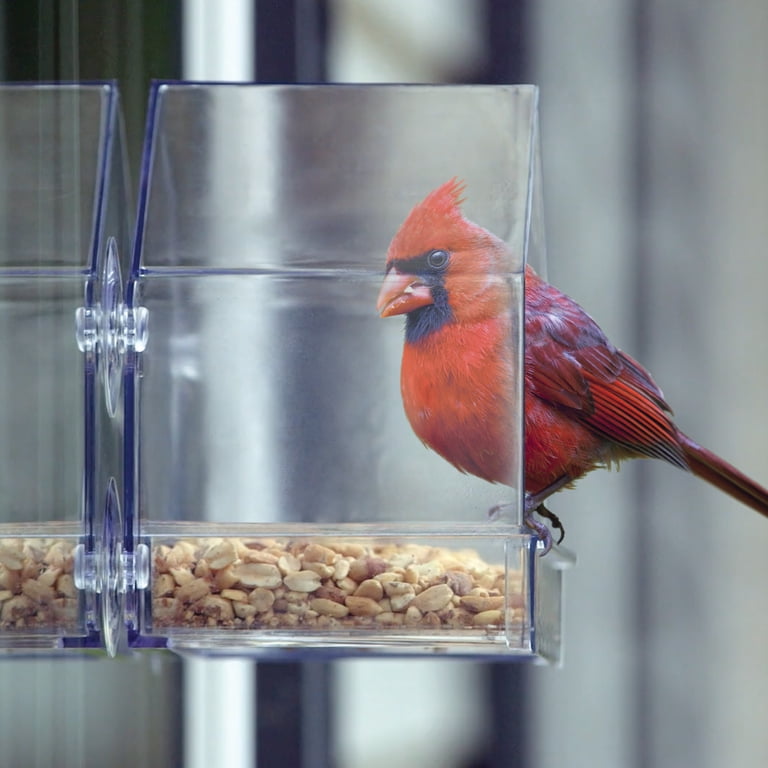
My first window feeder lasted about three days before I convinced myself birds hated it. Barely any visitors, a lot of nervous hovering. I was ready to return it.
Then a chickadee landed on day four and didn’t leave for ten minutes.
By the end of the week, I had a nuthatch, two finches, and a tufted titmouse treating it like a diner booth. The glass wasn’t the problem. I just needed to wait.
Modern window feeders have matte trays, frosted edges, and anti-reflective surfaces specifically designed to knock out the fear factor.
Chickadees, nuthatches, and finches figure it out in 3 to 5 visits. The birds that stay nervous longest such as thrushes, warblers aren’t your big traffic drivers anyway.
So let’s stop letting them win the debate.
Why Your Pole Feeder Might Be Sitting Empty
I spent $60 on a cedar pole feeder one spring, set it up dead center in my backyard, and watched it do absolutely nothing for eleven days. Eleven.
I thought I’d bought a very attractive lawn ornament.
Here’s what nobody tells you at the garden center: birds have to discover the feeder first, and a pole in the middle of an open lawn is not on anyone’s radar yet.
Birds naturally follow building edges. Your house is already on their daily route. Your pole in the open grass?
That’s a detour they have to decide is worth it. A window feeder on a wall they already fly past gets sampled within two or three days.
Most people put the pole feeder out, check it after a week, decide their yard is bad for birds, and give up. The yard is fine. They just measured too early.
The Hidden Stuff That Drives Traffic
This is where it gets interesting.
The feeder type is almost never the deciding factor. What actually matters:
Your wall’s warmth. My south-facing kitchen wall gets morning sun and stays warm well into the afternoon.
I noticed years ago that birds seemed to hug that wall on cold mornings almost using it as a windbreak.
Turns out there’s actual physics behind this: warm walls create a thin column of rising air that chickadees, nuthatches, and titmice ride to conserve energy, especially in winter when every calorie counts.
Put a window feeder on that wall and you’re intercepting birds already in motion.
Your pole feeder sitting six feet away from that warm corridor requires them to step off their route. In January, some of them just won’t bother.
How many ways a hawk can attack. I had a Cooper’s hawk set up shop in the oak tree behind my pole feeder two winters ago.
Traffic dropped by half and I couldn’t figure out why for weeks.
Then I watched him stoop on a finch from above clean, open angle, no obstacles.
Birds don’t just check for predators. They calculate escape options.
A window feeder pressed against your house eliminates three attack vectors just by existing there. The building is a physical shield.
Smaller, nervous birds such as juncos, finches, sparrows notice this immediately. My window feeder stayed busy all winter while the pole feeder sat quiet.
Smell. This one surprised me.
Wooden pole feeder trays absorb seed oils and droppings over time, and raptors leave a scent that lingers and makes smaller birds uneasy even when no hawk is visible.
Glass doesn’t absorb anything.
One good rain and your window feeder smells like nothing. It’s a small thing, but it adds up over a season.
Where People Go Wrong (And Blame the Birds)
I’ve made most of these mistakes personally. Some of them twice.
The frost failure: First winter I had a window feeder, it fell off the glass during a hard freeze in December.
Standard suction cups just let go when the temperature drops fast enough.
Seeds rotted on the sill, birds showed up to an empty spot, and it took almost a month to get that traffic back.
The bird’s mental map had marked the location as unreliable.
The fix is silicone-reinforced or clip-mount suction cups rated for cold temps about five bucks.
I now consider it mandatory.
The hawk perch you didn’t notice: That Cooper’s hawk I mentioned?
His favorite perch was a utility pole about 35 feet from my feeder. My morning traffic looked fantastic.
From mid-morning on, nothing. I spent two weeks thinking it was heat suppression before I actually sat and watched for an hour.
You’ll blame the heat. It’s not the heat.
The corner window trap: I hung a feeder right at a corner where two glass panes met on the side of my house.
Birds kept having minor collisions when they flushed suddenly not fatal, but enough to stun them.
Turned out those stressed birds leave a scent that suppresses visits for days.
I moved the feeder 18 inches from the corner and the difference was noticeable within a week.
Too many pole feeders in a neighborhood: My street has six houses with pole feeders within a 200-foot stretch.
Cardinals and house finches have basically carved up the airspace into micro-territories and every feeder is hitting a ceiling.
You can’t out-seed your neighbors for the same birds.
A window feeder at a different height breaks out of that competition entirely as birds treat it as a separate habitat layer and don’t apply the same territorial rules.
The Setup That Works: Use Both
The year I stopped thinking about which feeder was better and started treating them as a system was the year my yard actually became what I’d always wanted it to be.
Here’s what happens when you sequence them right:
A bird enters your yard for the first time and it’s on high alert.
The window feeder, pressed against your house, half the attack angles blocked, roofline escape a second away which is the low-risk entry point.
The bird grabs a few seeds, survives, and logs your yard as “probably safe.”
After a few visits, it relaxes. Now the pole feeder, which has more seed variety and higher capacity, becomes appealing because the bird already trusts the neighborhood.
The window feeder wasn’t competing with the pole feeder. It was the on-ramp to it.
How to run this in practice:
Put the window feeder up first. Give it 10 to 14 days before the pole feeder goes in. Let birds get comfortable with your yard before you add the more exposed option.
Place the pole feeder within about 20 feet of the window feeder so birds transfer their existing comfort level rather than recalibrating from scratch.
Put different seed in each.
I run sunflower chips in the window feeder which is clean, high-value, no mess on the sill.
Mixed blend in the pole feeder for volume and variety. They pull in different birds for different reasons, and the yard feels genuinely alive most mornings now.
A Few Placement Details Worth Getting Right

You don’t need to be obsessive, but these actually matter:
- Window feeder height: 5.5 to 7 feet off the ground. I learned the “below 5 feet” lesson the hard way when my neighbor’s cat figured out she could wait underneath it. Above 8 feet and you’re above the main songbird flight band.
- Seed freshness: Refill at dawn, not “whenever.” Birds hitting your feeder in the first 30 minutes after sunrise are in full foraging mode. I started doing a quick morning top-off with my coffee and the difference in early traffic was immediate.
- Pole feeder height: 4.5 to 5.5 feet. Lower and raccoons raid it overnight and leave a smell that wrecks your morning traffic. Higher and ground-oriented species stop targeting it.
- Baffle position: 18 to 22 inches below the tray, not the 24 to 36 inches the instructions usually say. The larger gap gives squirrels enough room to launch past it. I made this mistake for two full years before someone finally told me. Geometry beats stubbornness, every time.
So Which One Gets More Traffic?
Honestly? Whichever one you place better.
In a city, on a thermally active wall, away from hawk perches, with a good suction cup, the window feeder wins easily.
In a big open rural yard with minimal foot traffic and good shrub cover, the pole feeder probably edges ahead.
But if you’re asking what I’d actually do? Window feeder first, pole feeder two weeks later, different seed in each.
My yard traffic roughly doubled the season I finally ran them together, and I stopped obsessing over the comparison entirely.
The birds don’t care about the debate. They care about safety, food quality, and whether your setup is worth the detour. Give them a reason to say yes, and they will.
Related Posts: