Lawn Care Tools You Need to Keep Your Lawn in Top Shape and How to Choose the Right Tools
Last Updated on May 4, 2026 by Duncan
Beautiful lawns don’t happen by themselves. I learned that lesson the hard way in my early teens when I took over as the designated gardener at home and quickly discovered that enthusiasm without the right tools leads to patchy grass, uneven edges, and a lot of wasted effort.
After more than 17 years of hands-on lawn care, I’ve narrowed down the essential tools every homeowner needs — and more importantly, I’ll tell you exactly how to choose the right one for your specific situation. Let’s get into it.
Quick Reference: Essential Lawn Care Tools
| Tool | Primary Use | Frequency of Use |
|---|---|---|
| Lawnmower | Cutting grass | 1–2× per week (growing season) |
| Lawn Aerator | Loosening compacted soil | 1–2× per year |
| Edger | Defining lawn borders | Every 2–4 weeks |
| Rake | Clearing debris and leaves | Seasonally / after wind |
| Shovel | Digging, moving soil, weeding | As needed |
| Lawn Spreader | Distributing seed, fertilizer | 2–4× per year |
| De-thatcher | Removing thatch buildup | 1× per year (spring or fall) |
1. Lawnmowers
The grass won’t cut itself. A lawnmower is the single most important piece of lawn care equipment you’ll own. You should use it to cut the grass once or twice a week during the active growing season of the turf.
Over the years I’ve owned a reel mower, a corded electric push mower, and currently use a battery-powered walk-behind for my small garden.
For a lawn under a quarter-acre with relatively flat terrain like mine, a battery-powered mower is enough — no fumes, less noise, and I’ve never had it fail to start on the first try.
How to Choose the Right Lawnmower
1. Match the mower to your lawn size
- Under ¼ acre: A reel mower or lightweight electric push mower is ideal. Reel mowers are quiet, require no fuel, and produce a clean scissor-style cut that’s gentle on grass blades.
- ¼ to ½ acre: A walk-behind push mower — gas or battery — gives you the power and cutting width (typically 20–22 inches) to finish in a reasonable time.
- Over ½ acre: A riding lawnmower is the practical choice. They’re a significant investment, but the time savings on large properties are real. You will need garage or shed space to store one.
2. Choose a power source
- Gas: More power and longer runtime — ideal for large lawns with thick grass. Requires regular maintenance (oil changes, air filter, spark plugs).
- Corded electric: Consistently powerful and cheap to run, but you’re limited by cord length (typically 100 feet) and can’t use it in wet conditions.
- Battery-electric: My personal favorite for smaller lawns. Modern lithium-ion batteries from brands like Ryobi, Worx, and Greenworks last 30–60 minutes per charge — enough for most residential lawns. Quieter and more environmentally friendly than gas.
3. Set a realistic budget
Lawnmower prices span a wide range: a manual reel mower starts under $100, a quality battery-powered push mower runs $250–$500, and a riding mower can cost $2,000–$5,000+.
Popular brands to research include Sun Joe, Black & Decker, Craftsman, Worx, and Ryobi — all widely available with solid parts and support networks.
4. Manage your clippings properly
To avoid lawn thatch after cutting, either bag your clippings or add them to a compost pile. Many modern mowers include a mulching mode that finely chops clippings and returns them to the soil — a free, natural fertilizer.
I use my mower’s mulching setting about half the time and notice noticeably greener growth afterward.
2. Lawn Aerators
Aerators allow air, water, and nutrients to penetrate compacted soil and reach the grass roots. Without aeration, clay-heavy or heavily trafficked lawns can become so dense that even regular watering won’t reach the root zone.
My garden soil tends to compact during the long dry season. I use a garden fork on the worst spots and finish with a pass from a spiked roller.
Within two weeks of aerating, I can visibly see improved color in those areas — the grass simply responds better to water and fertilizer.
Choosing the Right Aerator for Your Lawn Size
- Small lawns (under ¼ acre): Aerating sandals or a handheld garden fork work well and cost very little. Push the fork 4–6 inches into the soil and rock it back and forth in compacted patches.
- Medium lawns: A push-style spike aerator or plug aerator (which removes small cores of soil) is efficient and more thorough than a fork alone.
- Large lawns: A tow-behind or powered core aerator is worth renting for the day — most garden centers offer this service. Core aeration is considered more effective than spike aeration because it physically removes soil plugs rather than just puncturing the surface.
After aerating, apply fertilizer, lime (calcium carbonate), or gypsum to your lawn to take full advantage of the open soil channels.
3. Edgers
An edger creates a clean, defined boundary between your lawn and garden beds, driveways, or paved walkways. While not strictly essential, an edger is what separates a tidy-looking lawn from a truly polished one.
I used to rely on my string trimmer flipped on its side for edging. It works, but I always ended up with slightly wavy lines.
Once I bought a dedicated manual half-moon edger, the borders became razor-straight. For small gardens, a manual edger takes maybe 10 minutes — no power needed.
Types of Edgers
Manual Edgers
These include half-moon (spade-type) edgers, roller-based edgers, and hand shears. They require physical effort but give you excellent control and don’t need charging or fuel. Best for small lawns and detail work.
Motorized Edgers
These run on gas, battery, or a corded electric supply. Some are standalone walk-behind machines with wheels — great for long driveways and large lawn perimeters.
Others are integrated into string trimmers as a rotating head attachment, which is a cost-effective option if you already own a compatible trimmer.
For most homeowners with a small-to-medium lawn, a battery-powered edger attachment is the sweet spot: precise, convenient, and no cords to manage.
4. Rake
Don’t underestimate a basic rake. After a windy day or during autumn, a leaf rake is indispensable for clearing debris from your lawn before it smothers the grass underneath.
I own two rakes — a wide plastic leaf rake for fast debris clearing and a narrower steel bow rake for working amendments into the soil. The steel rake has lasted over eight years; the plastic leaf rake I’ve replaced twice. Buy quality once.
How to Choose a Rake
- Leaf rake (fan rake): Wide, flexible tines — ideal for gathering leaves, grass clippings, and light debris without damaging turf.
- Bow rake (garden rake): Sturdy metal tines set in a straight line — better for moving soil, breaking up clumps, and working fertilizer or seed into the surface. This is the one worth spending more on.
- Material tip: Steel rakes outlast bamboo and plastic by years. If budget allows, always go steel for the bow rake.
5. Shovel
A shovel is the workhorse of any lawn or garden toolkit. It handles digging holes for plants, moving soil or compost, removing weeds by the root, and shaping lawn edges.
My most-used shovel is a mid-sized spade with a fiberglass handle. I’ve had it for six years and it shows no sign of cracking or splintering — something I can’t say for the two wooden-handled spades I owned before.
Fiberglass handles flex slightly under load, which actually reduces fatigue over a long session.
Choosing the Right Shovel
- Handle material: Fiberglass or steel handles are the most durable. Wooden handles work fine for light use but can crack over time, especially when left outdoors.
- Blade shape: A pointed spade blade digs into hard ground more easily. A flat-edged shovel is better for scooping and moving loose material.
- Specialty shovels: For weeding, a narrow-bladed weeding shovel or hori-hori knife is more precise than a full-size spade. It lets you target individual weeds without disturbing surrounding turf — particularly useful when managing the soil health of your lawn.
Sharpen your shovel blade with a metal file at the start of each season. A sharp blade reduces effort by 30–40% on compacted ground — a habit I picked up from my father and now swear by.
6. Lawn Spreaders
A lawn spreader distributes fertilizer, grass seed, insecticides, fungicides, and herbicides evenly across your lawn. Without one, you’ll almost always end up with patchy application — some areas over-dosed, others completely missed.
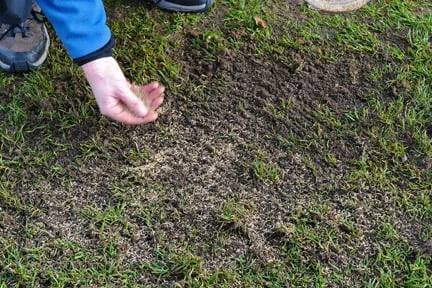
The first time I seeded a bare patch by hand, the result was embarrassingly uneven. Investing in a simple drop spreader fixed that.
I now use it for both overseeding in the fall and for my two annual fertilizer applications. It pays for itself quickly.
Drop Spreaders vs. Broadcast Spreaders
- Broadcast (rotary) spreaders fling material in a wide arc as you walk. They cover ground quickly and are ideal for large, open lawns. The coverage width (typically 6–8 feet) means fewer passes but less precision near edges or garden beds.
- Drop spreaders release material directly downward in a strip as wide as the hopper. They’re slower but far more precise — perfect for seeding specific areas or applying product close to flower beds without over-spray.
For most homeowners, a mid-size broadcast spreader is the most efficient choice. If your lawn is small or irregularly shaped, a drop spreader gives you better control.
7. De-thatcher
Thatch is the layer of dead grass stems, roots, and debris that accumulates between the soil surface and the living grass blades.
A thin layer (under ½ inch) is actually beneficial — it insulates roots and retains moisture.
But when thatch exceeds ½ inch thick, it blocks water, air, and nutrients from reaching the soil, weakening the grass and creating conditions for disease and pests.
I ignored thatch for two seasons and paid for it — a section of my lawn turned spongy and started going brown despite regular watering.
One de-thatching session followed by aeration and fertilization brought it back to health within a month. De-thatching once a year is now a non-negotiable part of my spring lawn care routine.
De-thatching Options by Lawn Size
- Thatching rake: A manual option with sharp, curved tines. Labor-intensive but effective and inexpensive for small areas.
- Dethatching blade attachment: Some mowers accept a dethatching blade that can be swapped in for a standard cutting pass.
- Power dethatcher / scarifier: An electric or gas-powered machine that aggressively combs through the lawn. Best for medium-to-large lawns and heavily built-up thatch. Many hardware stores rent these by the day.
Always dethatch before aerating — the combination in a single session produces the best results for soil penetration and nutrient uptake.
When to Hire a Lawn Service Provider
Knowing which tools to use is one thing — having the time, physical ability, and experience to use them correctly is another.
There’s no shame in hiring a professional, and in many cases it’s the smarter financial decision when you factor in tool costs, storage, maintenance, and your own time.
Consider hiring a lawn care professional if:
- Your lawn is larger than ½ acre and you don’t own or want to store riding equipment.
- You have a physical limitation that makes mowing, raking, or de-thatching difficult.
- Your lawn has serious issues (compaction, disease, severe thatch) that require diagnosis and treatment by someone with experience.
- You’ve tried DIY care for a season and haven’t seen improvement.
A reputable lawn service will arrive with commercial-grade versions of every tool listed above and the expertise to use them correctly. When hiring, ask to see before-and-after photos of their work and check reviews from clients with lawns similar in size and type to yours.
Frequently Asked Questions
What is the most important lawn care tool for beginners?
A lawnmower is the single most essential tool. Without regular mowing during the growing season, grass becomes too tall, shades itself out, and attracts pests. Start here before investing in anything else.
How often should I aerate my lawn?
For most lawns, aerating once a year is sufficient — ideally in the spring or fall when the grass is actively growing. Heavily trafficked or clay-heavy lawns may benefit from twice-yearly aeration.
What’s the difference between a drop spreader and a broadcast spreader?
A broadcast (rotary) spreader flings material in a wide arc for fast, large-area coverage. A drop spreader releases material directly below the hopper in a controlled strip, making it more precise but slower. Choose based on the size and layout of your lawn.
When should I de-thatch my lawn?
De-thatch when your thatch layer exceeds ½ inch in depth. The best time is early spring or early fall. Avoid de-thatching during drought or extreme heat, as it temporarily stresses the grass.
Can I use a string trimmer instead of an edger?
Yes, but the results are usually less precise. Holding a trimmer sideways works in a pinch, but a dedicated edger — manual or motorized — produces cleaner, straighter borders with less effort over time.
How do I know if my lawn needs lime?
Yellowing grass, poor fertilizer response, and moss growth can all indicate acidic soil. A soil pH test (available at most garden centers) will confirm it. Read more in our guide on how to tell if your lawn needs lime.
Final Thoughts
A well-maintained lawn comes down to using the right tool for each task — and using it consistently.
You don’t need to buy everything at once. Start with a mower and a rake, add a spreader and aerator as your routine matures, and invest in a de-thatcher once you’re seeing signs of buildup.
Over 17 years of caring for my own garden, I’ve found that the homeowners with the best-looking lawns aren’t necessarily using the most expensive gear — they’re using the right gear regularly and maintaining it well.
Sharpen your blades, clean your tools after use, and your investment will pay dividends for years.
If you’re just getting started, check out our guides on how to cut grass properly, what to do if grass seed doesn’t grow, and how to regrow damaged grass.
Related Posts: