How to Attract Bluebirds to Your Backyard Feeder
Last Updated on June 9, 2026 by Duncan
You put out a feeder. You filled it. Nothing came.
That’s not bad luck. It’s a mismatch between what you offered and how bluebirds are wired to find food.
Unlike sparrows or finches, bluebirds do not forage. They hunt. They sit on an elevated perch, scan the ground below, and drop.
As you can tell, a feeder full of seed sitting in open lawn doesn’t fit anywhere in that sequence.
Why Bluebirds Aren’t Coming to Your Feeder
The first thing most people get wrong is the food itself. Bluebirds are insectivores.
This means seeds hold zero nutritional interest for them. They won’t be interested in the usual sunflower seeds, safflower, nyjer, and mixed grain.
You could have the best-stocked seed feeder on the street and a bluebird would fly past it every single day without a second look.
The second mistake is timing. Bluebirds begin scouting and establishing territory in late February to mid-March.
This is usually weeks before most people think to set up a spring feeder.
By the time a typical backyard birder puts a dish out in April, a resident bluebird pair has already mapped their territory. If your feeder wasn’t in that map, it isn’t in their routine.
The third mistake is placement. Without a perch within 15 to 30 feet of the feeder, bluebirds have no way to do what comes naturally before they eat.
No perch means no scouting position, and no scouting position means no visit, regardless of what’s in the dish.
Fix all three of those things before you change anything else. The bird hasn’t rejected your yard. It just hasn’t been given a reason to stop.
Offer The Right Food
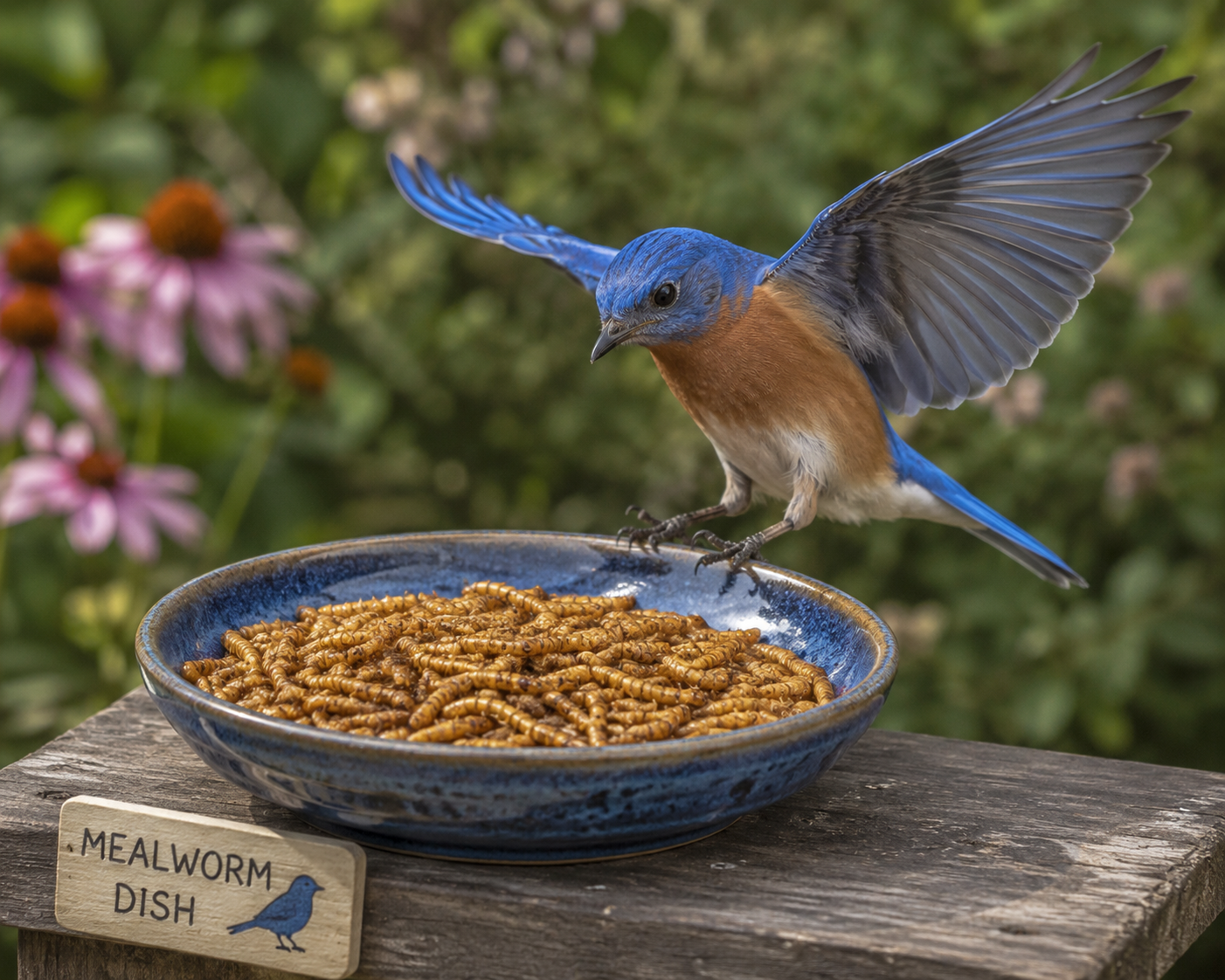
Mealworms are the only feeder food that consistently attracts bluebirds. Not berry blends, not suet cakes marketed with a bluebird on the label, not dried fruit.
Mealworms, specifically the larvae of the beetle Tenebrio molitor replicate the soft-bodied insects bluebirds hunt in the wild.
Live mealworms and dried mealworms are not interchangeable, and the time of year determines which one you should be using.
In fall and winter, dried mealworms work fine for drawing adults to the dish.
The moment eggs hatch in spring, switch to live and don’t go back until the season’s last brood has fledged.
You must be wondering why this matters, right? Well, bluebird nestlings get the majority of their hydration from the food their parents bring them, not from a separate water source.
Dried mealworms have had their moisture removed in processing.
A parent delivering dried worms to a brood of five chicks is delivering a dehydration risk with every single trip and parents make upward of 200 feeding runs a day during peak nestling growth. The math on that is not forgiving.
Thankfully, live mealworms are available at most wild bird supply stores and many pet shops.
A small colony started in a plastic tub with an inch of wheat bran costs a few dollars to set up and can sustain a full nesting season at a fraction of the retail price.
One more thing on quantity: do not fill the dish. Stock 15 to 20 mealworms per visit, let the birds empty it, then refill.
A dish that is always overflowing trains bluebirds to treat the feeder as background scenery and they have the impression that the food will always be there, never urgent.
A dish that empties and refills builds a checking habit. Scarcity, not abundance, is what makes the feeder essential to their daily routine.
Properly Place the Feeder
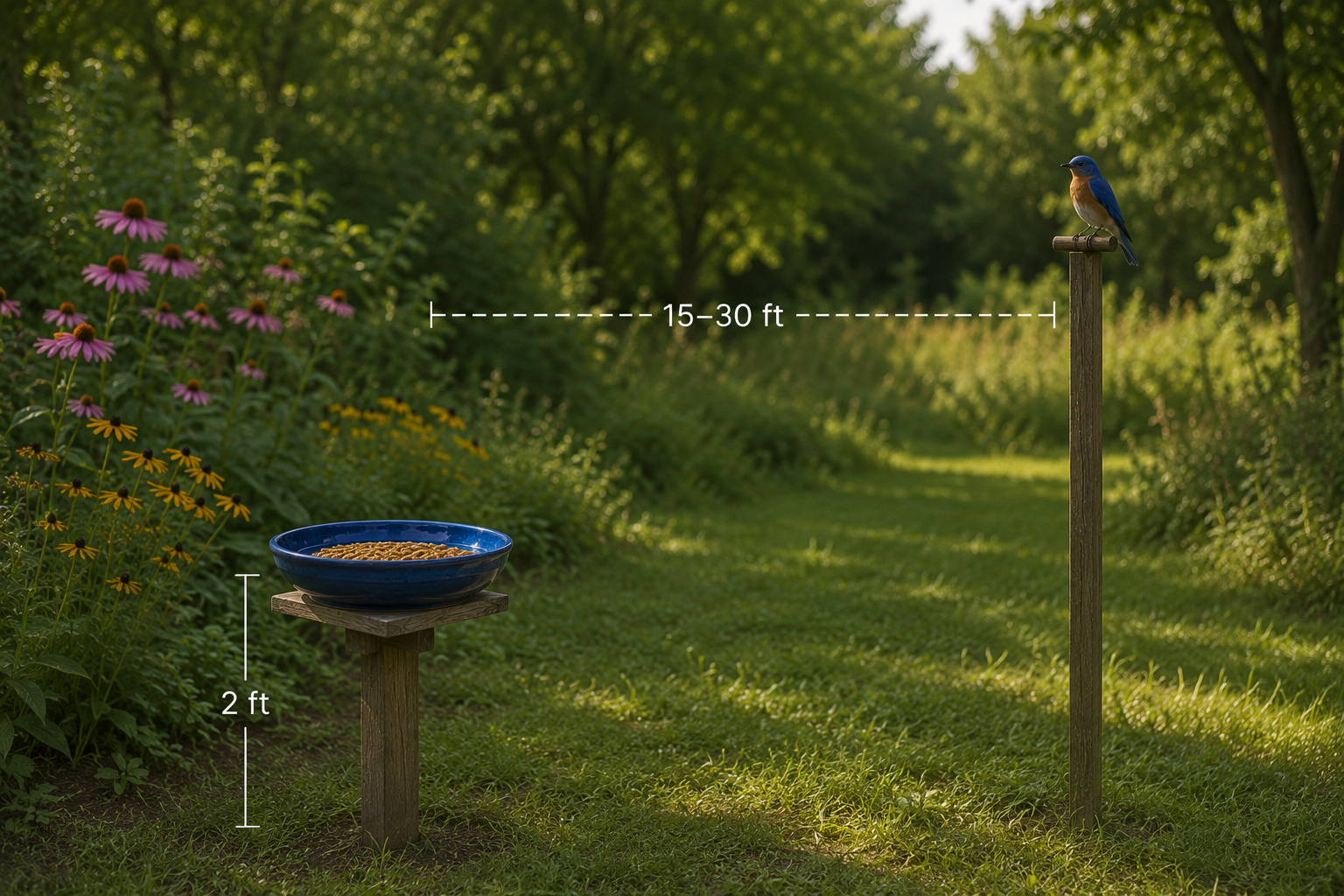
The dish itself is only half the equation. Where you put it, and what surrounds it, determines whether bluebirds ever find it at all.
Place the feeder within 15 to 30 feet of a perch. This can be a fence post, a shepherds hook, a wooden stake at least four feet tall.
Bluebirds are visual drop-hunters: they identify food from above, not at eye level.
Without a nearby elevated position to scout from, the feeder doesn’t fit their natural feeding sequence and they will ignore it even if they’re resident in your yard.
Keep the feeder in a semi-open location. Full shade makes it harder for the birds to spot movement in the dish.
Full exposure in a wide open lawn on the other hand leaves them vulnerable during the few seconds they’re on the ground.
Always remember that bluebirds are acutely aware of their exposure to aerial predators like Cooper’s Hawks, and a feeder with no nearby cover to retreat to registers as a risk, not a resource.
The feeder dish itself matters more than most people expect.
Use a glazed ceramic or smooth plastic dish no deeper than two inches, with walls that angle slightly outward.
Mealworms are good climbers so a deep-sided feeder with vertical walls becomes an escape route, and live worms will be gone within an hour of stocking, before bluebirds ever arrive.
A shallow glazed dish gives them nothing to grip and keeps the food where it belongs.
Position the feeder where you can see it from inside your house.
This sounds obvious, but it has a practical function: you’ll notice immediately when the dish empties, you’ll see which birds are using it, and most importantly, you’ll spot the moment a starling or robin discovers it, which requires a fast response.
Eliminate The Competitor Problem: Starlings and Robins
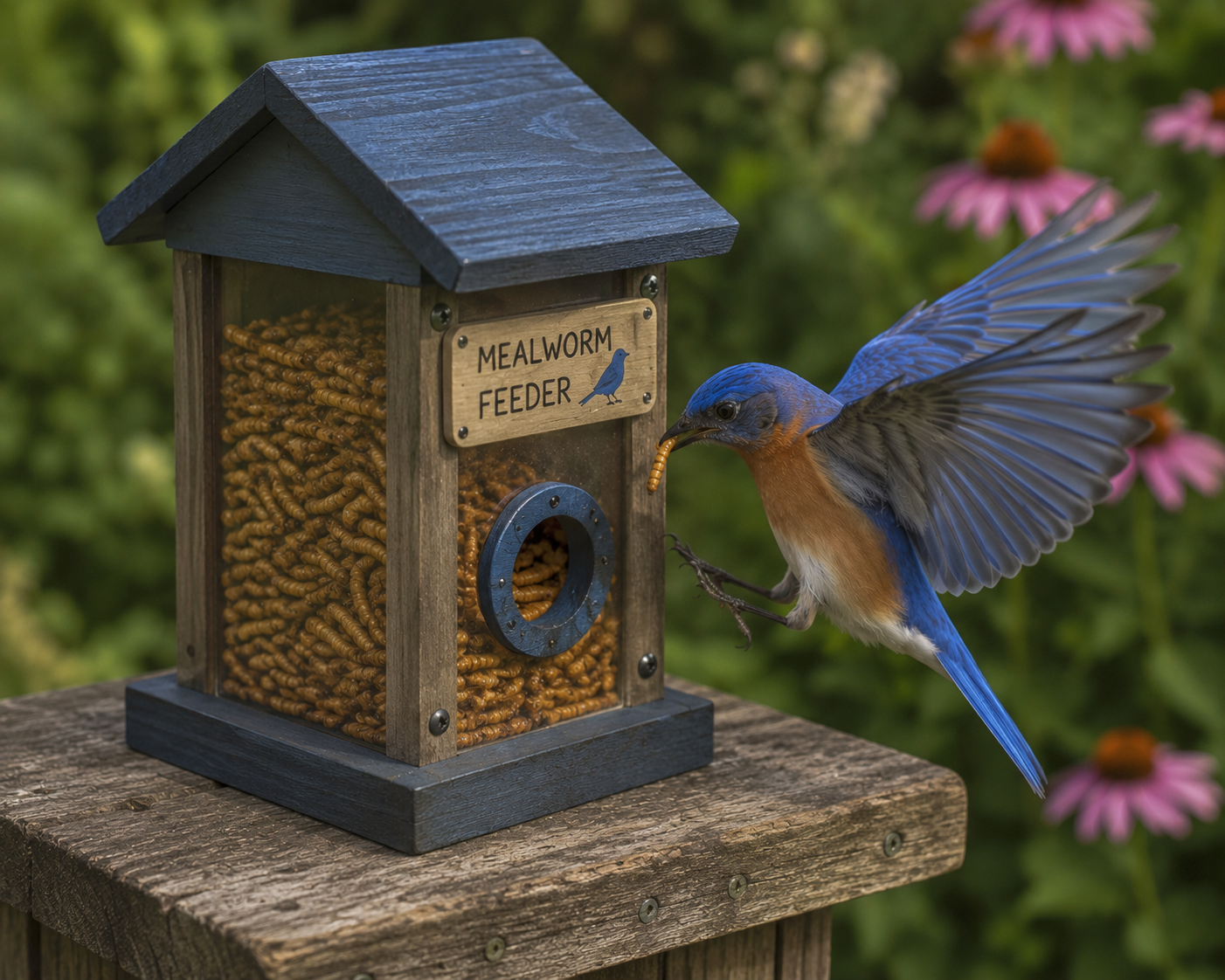
A mealworm dish left open in a backyard will be found by European Starlings or American Robins within days, sometimes hours.
Both species are faster, more aggressive, and will clean out a dish before a bluebird gets close.
This is the single most common reason people conclude that mealworm feeding “doesn’t work.”
The solution is not a different food. Instead it’s an enclosed feeding station.
A small wooden box with a 1½-inch entry hole cut into one or both ends, with the dish mounted inside, solves the problem completely.
Bluebirds enter easily. Starlings are too large for the opening.
Robins on the other hand will not enter an enclosed space on the ground as it conflicts with their instinct to feed in the open where they can see approaching threats.
That one modification changes the entire economics of mealworm feeding.
Instead of restocking a dish four or five times a day to keep up with starling raids, you’re filling it twice.
Your mealworms go to the bird you’re trying to attract, not to every opportunist in the neighborhood.
Enclosed bluebird feeders are available commercially for around $20 to $30, or you can build one in an afternoon from scrap cedar.
Place the enclosed feeder on the same pole as, or directly adjacent to, your perch stake.
The tighter the relationship between perch and feeder, the faster bluebirds connect the two and build a reliable visit pattern.
Provide Water: The Attractant Most Feeders Miss
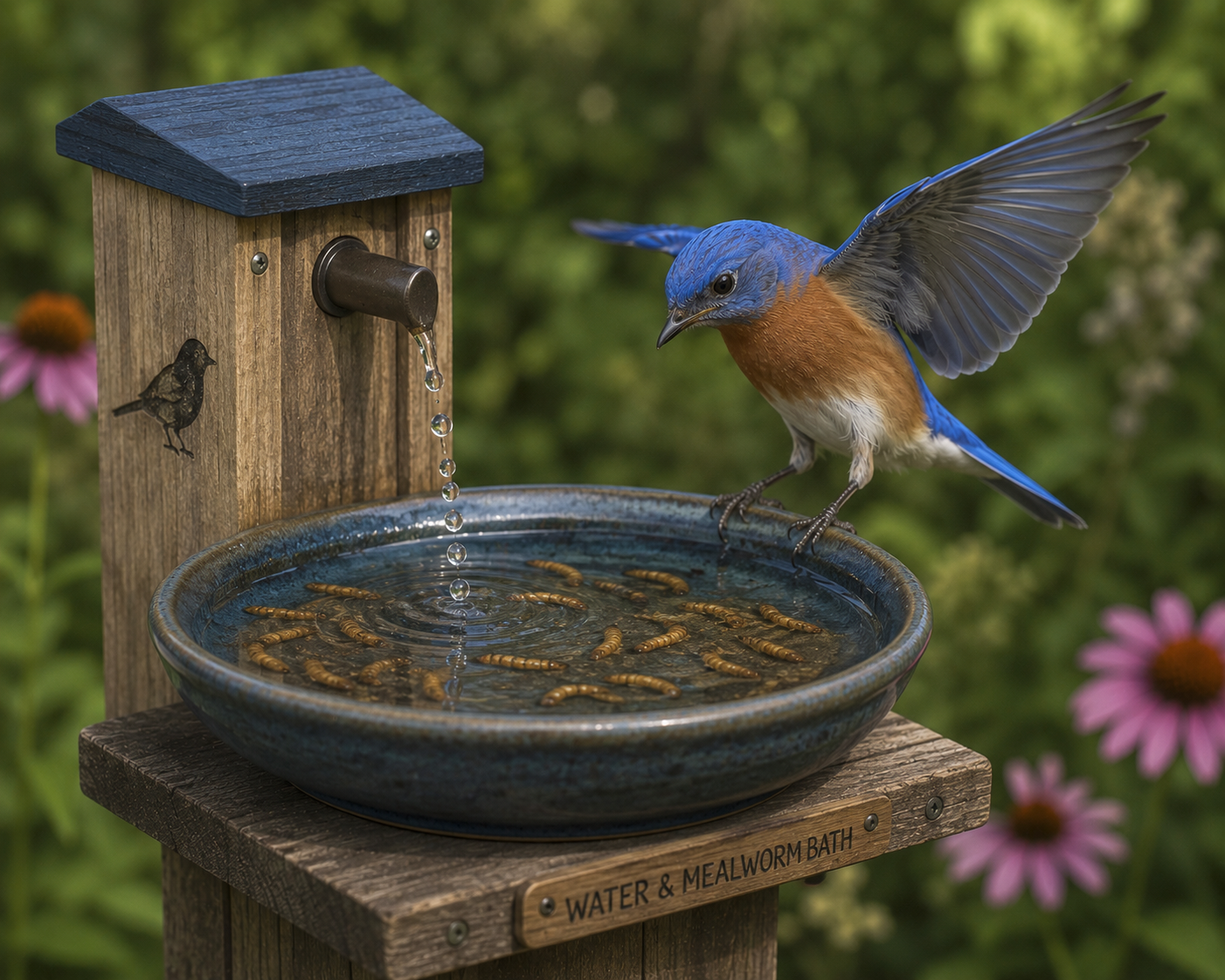
Moving water pulls bluebirds in faster and more reliably than mealworms alone.
This surprises most backyard birders, but the workings are simple.
Bluebirds locate resources partly by sound, and the drip or ripple of moving water carries further than a silent dish of worms.
A static birdbath registers weakly, if at all.
A dripper, a wiggler, or a small solar-powered fountain head mounted in a shallow bath creates constant surface movement and auditory signal.
In side-by-side comparisons, moving water draws first visits faster than mealworms in most seasons.
To attract bluebirds fast, always pair a mealworm feeder with a water feature within 10 feet. The water brings the birds in, the mealworms make them stay.
The bath itself should be no deeper than 1½ inches at the center.
Bluebirds bathe frequently and enthusiastically, but they are not strong swimmers and will avoid water they can’t stand in comfortably. A shallow, rough-textured surface gives them grip.
Change the water every two days regardless of how clean it looks.
Standing water in summer becomes a mosquito breeding site within 72 hours, and a fouled bath repels the birds you’ve spent weeks attracting.
Keep the water feature within sight of the feeder but not directly underneath it.
Mealworm debris in the bath fouls the water quickly and will drive bluebirds away from both resources and you don’t want this.
Be Cautious of Timing: The February Window Nobody Talks About
Experienced bluebird feeders have their stations set up, stocked, and running by the last week of February. Most beginners set up in April.
That six-week gap is the difference between a pair of bluebirds that integrates your feeder into their established territory and a pair that has already mapped their range without you in it.
Bluebirds are among the earliest cavity-nesting birds to begin territorial behavior in North America. Males in the Southeast begin scouting as early as late January.
In the Midwest and mid-Atlantic, late February to early March is the critical window.
By the time forsythia blooms, the common visual cue most gardeners use to signal “spring has arrived” the resident bluebird pairs are often already committed to their territory boundaries.
Once you have the feeder out, give it three full days before drawing any conclusions.
Bluebirds are observant and cautious and they will watch a new object in their territory from a distance before approaching it.
Three days of patient, consistent stocking is the right way to do it. Pull it after one day and you’ve ended the trial before the bird had a chance to decide.
In winter, keep a small amount of dried mealworms in the dish even during cold snaps when you wouldn’t expect activity.
Bluebirds are partially migratory, but resident pairs stay on territory through winter in much of the country.
A feeder that’s active year-round builds a stronger visit habit than one that disappears in October and reappears in spring.
Frequently Asked Questions
How do you get bluebirds to come to your feeder?
Stock a shallow dish with live mealworms, place it within 15 to 30 feet of an elevated perch, and have it out and running by late February.
Those three things, right food, right position, right timing, solve the majority of “no bluebirds” problems. Everything else is refinement.
What is the miracle meal for bluebirds?
Miracle Meal is a homemade winter supplement made from one cup of peanut butter, four cups of yellow cornmeal, and one cup of lard or vegetable shortening, mixed into a crumbly paste.
It was developed by bluebird trail monitors as a cold-weather alternative when live mealworms are unavailable or too expensive to maintain through winter.
It works. but it’s a supplement, not a replacement. Live mealworms remain the standard once temperatures rise above freezing consistently.
What color feeder attracts bluebirds?
Color does not meaningfully influence whether bluebirds use a feeder. Bluebirds locate food by movement and spatial memory, not by color cues.
The idea that a blue feeder attracts them faster is a marketing angle, not an ornithological one. Spend that attention on dish depth and placement instead.
What is the best time of day to feed bluebirds?
Early morning is when bluebirds are most active at feeders as they emerge hungry and will visit a stocked dish within the first hour of daylight.
A second activity peak typically occurs in late afternoon, roughly two hours before dusk, when they feed again before roosting.
Stock the dish in the evening so it’s ready at first light; don’t wait until mid-morning or you’ve already missed the most reliable window.
Where is the best place to put a bluebird feeder?
Semi-open ground with a perch within 15 to 30 feet. This can be a fence post, a low branch, or a dedicated stake.
You should have a clear sightline from that perch to the dish.
Avoid dense shrub borders where predators can approach unseen, and avoid placing it directly under a tree where squirrels and jays will dominate it.
The feeder should also be visible from inside your home so you can monitor it and restock it quickly.
How high should I hang a bluebird feeder?
Between two and four feet off the ground, lower than most people expect.
Bluebirds are ground-level hunters and feel most comfortable dropping into a food source that mirrors the height at which they naturally catch insects.
A feeder mounted at six or seven feet like a standard seed feeder sits outside their instinctive hunting range and will get less use.
If you’re using an enclosed bluebird feeder box on a pole, three feet is the standard to go with.
Do bluebirds need a special feeder?
For open dishes, no. A shallow glazed ceramic or smooth plastic dish two inches deep works perfectly.
Where a specialist feeder genuinely earns its cost is in competitor management.
Here you need an enclosed wooden feeder with a 1½-inch entry hole that keeps starlings and robins out while letting bluebirds pass freely.
If you have starling pressure in your yard, that enclosed design stops being a nicety and becomes a necessity.
How to attract bluebirds with a tuna can and a nail
A clean, empty tuna can nailed to a post at three to four feet is a functional starter feeder.
The shallow depth and smooth interior walls are actually close to ideal, and the metal surface dries quickly after rain.
The two failure points: the can needs to face away from prevailing wind so mealworms don’t dry out too fast, and the nail needs to go through the post horizontally so the can sits level rather than tilting and spilling.
It’s a legitimate low-cost entry point that many experienced feeders started with.
What do bluebirds eat at feeders?
Live mealworms are the primary draw, year-round. Dried mealworms work as a secondary option in fall and winter when nestlings aren’t in the picture.
Some bluebirds will take Miracle Meal paste in cold weather, and a small number will accept softened raisins or chopped dried fruit during migration.
Seed of any kind including the “bluebird mixes” sold at garden centers is not part of their diet and will not bring them to your feeder.
The Feeder Is the Beginning, Not the End
A bluebird that finds your feeder will return. That’s the nature of the bird. Once it maps a reliable food source into its territory, it checks it daily, often multiple times.
The work is front-loaded: right food, right dish, right placement, right timing. After that, the relationship largely maintains itself.
The next step, once a pair is visiting regularly, is a nest box a smooth metal pole, east-facing, five feet off the ground, within sight of the feeder.
Bluebirds that feed in your yard are far more likely to nest there, and a nesting pair becomes the most reliable feeder visitors you’ll ever have.
A male bluebird feeding nestlings makes over 200 trips a day. Many of them will be to your dish.
For deeper guidance, the North American Bluebird Society at nabluebirdsociety.org publishes annually updated feeding and housing guidelines backed by field research.
Cornell Lab’s Nest Watch program lets you log and contribute your observations to a national database. After two or three seasons, your own records become the most useful resource you have.
Related Posts: