Bird Feeders for Kids to Make At Home
Last Updated on June 6, 2026 by Duncan
I’ll be honest with you. This started as an accident.
My older one was bored in that loud, declarative way kids have, and my younger one was following her lead, which is always a warning sign.
So we went outside, grabbed a pinecone from the yard, and made something ugly and wonderful that the birds actually came to.
That was the beginning of a small obsession. Not mine, theirs. They started noticing which birds came, arguing about names, asking if we could build a bigger one.
My job shifted from “activity coordinator” to “assistant” pretty quickly, which is exactly where you want to be.
These are the bird feeder projects we’ve actually made together some in five minutes before school, some stretched into a whole Saturday afternoon. A few went sideways but most went great.
If you are looking for bird feeders for kids to make, here are some of the best ones to go with:
Bird Feeders for Kids to Make Recycling Soda Bottles
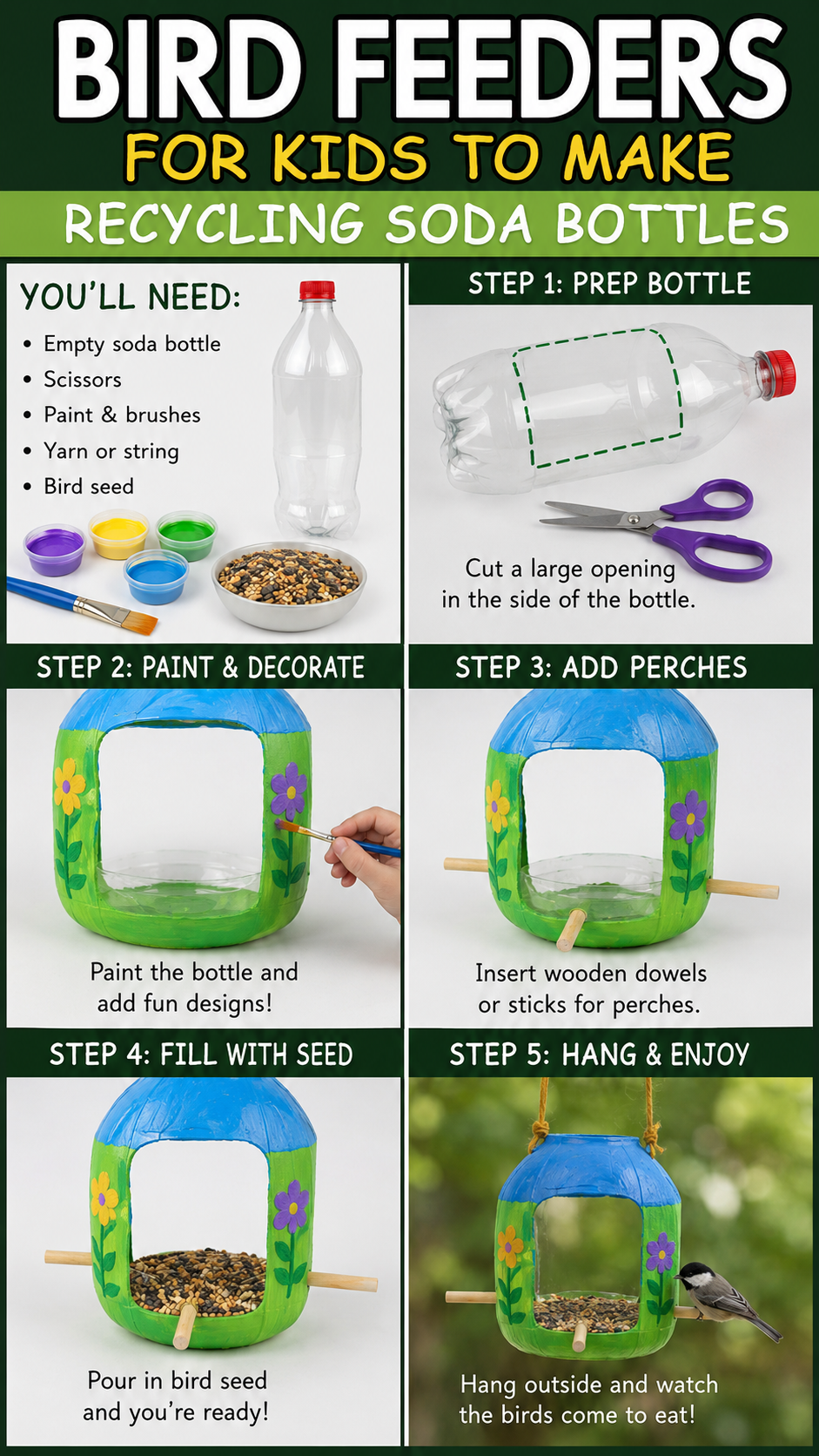
Before you toss that two-liter in the recycling bin, hand it to your kids. With a few simple additions, it becomes one of the most satisfying feeders you can make together.
The beauty is that its sturdy, weatherproof, and genuinely good-looking once it’s hanging in the yard.
What you’ll need:
- A clean, empty plastic soda bottle (2-liter works best)
- Two wooden spoons or dowels
- Birdseed
- A length of twine or wire
- A sharp knife or scissors
How to make it:
Clean thoroughly: Start by rinsing the bottle and letting it dry completely. This is a good job for kids while you track down the other supplies.
Poke holes: About three inches from the bottom, carefully poke two holes on opposite sides of the bottle. Push a wooden spoon straight through so it comes out the other side; this is your first perch.
Do the same a few inches higher, rotating the spoon ninety degrees so the perches cross.
Cut: Now cut small openings just above each spoon handle. They should be big enough for seed to spill out, but small enough that it doesn’t all pour out at once.
Fill the bottle with birdseed, screw the cap back on, and tie twine around the neck to hang it.
The whole project takes about twenty minutes.
Who will come: Finches, sparrows, and juncos tend to find bottle feeders quickly. Hang it near a tree or shrub and give it a few days. Once one bird finds it, others follow.
The quiet win here: When your kids watch a bird land on a perch they pushed through the bottle themselves, something clicks.
They built a thing that works in the real world, for a real creature. That’s not a small feeling for any kid.
Bird Feeders for Kids to Make Using Lard
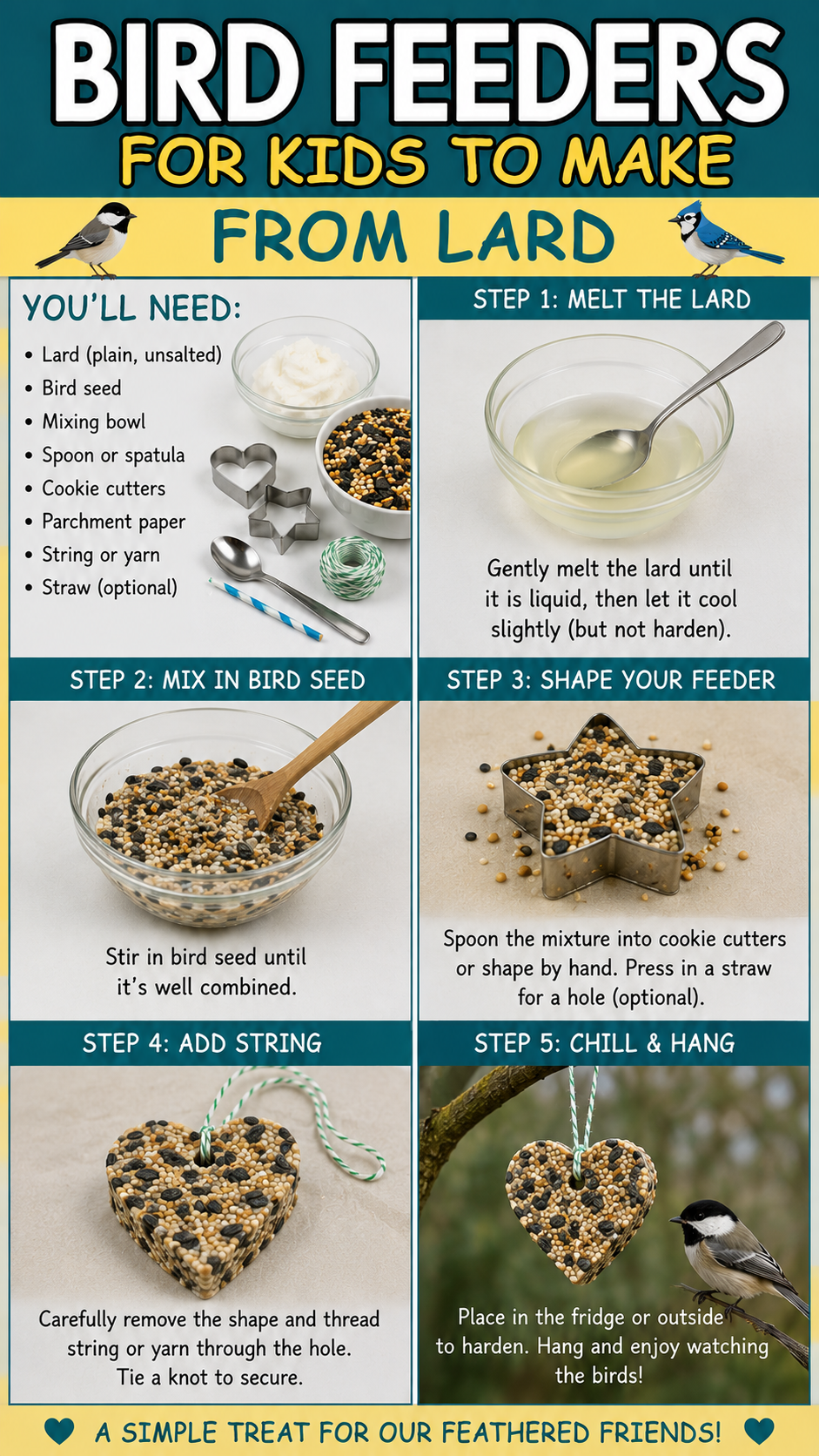
You do this in the kitchen, which immediately makes it feel different from the others. It feels more like cooking than crafting.
The basic idea is simple: mix lard with seeds and let it set, and put it outside. Birds go absolutely mad for it, especially in colder months when they need the extra calories.
What you’ll need:
- 1 cup of lard (not butter, not vegetable shortening. It should be lard that holds up better outdoors)
- 2 cups of birdseed
- A handful of oats, raisins, or crushed unsalted peanuts (optional but good)
- A muffin tin, yogurt pot, or small bowl for shaping
- String or twine
- A mixing bowl
How to make it:
Heat or let it soften: Let the lard soften at room temperature for about thirty minutes. It should be scoopable but not melted.
This is a good time to measure out the seed and let the kids mix the dry ingredients together.
Mix: When the lard is ready, combine everything in a bowl and mix it with your hands until it comes together like a rough dough. Press the mixture firmly into the molds you’re using.
Hang: If you want to hang them, press a looped piece of string into the center before it sets. Refrigerate for at least two hours until solid.
Who will come: Robins, starlings, and thrushes love a lard cake. Woodpeckers will visit too if you press in some crushed peanuts. In winter, you may be surprised how quickly it disappears.
The quiet win here: This one teaches kids that feeding animals isn’t just about putting something out. It’s about understanding what different creatures actually need.
Fat in winter isn’t a treat for birds, it’s fuel. That small piece of context turns a kitchen project into a genuine nature lesson.
Bird Feeders for Kids to Make From an Egg Carton
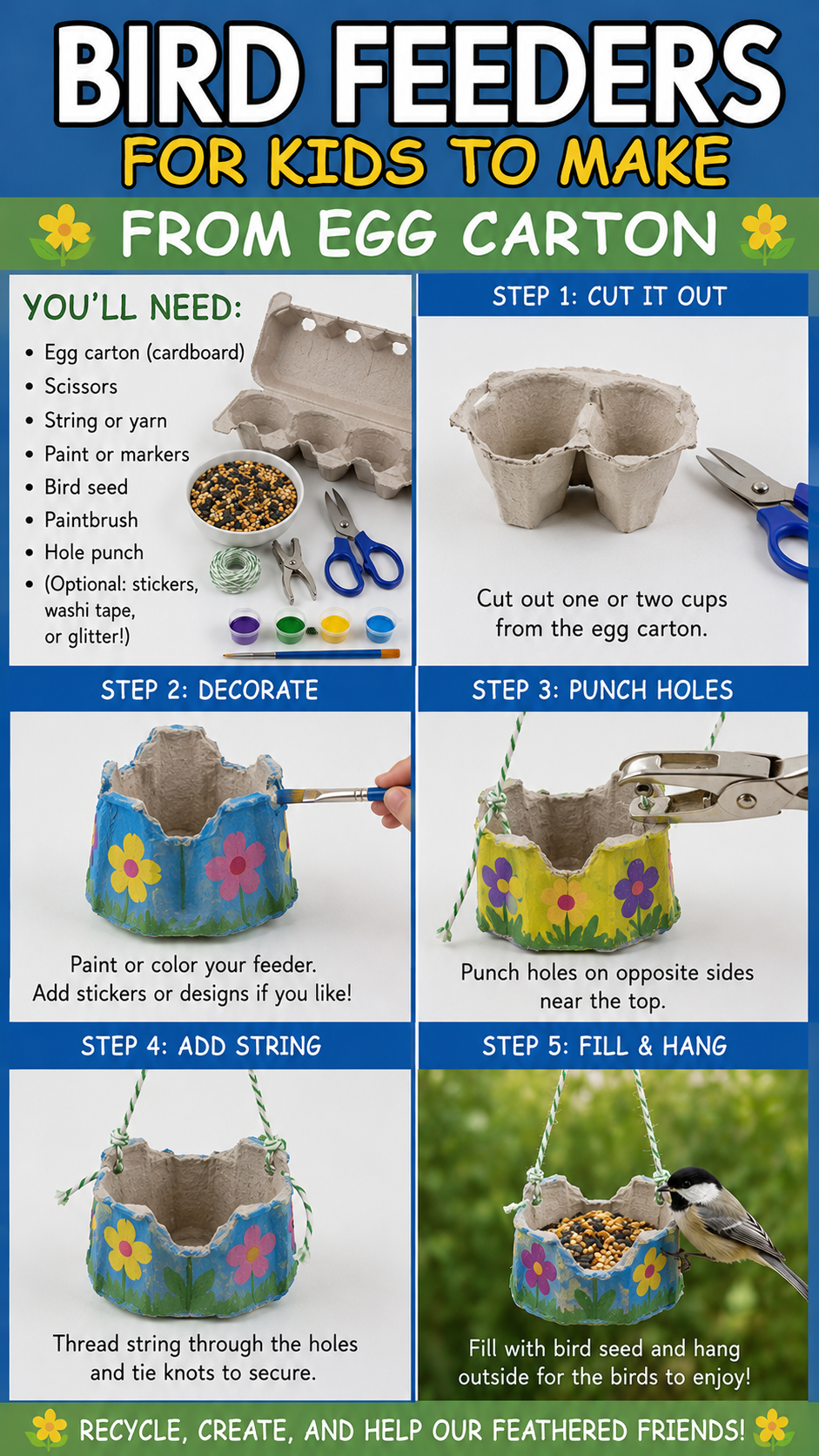
The egg carton feeder is the one that looks like it shouldn’t work. It’s cardboard. It sits on the ground or on a flat surface.
There’s no hanging, no perch engineering, no real structure to speak of. And yet it works, and kids love it precisely because the barrier to entry is so low that they can own the whole thing themselves.
What you’ll need:
- One empty cardboard egg carton
- Birdseed
- Peanut butter (optional)
- A safe spot in the yard — a flat fence post, a tree stump, a patio ledge
How to make it:
Open the egg carton: Open the egg carton and set it out flat. If you want to give it some staying power, let the kids spread a thin layer of peanut butter into each cup.
This keeps the seed from scattering in the wind and adds something birds find genuinely irresistible.
Fill it up: Fill each cup with birdseed, pressing it down lightly. That’s it. Set it outside somewhere stable and step back.
My kids were unconvinced. The older one pointed out, correctly, that it was just an egg carton with seeds in it. She wasn’t wrong.
Then a sparrow landed on it eleven minutes later and she didn’t say another word about it.
Who will come: Ground feeders especially sparrows, doves, and towhees tend to prefer eating low rather than hanging.
The egg carton’s flat, accessible shape suits them perfectly. You may also get squirrels, which is either a problem or an added attraction depending on your household’s position on squirrels.
The quiet win here: This is the project where kids realize that wildlife doesn’t care about effort or aesthetics.
A bird will choose a soggy egg carton over an expensive store-bought feeder if the seed is right. That’s a useful thing to know at any age.
Bird Feeders for Kids to Make with a Pinecone
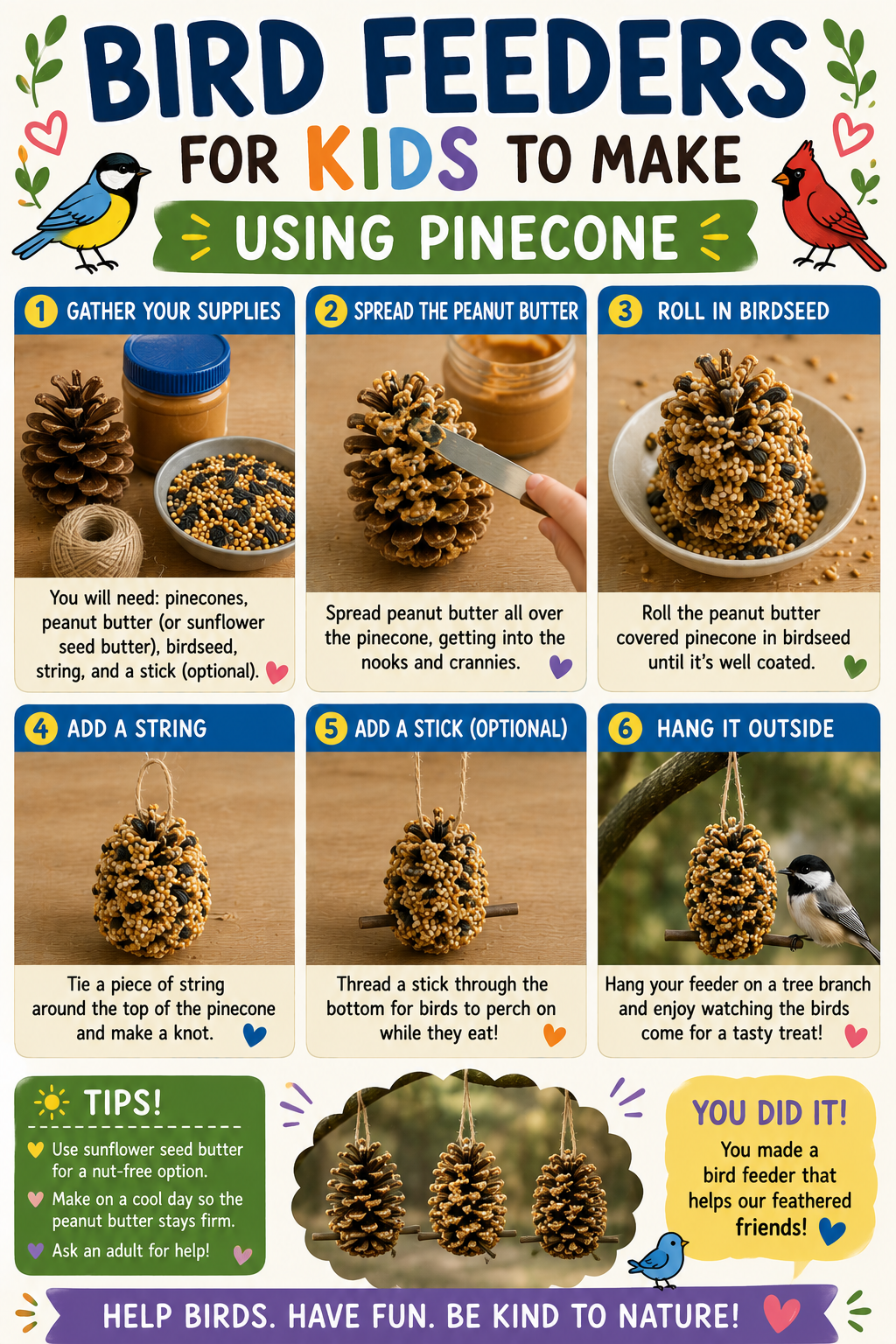
If there’s a gateway project in backyard bird feeding, this is it. The pinecone feeder is the one that started our whole habit.
We made it in about fifteen minutes on a Tuesday afternoon with things we already had, and the one that made my youngest understand, for the first time, that she could do something genuinely useful for an animal.
What you’ll need:
- A large pinecone (the bigger and more open, the better)
- Peanut butter
- Birdseed
- A length of twine or string
- A butter knife or spoon
How to make it:
Tie the pinecone: Tie your twine securely around the top of the pinecone. You should do this before anything else as it’s much harder to do once everything is sticky.
Apply peanut butter: Give each child a spoon and a scoop of peanut butter and let them work it into the crevices of the pinecone. Don’t rush this part.
The pressing and filling is where most of the satisfaction lives, and kids will be more thorough than you expect if you give them the time.
Roll in birdseed: Once the pinecone is well coated, roll it through a dish of birdseed or press seed in by hand until it’s covered.
Hang it: Hang it from a branch at eye level. It should be low enough that kids can actually watch what happens next.
The pinecone is a forgiving project. There’s no cutting, no molds, no waiting for things to set.
My younger one did almost all of it herself, announced she was done in a voice that suggested she had just built something architectural, and went inside to wash her hands without being asked. That has never happened before or since.
Who will come: Chickadees almost always find a pinecone feeder first. Maybe this is because they’re bold, curious, and not particularly bothered by a recently hung, slightly lopsided homemade feeder.
Nuthatches follow. If you’re lucky, a downy woodpecker will work the crevices with a focus that borders on professional.
The quiet win here: The pinecone is already a perfect object. Its textured, layered, designed by something much older and smarter than any of us.
Bird Feeders for Kids to Make Using a Milk Jug
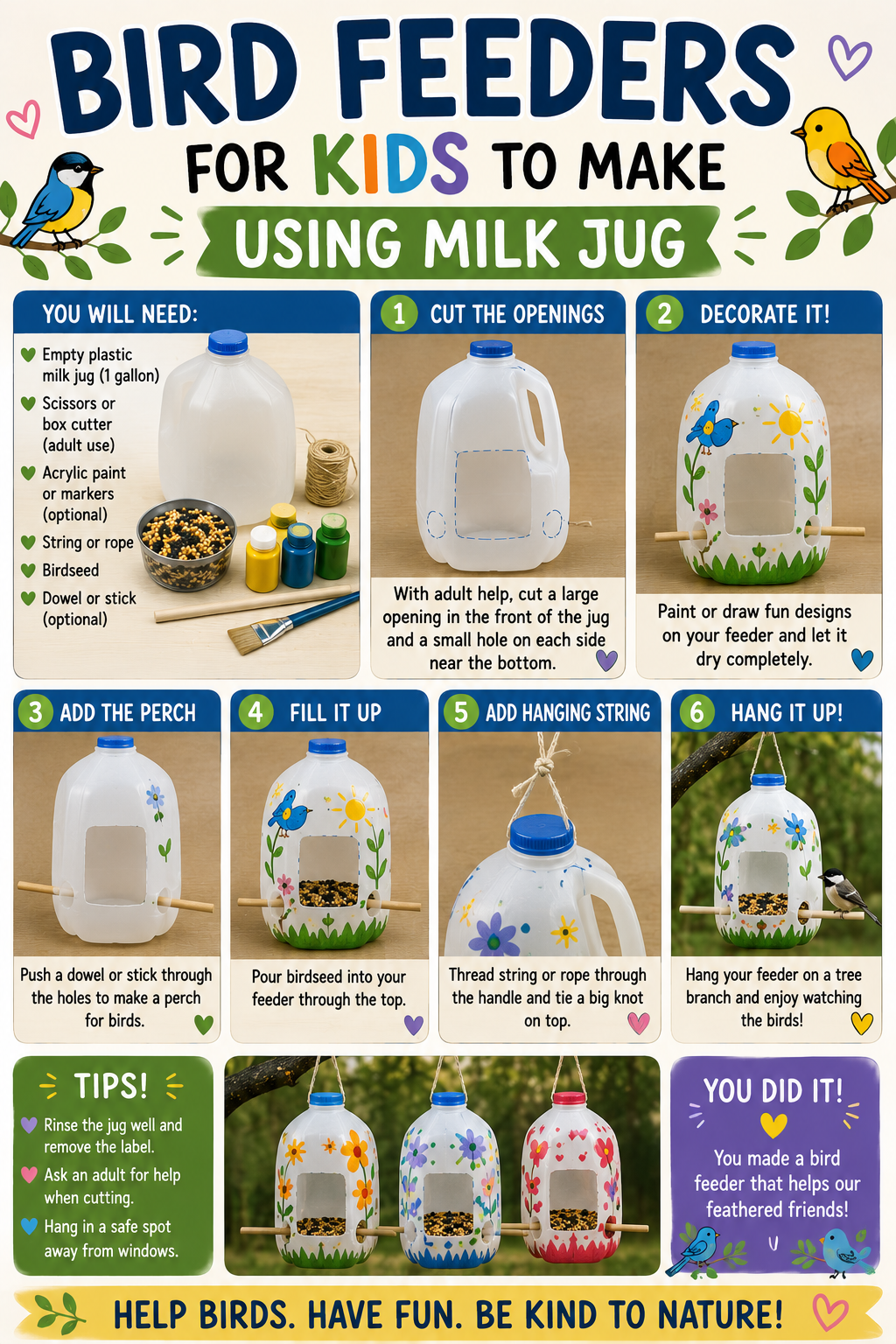
The milk jug bird feeder is the one that feels like a proper project. Not because it’s complicated as it isn’t, but because when it’s done, it actually looks like something.
A real feeder, with windows and a roof and a place for birds to land.
Kids who have made the egg carton and the pinecone and are ready for something that requires a little more patience will find it here.
What you’ll need:
- A clean, empty plastic milk jug with the cap
- A sharp knife or scissors (for the grown-up)
- A wooden spoon or dowel for the perch
- Twine or wire for hanging
- Birdseed
- Waterproof markers or outdoor paint (optional)
How to make it:
Clean the jug: Rinse the jug thoroughly and let it dry. On two opposite sides, draw a large opening roughly four inches wide and three inches tall, leaving enough plastic around the edges to keep the structure sound.
Cut: Cut these out carefully; this is the one part that needs a grown-up’s hands. Just below each opening, poke a hole and push a wooden spoon through so it protrudes a few inches on each side as a perch.
Tie it: Tie twine securely around the handle at the top for hanging. Fill the bottom of the jug with birdseed, about two inches deep and replace the cap.
Hang it at a comfortable height and let the kids step back and look at what they made.
If your kids want to decorate it first, waterproof markers work well on clean plastic.
My older one spent longer on the decorating than the building, which felt exactly right. The birds, for the record, did not comment on the artwork but came anyway.
Who will come: The milk jug feeder is roomy enough to attract a good variety of bird. Sparrows, finches, and chickadees are regulars.
The enclosed sides keep seed dry in light rain, which means it stays active on days when other feeders get waterlogged and abandoned.
The quiet win here: This is the feeder that teaches kids something about design. The openings need to be big enough for birds to reach in but the bottom needs to hold seed without spilling.
The perch needs to stick out far enough to be useful. These are small engineering problems, and kids solve them instinctively if you let them think it through rather than just following instructions.
Bird Feeders for Kids to Make Using Cheerios
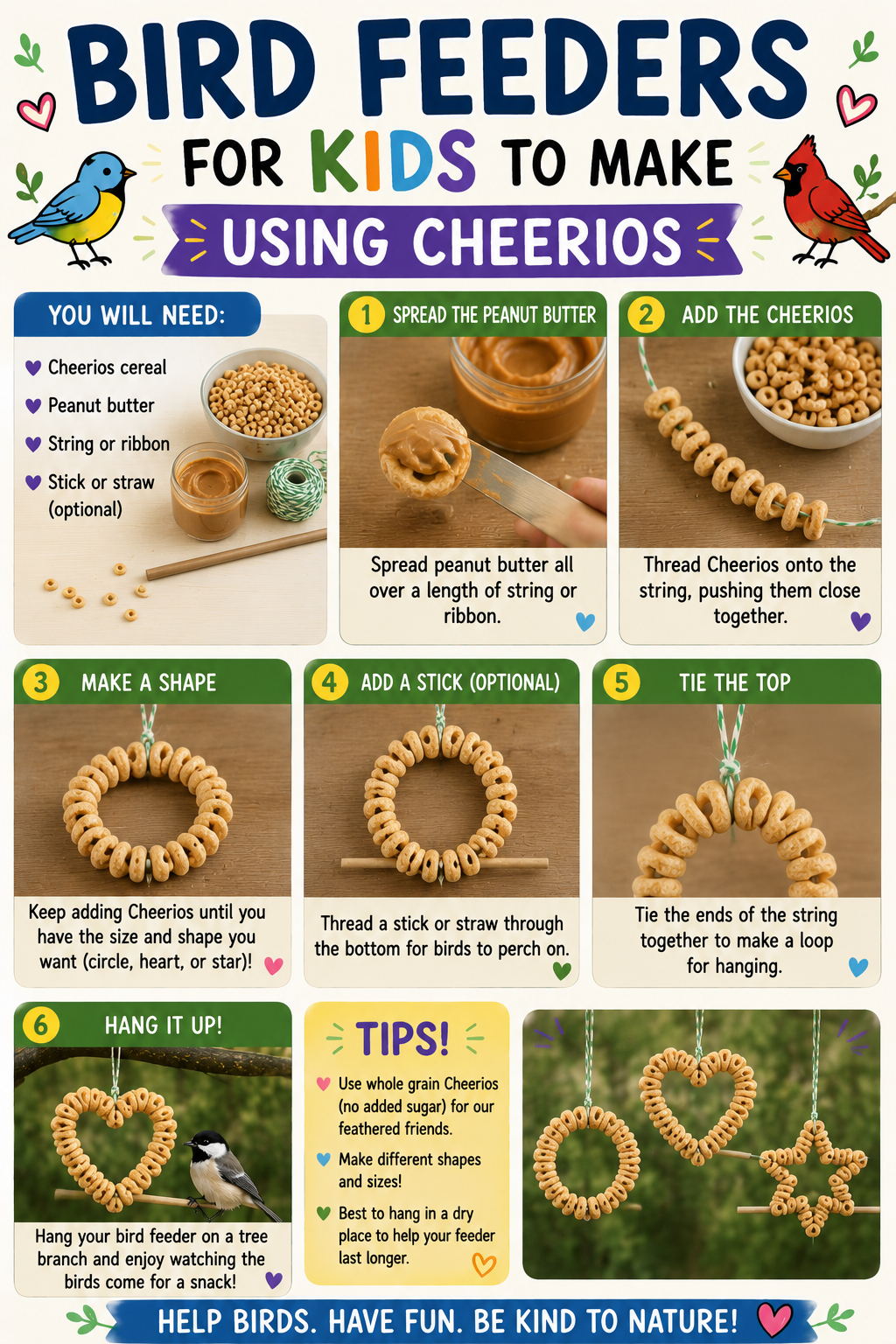
This is the one you make when you have twenty minutes, a restless kid, and a box of Cheerios that’s been at the back of the cupboard long enough that nobody is eating it anymore.
It requires almost nothing, produces almost no mess, and results in something a child can hold in their hands and hang outside themselves. It is, in the best possible way, the simplest thing in this entire collection.
What you’ll need:
- Plain Cheerios (not honey-nut, not frosted)
- Pipe cleaners or stiff twine
- Optional additions: cranberries, popcorn, small pretzels, dried fruit
How to make it:
Thread the Cheerios: Give each child a pipe cleaner and point them toward the Cheerios. The instructions are exactly what they look like: thread the Cheerios onto the pipe cleaner, one by one, until it’s full.
If you have cranberries or popcorn on hand, alternate them in. The color variation makes it look more intentional and gives kids something to think about while they work.
Hang it: When the pipe cleaner is full, twist the ends together into a loop and hang it from a branch, a fence hook, or anywhere a bird might reasonably land nearby.
My youngest did this entirely independently, which is the whole point. She threaded, she hung it herself on the lowest branch she could reach, and she sat on the back steps for a while just waiting.
Who will come: Small birds take to Cheerios quickly, sparrows and finches in particular.
The open threading means they can pick pieces off easily, which suits birds that prefer to grab and go rather than perch and linger. Don’t be surprised if the whole thing is gone within a day.
The quiet win here: This is the project for the youngest kids, the impatient ones, the ones who want to do something right now.
There’s no drying time, no adult cutting, no waiting for anything to set. From box to branch in under ten minutes.
And it works, which is the thing that matters most when you’re four years old and you built it yourself.
Frequently Asked Questions
What kind of birdseed should we use?
A mixed seed blend covers the most ground as it attracts a wider variety of birds than any single seed type. Black oil sunflower seeds are the most universally loved if you want to keep it simple.
Avoid mixes with a lot of milo or red millet as most backyard birds ignore them and they end up on the ground.
For the lard and pinecone feeders specifically, straight birdseed mix works perfectly.
For the Cheerios feeder, the Cheerios themselves are the main event. You don’t need additional seed.
Is peanut butter safe for birds?
Yes, with one caveat: use plain, unsalted peanut butter. The regular kind you already have in the cupboard is fine.
The concern some people raise about birds choking on thick peanut butter is largely unfounded as birds manage it well, especially when it’s pressed into crevices or mixed with seed.
What you want to avoid is anything with added salt, sugar, or xylitol, which is harmful to wildlife.
How long will homemade feeders last outside?
It depends on the materials. The milk jug and soda bottle feeders are weatherproof and can last an entire season with occasional refilling.
The egg carton and Cheerios feeders are intentionally short-lived so you should think of them as single-use, designed to be eaten and replaced rather than maintained.
The lard cakes hold up well in cold weather but can go rancid in heat, so make those in fall and winter rather than summer.
Why aren’t any birds coming to our feeder?
Give it time. Usually three to seven days before the first visitor arrives. Birds are cautious about new food sources and need time to notice and trust something unfamiliar.
You should note how you place the feeder helps: hang feeders near cover like a bush or tree where birds already feel comfortable, rather than in the middle of open space.
If nothing has come after two weeks, try moving it to a different spot or adding fresh seed.
Can we use any type of lard or fat?
Stick to plain lard, which you can find in the baking aisle of most grocery stores.
Avoid using bacon fat, cooking grease, or butter as these can contain salt and additives that aren’t good for birds, and they go rancid faster outdoors.
Suet, which is raw beef fat available at most butchers, is an excellent alternative if you can find it and is what commercial suet cakes are made from.
Do we need to clean the feeders, and how?
Yes, and it matters more than most people realize. A dirty feeder can spread disease between birds, which is the opposite of what you’re going for.
For the longer-lasting feeders such as the milk jug and soda bottle, rinse them out every two weeks with a weak solution of one-part white vinegar to nine parts water, let them dry completely before refilling.
The shorter-lived feeders like the egg carton and Cheerios string don’t need cleaning; just replace them when they’re empty or weathered.
Related Posts: