7 Must-Have Lawn Care Tools
Last Updated on April 25, 2026 by Duncan
No single tool can do everything a lawn needs. To keep grass healthy, green, and thick across every season, you need a targeted set of tools — each built for a specific job.
This guide covers the 7 essential lawn care tools, what to look for when choosing each one, and how to use them effectively.
Quick Reference — 7 Essential Lawn Care Tools
| # | Tool | Primary Job | Key Spec | Best For |
|---|---|---|---|---|
| 1 | Lawn Mower | Cut grass to height; suppress weeds | Deck width; mulching capability | All lawn sizes |
| 2 | String Trimmer | Edge areas the mower can’t reach | Line diameter (0.080″–0.095″) | Borders, fences, obstacles |
| 3 | Leaf Blower & Rake | Clear fallen leaves without smothering grass | CFM airflow rating for blowers | Yards with nearby trees |
| 4 | Sprinkler System | Deliver ~1 inch of water per week | Coverage area; adjustable flow rate | All lawns, especially dry seasons |
| 5 | Snow Removal Equipment | Protect grass from compaction and ice damage | Blade width; mower compatibility | Cold-climate lawns |
| 6 | Seeder & Sprayer | Spread seed or treatments evenly | Tank capacity (3–4 gal for home use) | Overseeding, weed control |
| 7 | Personal Safety Gear | Protect ears, eyes, hands, and lungs | NRR rating for ear protection | All lawn care tasks |
1. Lawn Mower
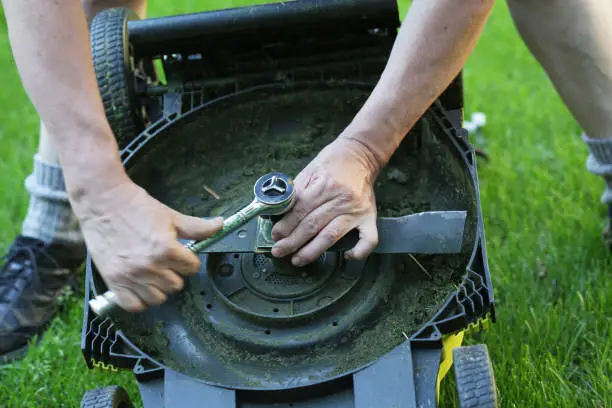
A lawn mower is the foundation of any lawn care tool kit. Its primary function is to cut grass to a consistent, controlled height — a practice that directly affects root health, weed suppression, and turf density.
Cutting grass regularly at the correct height is one of the most impactful things you can do to keep your lawn green and healthy.
Types of lawn mowers
- Push mowers — Manual or engine-assisted models suited for small to medium yards up to about ¼ acre. Powered reel mowers are a popular option for eco-conscious homeowners with flat lawns.
- Self-propelled mowers — Engine-driven models that move forward on their own. Ideal for medium yards (¼–½ acre) or lawns with slopes that make pushing difficult.
- Riding mowers — Sit-down models with deck widths from 30″ to 54″. Best for large properties of ½ acre or more, where a push mower would take excessive time and effort.
Why a mulching mower is the best choice for most homeowners
A mulching mower chops grass clippings into fine pieces and deposits them back onto the lawn rather than collecting them in a bag.
This process returns nitrogen and moisture to the soil, functioning as a light, continuous fertilizer.
Over a full growing season, mulching can reduce the amount of supplemental fertilizer a lawn needs by up to 25%.
Buying tip: Choose your mower based on yard size — a 21″ deck is standard for small to medium yards. For yards over ½ acre, a riding mower saves significant time and effort.
Prioritize models with an adjustable cutting height so you can set the blade to the correct level for your specific grass type.
2. String Trimmer
Even the best lawn mower cannot reach every part of a yard.
A string trimmer handles the edges and tight spaces a mower deck cannot access — along fences, around tree bases, under decks, beside driveways, and around mailboxes and garden beds.
Without a string trimmer, these areas develop long, ragged grass that makes an otherwise well-maintained lawn look neglected.
A quality string trimmer used after every mow takes 10–15 minutes for an average yard and makes a significant difference in how neat the final result looks.
What to look for
- Line diameter: 0.080″–0.095″ is standard for residential use. Thicker line (0.095″–0.110″) handles heavier weeds and more demanding edges.
- Shaft type: Straight shafts give better reach under obstacles and easier control for edging. Curved shafts are more compact and easier to store.
- Power source: Battery-powered trimmers (40V or higher) are quieter and require less maintenance than gas models, and are sufficient for most residential yards. Gas models offer more power for larger or more demanding properties.
Technique tip: To edge a clean, vertical line along driveways or sidewalks, rotate the trimmer head 90° so the line spins vertically. Move slowly along the edge for a sharp, defined border.
3. Leaf Blower and Rake
Fallen leaves left on a lawn for more than a week or two can block sunlight, trap moisture, and create conditions for fungal disease and brown patches.
A leaf blower and rake clear leaves efficiently — the blower moves leaves into piles and the rake consolidates them for disposal.
Leaf blower
Leaf blowers are rated by CFM (cubic feet per minute), which measures airflow volume. For most residential yards, a battery-powered blower producing 300–450 CFM is sufficient.
Properties with heavy leaf fall or large areas benefit from 500+ CFM. There are also many additional uses for a leaf blower beyond clearing leaves — including cleaning gutters, drying surfaces, and sweeping grass clippings after mowing.
Rake
A fan rake with flexible, widely spaced tines is best for leaves — the tines grab and pull material without digging into the turf.
A bow rake (metal, rigid tines) is better for leveling soil, moving mulch, or dethatching. Most homeowners benefit from owning both.
Important: Do not let leaves sit on the lawn through an entire week of rain. Wet, matted leaves are significantly more damaging than dry ones and are much harder to remove. Clear leaves promptly in autumn, especially after heavy wind events.
4. Sprinkler System
Grass requires approximately 1 inch of water per week — equivalent to 0.63 gallons per square foot — to maintain healthy root function and color. During dry periods, a sprinkler system is the most reliable way to deliver that amount consistently.
Types of sprinkler systems
- Oscillating sprinklers — A fan-shaped arm sweeps back and forth to cover a rectangular area. Good for square or rectangular lawns up to about 4,000 sq ft. Easy to set up and reposition.
- Rotary (impact) sprinklers — A rotating head delivers water in a circular pattern. Covers large areas efficiently and handles windy conditions better than oscillating models.
- In-ground irrigation systems — Permanently installed sprinkler heads connected to a water timer. The most efficient option for large or complex lawns, but requires professional installation.
If a full sprinkler system is not an option
A garden hose with an adjustable nozzle works as a backup. To check soil moisture, push a 6-inch screwdriver into the soil after watering.
If it slides in easily to the full depth, the soil has absorbed enough moisture. If it meets resistance before 4–6 inches, the lawn needs more water.
Watering timing: Water early in the morning before 10 AM. Morning watering allows the soil to absorb moisture before heat evaporation increases, while evening watering leaves the grass wet overnight, which promotes fungal growth.
5. Snow Removal Equipment
In regions with cold winters, snow and ice management is a genuine part of lawn care.
Heavy or prolonged snow cover creates two problems for grass: it physically compresses the turf, and it traps moisture that can cause snow mold — a fungal disease that leaves circular, matted patches when snow melts in spring.
Snow removal options
- Snow blade attachment for a riding mower — Converts your riding mower into a snow pusher for clearing driveways and pathways without needing a separate machine. Useful for properties where a riding mower is already in use.
- Two-stage snow blower — Handles heavier accumulations of 8 inches or more and throws snow further than single-stage models. Best for areas with regular heavy snowfall.
- Snow shovel — Sufficient for small areas or light snowfall. Ergonomic curved-handle shovels reduce back strain during repeated use.
Lawn protection tip: Avoid piling removed snow on the same sections of grass repeatedly.
Repeated compaction delays spring recovery and creates uneven patches. Distribute snow piles across unused areas of the property where possible.
6. Seeder and Sprayer
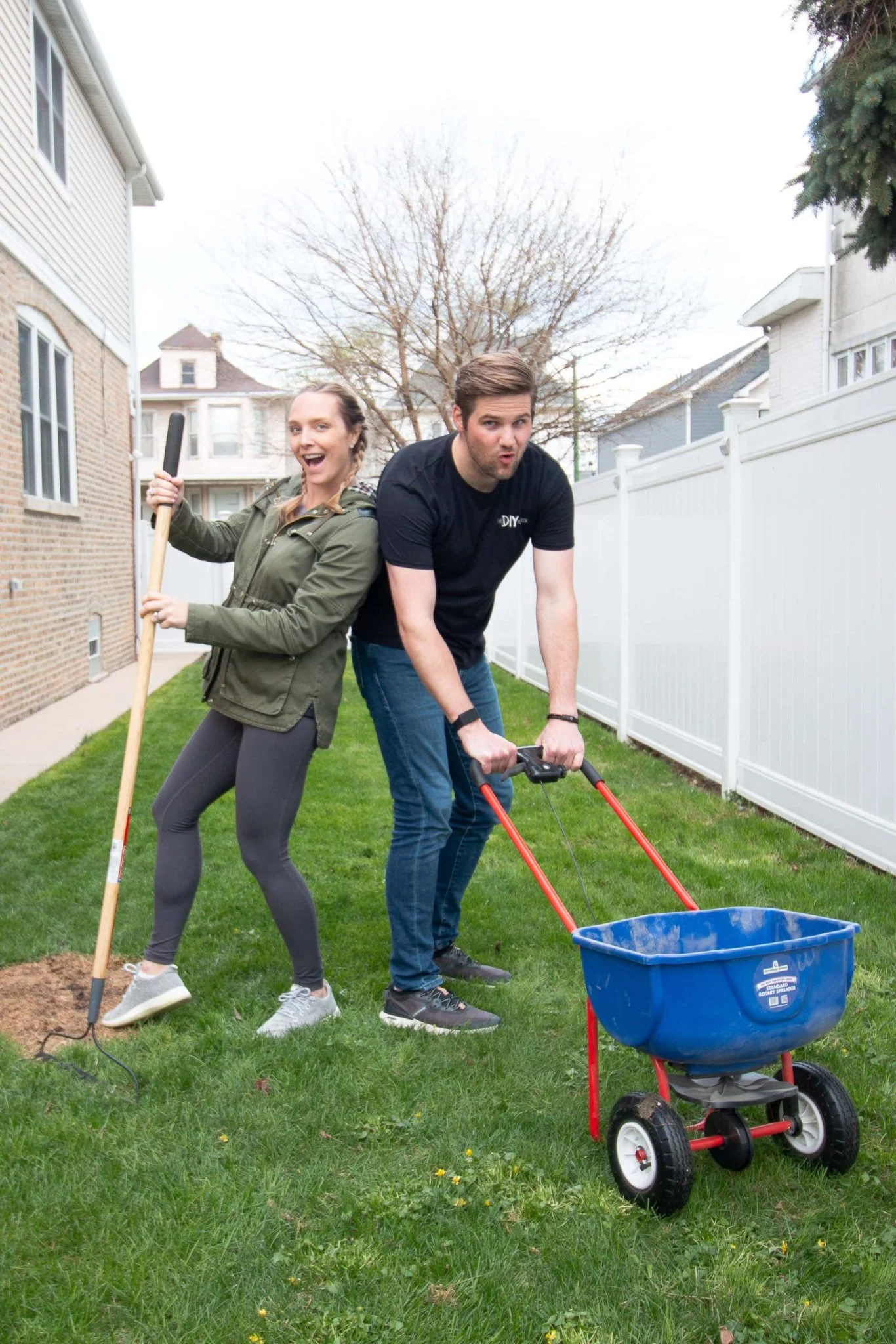
A seeder and a sprayer serve distinct but equally important roles in lawn maintenance. A seeder distributes grass seed evenly across the lawn for overseeding or patch repair.
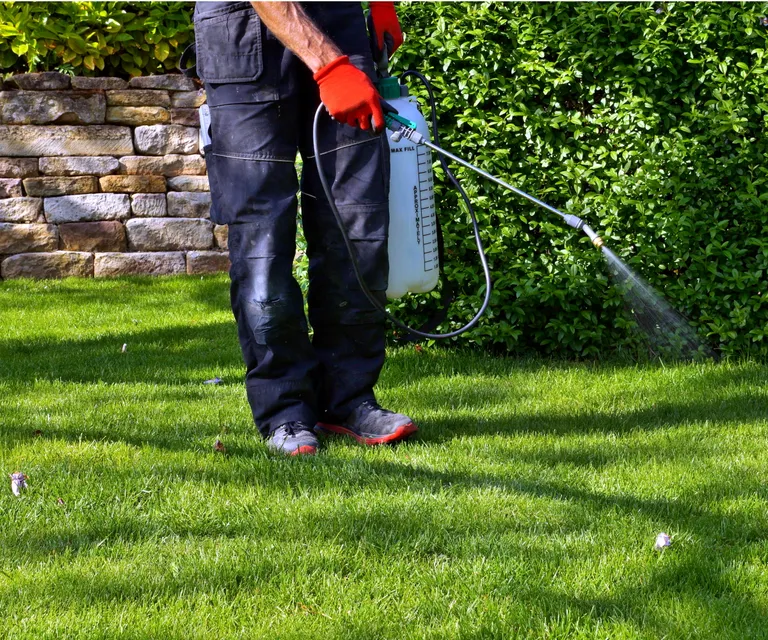
A sprayer applies liquid treatments — herbicides, pesticides, liquid fertilizers, or fungicides — at a controlled rate.
Seeders
- Broadcast (rotary) spreader — Throws seed in a wide arc, making it efficient for covering large areas quickly. Also used for granular fertilizer and ice melt. Best for open, flat lawns.
- Drop spreader — Releases seed directly downward through a slot at the base of the hopper, giving precise control over exactly where seed falls. Better for narrow strips, edges, or lawns near garden beds.
Sprayers
A 3-gallon pressurized pump sprayer handles most residential applications for yards under half an acre.
For larger properties, a 4-gallon backpack sprayer distributes the weight more comfortably and reduces the number of refills needed.
Important: Use separate sprayers for herbicides and fertilizers. Herbicide residue that remains in a sprayer can damage or kill grass if the same unit is later used to apply fertilizer or fungicide. Label each sprayer clearly.
7. Personal Safety Gear
Personal safety equipment is as essential as any power tool in a lawn care kit.
Lawn care exposes you to noise levels that cause hearing damage, debris that can injure eyes, chemicals that irritate skin and lungs, and foot hazards from rotating blades and uneven terrain.
Essential safety equipment
- Hearing protection — Gas-powered lawn mowers typically produce 85–95 decibels. Sustained exposure above 85 dB causes cumulative hearing loss. Use ear protection rated NRR 25 or higher whenever operating a gas mower, string trimmer, or leaf blower.
- Safety glasses — String trimmers and mowers eject debris at high speed. Use ANSI Z87.1-rated safety glasses. Standard eyeglasses do not provide adequate side protection.
- Work gloves — Protect hands from blisters, cuts during edging, and chemical absorption when handling fertilizers or herbicides.
- Work boots with toe protection — Steel-toed or composite-toed boots protect against dropped equipment and blade contact. Never operate a mower in open-toe footwear.
- Dust/respirator mask — Necessary when applying granular chemicals, mowing in dry dusty conditions, or working with fungicides and pesticides.
For a broader overview of DIY safety practices that apply across outdoor work: assess the hazard before starting, select gear rated for that specific risk, and never trade comfort for protection.
My Experience Building a Lawn Care Tool Kit
When I started taking lawn care seriously at 15, I made the mistake most beginners make: I bought tools reactively, one problem at a time.
The grass got long, so I borrowed a mower. Edges looked ragged, so months later I bought a trimmer.
Leaves piled up in autumn, and I was raking by hand for hours with an inadequate rake that kept bending under the pressure.
The turning point was learning that the tools work as a system, not independently. The mower sets the baseline. The trimmer finishes the edges the mower leaves behind.
The blower clears the clippings so they don’t clump and smother the grass. Without all three working together after each session, the lawn never looked as good as the effort deserved.
The tool that surprised me most was the sprayer. I had been applying weed killer with a watering can — inconsistent concentration, uneven coverage, and constant over-application in spots.
Switching to a 3-gallon pressurized sprayer halved the amount of product I used and gave me far better control over where it landed.
My guava and peach trees near the lawn edge had been getting unintentional herbicide drift from the watering can. The sprayer wand fixed that immediately.
If I were starting over today, I would build the kit in this order: mower first, string trimmer second, then sprayer, then leaf blower.
Those four cover 90% of what a lawn needs. The sprinkler system and safety gear should be there from day one — I learned the hard way that skipping ear protection during a full afternoon of mowing leaves your ears ringing for hours afterward.
Frequently Asked Questions
What is the most important lawn care tool?
A lawn mower is the single most essential lawn care tool.
Mowing at the correct height on a regular schedule — typically every 5–7 days during peak growing season — does more to maintain turf health, suppress weeds, and improve density than any other single practice. All other tools support the results that regular mowing establishes.
Do I need both a leaf blower and a rake?
For most homeowners with trees near the lawn, yes. A leaf blower moves large volumes of leaves quickly into piles, while a fan rake is better for tight spaces, between plants, and along edges where a blower scatters debris rather than consolidating it.
Used together, they make autumn cleanup significantly faster than either tool alone.
What is the difference between a seeder and a spreader?
The terms are often used interchangeably and describe the same category of tool. A broadcast or drop spreader distributes grass seed when overseeding or repairing bare patches.
The same tool, adjusted for a coarser setting, distributes granular fertilizer, lime, or ice melt. One quality spreader covers all of these tasks.
How do I know if my lawn needs more water?
Two simple tests indicate lawn moisture levels. First, step on the grass — if the blades spring back within a few seconds, moisture levels are adequate; if they stay flat, the lawn needs water.
Second, push a 6-inch screwdriver into the soil. Easy penetration to the full depth means sufficient moisture; resistance before 4 inches means the lawn needs irrigation.
You can also check soil condition when leveling your lawn by hand.
What safety gear is non-negotiable for lawn mowing?
At minimum: hearing protection rated NRR 25 or higher, ANSI-rated safety glasses, and closed-toe footwear.
These three address the highest-risk hazards — hearing damage, eye injury from ejected debris, and foot injury from blade contact. Proper hearing protection is especially important because hearing loss from repeated noise exposure is cumulative and permanent.
Related Posts: