Where Is the Best Place to Put an Oriole Feeder? The Secret to More Visits
Last Updated on June 11, 2026 by Duncan
I still remember the spring I did everything wrong.
I’d been gardening in our suburban backyard for years, and somewhere along the way I decided I wanted orioles.
I bought a feeder, a bright orange, exactly as advertised and filled it with grape jelly, and hung it dead center in the yard where I could see it perfectly from the kitchen window while I made my morning coffee.
And then I waited.
Nothing came. A week passed. Then two. The jelly sat there turning in the sun while I refreshed various birding forums trying to figure out what I was missing.
Here’s what nobody told me at the time. It wasn’t the feeder.
It wasn’t the jelly. And it definitely wasn’t that orioles don’t pass through our neighborhood, because I’ve since watched them visit regularly every spring.
The problem was entirely where I put it, and more importantly, how I was thinking about placement.
Five-plus years and a lot of trial and error later, I want to give you the breakdown I wish I’d had that first season.
First, Understand How an Oriole Actually Thinks
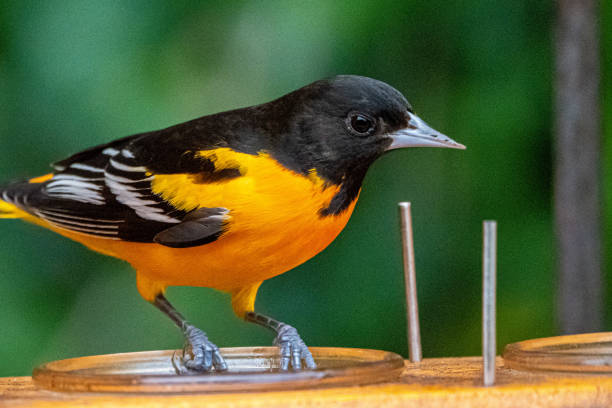
Before we talk about inches and angles, let’s get inside the mind of a Baltimore or Bullock’s oriole for a moment because everything else flows from this.
Orioles are not bold birds. They are not like the house sparrows that land on my garden fence looking for any crumb they can find. Orioles are edge creatures.
They are birds that evolved foraging along the boundaries between forest and open space.
Every instinct they carry tells them: before you commit to a food source, make sure you have a way out.
That first year, I had placed my feeder like I was decorating the yard for myself. I wanted to see it clearly. I wanted it front and center.
What I didn’t understand was that my open, exposed, perfectly-visible-to-me placement was essentially a threat display to the very birds I was trying to attract.
Your feeder placement isn’t about what looks good to you. It’s about what feels safe to them. Keep that in mind for everything that follows.
Place the feeder in a covered area
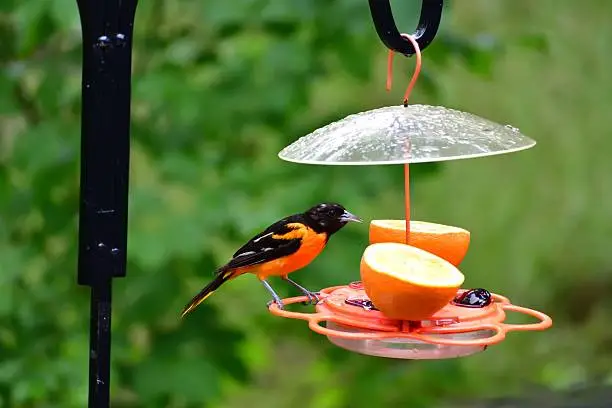
Ask almost any backyard birding blog and they’ll tell you to hang your feeder in an open, visible area near flowering trees. It sounds logical. It sounds right. But it isn’t
It’s actually one of the main reasons feeders go unvisited for weeks and I know because I lived it.
Here’s why: An open, exposed feeder with no nearby cover asks an oriole to fly straight at a target with no place to stop, assess, and decide.
There’s no abort option. No staging area. Just a long, vulnerable approach across open lawn.
For a prey species that shares the sky with hawks, that’s not an invitation. It’s a threat.
The real-world rule I now swear by is the 10–15-foot cover rule: Your feeder should sit 10 to 15 feet away from the nearest tree, tall shrub, or dense cover.
Not right next to it as this creates ambush anxiety from cats and squirrels. It also should not be 30 feet away as this strips out the safety net entirely. Right in that 10–15-foot window.
In my backyard, that ended up being a spot between my raised garden beds and the old apple tree at the back fence.
Not glamorous. Not the spot I would have chosen for aesthetics. But it worked, and that first pair of Baltimore orioles that found it in my second season has shown up every year since.
Ensure you have a Staging Perch
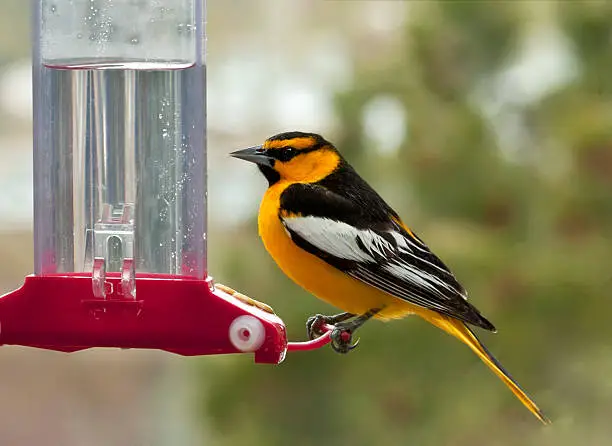
This is the single most underrated element in oriole feeder placement and the thing that made the biggest difference for me personally.
Orioles don’t fly straight to a new food source. They fly to a nearby perch first, sit for 15 to 45 seconds, call out once or twice, look around, and then decide whether to approach.
This behavior is called staging, and it is hardwired into them.
The year I finally figured this out, I’d been watching a male oriole circle my feeder repeatedly without landing.
He’d approach, hover briefly, then pull away.
It happened three mornings in a row. On a hunch, I zip-tied a short piece of dowel rod to a shepherd’s hook about 10 feet out from the feeder at the same height.
The next morning, he landed on it, sat there for about 30 seconds scanning the yard, and then flew straight to the feeder. I nearly spilled my coffee.
The fix is simple:
- Place a shepherd’s hook, a bare horizontal branch, or even a length of dowel rod 8 to 12 feet from the feeder at roughly the same height.
- It doesn’t need to be elaborate. It just needs to be there
- If your feeder is on a pole, a perpendicular arm extending 10 feet out does the same job.
Think of it this way: The staging perch is the front porch. The feeder is the kitchen. Nobody walks straight into a stranger’s kitchen. They pause at the door first, right?
Height, Sun, and the Details That Actually Matter
Once you have your location and staging perch sorted, these specifics will lock everything in:
Height: Hang your feeder between 5 and 8 feet off the ground. Below 4 feet, ground predator anxiety kicks in.
Above 10 feet, wind starts to swing the feeder and orioles dislike feeding from a moving platform.
I keep mine at about 6.5 feet, which also happens to be a comfortable height for refilling without a step stool. This height also makes cleaning easy.
Sun exposure: Avoid south and west-facing placements if you can.
This is because afternoon sun will heat the nectar or jelly inside your feeder rapidly and sometimes raise the temperature by 20°F above the air around it in under 90 minutes.
I learned this the hard way one July when I noticed my jelly had gone runny and dark by mid-afternoon despite being fresh that morning.
Hot, fermenting food doesn’t just smell bad. It changes how the food flows out of the ports and birds notice it immediately and they might stop coming to the feeder.
East or northeast-facing placements catch morning light (orioles feed heavily after sunrise) and stay cooler through the day. And this is what you want.
Background contrast: This one surprised me. Orioles spot the orange of your feeder from 40 to 80 feet away and they are attracted to it.
You should note that orange only pops visually against neutral backgrounds. So have grey bark, blue sky, or green foliage. As your backdrop.
My original placement was in front of my red brick garden wall, and I’m fairly convinced that contributed to the invisibility problem that first year. Neutral backdrop, always.
Sound and movement: Keep the feeder away from wind chimes, flags, HVAC vents, or anything that makes unpredictable noise or movement within 6 feet.
I had a small weather vane about 4 feet from one of my early setups and never connected the two until I moved it.
Orioles use a soft call-and-response behavior as they approach a new food source and any sensory interference in that approach zone interrupts the pattern and triggers retreat.
Timing Matters More Than Most People Realize
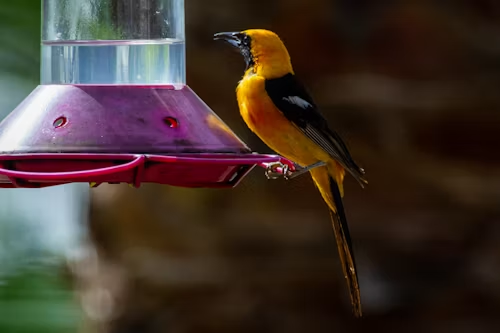
Even a perfectly placed feeder will be ignored if it goes up at the wrong time.
Orioles arrive in spring and spend their first few days establishing a mental map of their territory.
Every good food source they find in that window gets locked into their memory for the rest of the season.
Every source they don’t find in that window is largely invisible to them afterward and they simply don’t update the map often once it’s set.
I missed that window completely in my first year.
The feeder went up the day after I spotted my first oriole. By then, the bird had already done its survey without me on the list.
The practical timing rule: Put your feeder out 10 to 14 days before your region’s average first-arrival date.
Don’t wait until you see your first oriole of the year and then scramble to hang something.
Now I treat it like a garden task where my feeders go up in mid-April the same week I start hardening off my seedlings.
A useful trick for making the feeder look “used” on day one is to rub a small amount of dried orange peel or a tiny smear of grape jelly on the perch rod before the birds arrive.
The scent and visual residue signal that other birds have already been there.
It sounds almost too simple, but I’ve used it every year since I first read about it, and I’m convinced it shortens the discovery window.
Jelly freshness in warm weather: In temperatures above 80°F, change the grape jelly every 48 hours.
Fermenting jelly is worse than an empty cup as it actively trains the bird to avoid your feeder.
This is a 48-hour task in summer, not a weekly one. I keep a small container of fresh jelly in the fridge and make it part of my morning garden check.
Putting It All Together: The Ambush Funnel
Here’s the framework that finally made all of this click into place for me and the way I now explain it to anyone who asks why their feeder isn’t working.
Instead of asking “where do I put my oriole feeder?”, ask: “have I built a corridor that makes my feeder the easiest, safest-feeling choice within my yard?”
Think of it in three layers:
Layer 1: The Beacon (40–80 feet out): Can an oriole flying along your tree line actually see your feeder? Is there a clear sightline from the likely flight path usually along the back fence or tree line?
Is the background behind it neutral enough to let the orange pop? This is the layer I failed completely in year one.
Layer 2: The Approach Zone (15–30 feet out): Is this space calm, quiet, and free of sudden movements? Is there a clear glide path at feeder height with no obstacles?
My garden path runs through this zone, and I made a conscious decision to route foot traffic around it during peak morning feeding hours.
Layer 3: The Commitment Point (8–12 feet out): Is your staging perch here? This is the most important element in your whole setup, and the one almost every beginner including past me skips entirely.
Most failed feeder placements break down at Layer 3. The bird made it all the way to the commitment point and found nothing to land on.
A Quick Note for the New Oriole Birders
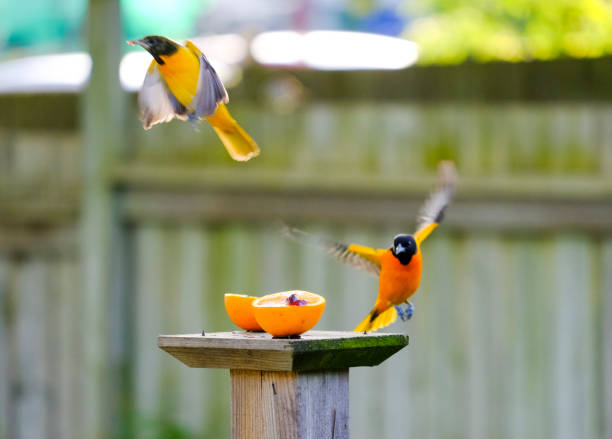
If all of this feels like a lot, just remember the two things that made the biggest difference in my backyard:
- 10–15 feet from cover. Not in the open. Not jammed against a fence. In that window.
- Put a staging perch 8–12 feet away at the same height as the feeder.
Everything else is refinement.
Those two things alone will put you ahead of 90% of casual setups and ahead of where I was in year one.
Oriole watching is one of the most genuinely rewarding things I do in my backyard.
That flash of deep orange against the morning light, the rich fluted call echoing across the garden is the kind of thing that makes you stop whatever you’re doing and just watch.
It’s worth getting the placement right. And once a pair finds your feeder and trusts it, they will return to that exact spot year after year.
You’re not just setting up a feeder. You’re building a relationship with a wild creature. Take a little care with the setup, and it’ll pay you back every spring.
Oriole Feeder FAQ
Should oriole feeders be in sun or shade?
Shade wins but the full answer is a little more nuanced than that.
Direct afternoon sun is the enemy of any oriole feeder.
It heats the nectar or grape jelly inside your feeder sometimes by 20°F above the surrounding air temperature within an hour or two.
That heat speeds up fermentation, and fermented food doesn’t just taste bad but also it changes the texture and flow in ways that birds notice and reject.
The sweet spot is dappled shade: A spot that gets gentle morning light (orioles are active early and morning sun is fine) but stays sheltered from the hard west and southwest afternoon sun.
Think of the soft, shifting shadow under a leafy canopy.
That’s your ideal microclimate. It keeps food fresh longer and, and as a bonus, it mimics the forest-edge habitat orioles naturally forage in.
You should note full deep shade all day isn’t ideal either. Remember you still want the feeder to be visible and lit enough to catch an oriole’s eye from a distance.
Where should I put my oriole feeder?
You need to think less about a single spot and more about building a safe corridor leading to the feeder.
The core rule is 10 to 15 feet from the nearest tree, shrub, or dense cover. That distance is deliberate.
Too close and you’re creating a hiding spot for cats and squirrels right next to the food. Too far and the bird has no safe retreat if a hawk appears and orioles won’t take that risk.
Beyond that distance, these three other things matter enormously:
- There should be a clear sightline to the feeder from your yard’s likely flight path (usually along the tree line).
- There should be a perch which can be a bare branch or hook arm 8 to 12 feet away where birds can land and assess the feeder before committing to it.
- The background behind the feeder should be neutral (green foliage, grey bark, blue sky) so the orange color of the feeder pops visually from a distance.
Get those three things right and your placement will outperform almost any “perfect” spot that ignores them.
How do I attract orioles to my bird feeder?
Start with the right food: Fresh grape jelly and orange halves are the most reliable attractants, with nectar (same 4:1 water-to-sugar ratio as hummingbird nectar) as a strong third option.
Then focus on the setup:
Timing is everything: Get your feeder out 10 to 14 days before orioles typically arrive in your area.
Orioles spend their first few days mapping food sources in their territory. If your feeder isn’t there when they’re doing that survey, you’ll be an invisible option for the rest of the season.
Make it look visited: Before the first birds arrive, rub a small smear of grape jelly or a piece of dried orange peel on the perch.
The scent signals that other birds have already found the spot safe. This way you take advantage of social proof that works on orioles just as well as it works on people.
Add a water source nearby: A shallow birdbath within 20 to 30 feet of the feeder dramatically increases attraction, especially during dry spells. Orioles drink and bathe frequently.
Be patient. A new feeder in a new location takes time. Give it two full weeks before drawing conclusions.
Can oriole feeders be near other bird feeders?
Yes, but with one important exception: keep oriole feeders at least 12 feet away from hummingbird feeders.
This surprises most people, but hummingbirds are ferociously territorial about nectar sources.
Despite being a fraction of an oriole’s size, they will repeatedly dive-bomb and harass much larger birds.
After a few of these encounters, orioles begin to associate that feeder location with conflict and quietly stop returning.
Beyond hummingbirds, most other feeder types such as seed feeders and suet feeders don’t cause much conflict.
Orioles aren’t competing for the same resources, so proximity isn’t usually a problem.
If you’re running multiple oriole feeders, keep them at least 30 feet apart.
In most cases, a dominant male will perch-guard a single feeder, keeping females and younger birds away.
Spreading feeders out breaks that monopoly and lets more birds feed comfortably.
What is the best thing to feed orioles?
In order of effectiveness:
- Grape jelly: This is the most reliably irresistible oriole food. Use regular, commercially available grape jelly (not sugar-free as artificial sweeteners are harmful to birds). Offer it in a small cup, not a smear on a surface. This way you can monitor freshness easily.
- Orange halves: Cut navel oranges in half and skewer or spike them on a feeder peg. The color draws orioles visually from a distance, and they will eat both the flesh and the juice.
- Homemade nectar: This is made up of four parts water to one part plain white granulated sugar, boiled to dissolve, then cooled. Never use honey (it ferments quickly and can cause fatal fungal infections), artificial sweeteners, or red food dye.
- Mealworms: These are especially vital during nesting season (late spring through early summer) when parent birds are seeking high-protein food for their chicks.
One important caveat on grape jelly: In hot weather, limit how much you put out at a time and change it every 48 hours.
Fresh and cool jelly always beats a full cup that’s been sitting in the sun all day.
Why do orioles stop coming to feeders?
This is one of the most common and most frustrating questions in backyard birding and there are usually a few culprits:
The food went bad: Fermented jelly or spoiled nectar is the number one reason.
Orioles have sensitive palates and will abandon a feeder that’s repeatedly offering off food. Check and refresh the food every 48 hours.
Nesting season shifted their priorities: In mid to late summer, orioles naturally reduce feeder visits as they shift to catching insects for their growing fledglings.
This isn’t abandonment, but biology. In most cases they return in late summer.
A territorial male is blocking access: If you only have one feeder, a dominant bird may be driving others away when you’re not watching.
Add a second feeder 30+ feet away if you notice this.
Natural food became more abundant: After spring migration, local berry and insect populations explode.
Your feeder becomes less essential when the buffet is everywhere.
You shouldn’t feel bad that your favorite bird isn’t coming to feed. It is actually a good sign as it means the habitat around you is healthy.
The feeder developed a “bad reputation.” Repeated disturbances near the feeder such as a cat that camps nearby, a dog that charges at the yard, repeated close human activity can train birds to avoid that area and feeder.
To attract the birds back, give the area a quieter buffer zone.
How long does it take orioles to find a feeder?
Realistically, one to three weeks for a new feeder in a new location.
While this is the case, you should note that timing has a significant impact.
If your feeder is up before spring migration starts, discovery time drops dramatically.
Orioles arriving fresh from Central America are actively scouting for food sources and will find a well-placed feeder quickly.
If you put a feeder up mid-season, after resident birds have already established their routines, discovery can take much longer or may not happen at all that year.
The two things that can shorten discovery time most reliably: orange halves (the color acts as a long-range visual beacon) and having a water source nearby.
Moving water, even a simple dripper attachment on a birdbath is one of the most powerful bird attractants you can have in your yard.
Do orioles return to the same feeders?
Yes, and this is one of the most wonderful things about oriole behavior.
Orioles have strong site fidelity.
If a bird successfully fed at your feeder last season, there is a high probability it will return to the same yard sometimes within days of arriving back in spring.
Banding studies have shown individual orioles returning to the same suburban yards year after year.
This is why getting that first-season setup right matters so much. You’re not just attracting a bird for one summer.
You’re potentially creating a relationship that lasts the bird’s entire life.
Keep your feeder in the same location year to year once you find a successful spot.
Remember that changing the location between seasons can disrupt that memory map and cost you returning visitors.
What color feeder attracts orioles?
Orange is the clear answer and there’s real biology behind it, not just marketing.
Orioles, like all birds, see color in four channels (tetrachromatic vision), and orange sits in a range they are naturally attuned to from foraging on ripe fruit. The color is not just attractive, it’s a feeding trigger.
That said, color matters most at a distance. The orange feeder needs a neutral background to be visible. This can be green foliage, grey bark, or open sky.
Placed against competing warm colors such as red brick, autumn leaves, terracotta pots, the visual contrast collapses and the feeder becomes effectively camouflaged from 40+ feet away.
Some birders add orange surveyor’s tape or an orange ribbon near the feeder as an additional visual beacon during the first week.
It’s not elegant, but it works as a short-term discovery aid while birds are still learning the location.
How to attract orioles to a feeder?
The full playbook, in plain terms:
- Get the feeder up early usually 10 to 14 days before expected first arrival in your region.
- Use grape jelly and orange halves as your primary attractants.
- Place it 10 to 15 feet from cover, not in open lawn and not right against a fence.
- Install a staging perch 8 to 12 feet away as a bare branch or hook arm at the same height as the feeder.
- Add a water source within 20 to 30 feet, ideally with gentle movement.
- Rub dried orange peel or a tiny smear of jelly on the perch before birds arrive to signal prior use.
- Keep the food fresh by replacing it every 48 hours in warm weather.
- Stay patient and give it at least two full weeks before concluding anything.
The biggest shift in mindset: stop thinking about what feeder to buy and start thinking about what environment you’re creating around it.
Why don’t orioles come to my feeder?
Run through this checklist honestly:
- Did you put it out late? If resident birds have already mapped their territory, your feeder is invisible to them. Early placement matters.
- Is the food fresh? Fermented jelly or stale nectar is a fast way to train birds to avoid your feeder permanently.
- Is the placement too exposed? Open lawn with no cover within 20 feet is a threat zone, not a dining room.
- Is there a staging perch nearby? Without somewhere to land and assess, most orioles won’t commit to an approach.
- Are hummingbirds harassing the feeder? Look out for this s it’s more common than you might think.
- Is there a cat, dog, or frequent human disturbance within 10 feet? Repeated disruptions teach birds that a location is unsafe.
- Is the background working against you? Orange feeders against warm-colored backgrounds lose their visual signal at a distance.
Most failed feeders are not a food problem. They’re a placement or timing problem. Adjust those first before changing anything else.
When should you put out an oriole feeder?
Earlier than you think.
The rule of thumb most experts use: put your feeder out 10 to 14 days before your area’s average first oriole sighting date.
In much of the US, that means late April. In southern states, it can be as early as late March. In northern states and Canada, early to mid-May.
A more reliable trigger than calendar dates is to put the feeder out when your region has had five consecutive nights above 45°F.
That temperature pattern correlates closely with migration movement regardless of what the calendar says.
Do not wait until you see your first oriole and then rush to set something up. By then, the bird has already begun mapping its territory without you in it.
How high should I hang my oriole feeder?
Between 5 and 8 feet off the ground.
Below 4 feet, ground predator anxiety starts to affect feeding behavior. Cats, raccoons, and even the visual memory of a cat moving through the yard will make low-hanging feeders feel unsafe.
Above 10 feet, two problems emerge: first, wind begins to swing the feeder, and orioles are reluctant to feed from a moving platform.
Second, you’re making refilling and cleaning significantly harder for yourself, which means you do it less often.
Since fresh food is critical, keeping old food increases the chances of the birds not coming back.
Right in that 5 to 8-foot window, the feeder is elevated enough to feel safe, stable enough to be comfortable, and easy enough for you to maintain properly.
Will orioles eat from a bird feeder?
Absolutely, but they are selective about what kind of feeder and what is in it.
Orioles will not eat from standard seed feeders. They have no interest in sunflower seeds, millet, or safflower.
They are fruit and nectar feeders by nature, and your feeder needs to reflect that.
What they readily eat from feeders: Grape jelly cups, orange halves on spikes or skewers, liquid nectar ports and mealworm trays.
The key variable isn’t whether orioles will eat from a feeder as they will, once they find one they trust.
The key variable is whether your feeder is designed for what they actually eat, placed where they feel safe enough to approach, and stocked with food that’s fresh enough to be worth returning to.
Get all three right, and orioles will become some of the most reliable and rewarding visitors in your backyard.
Related Posts: