What to Do With Your Lawn After Winter
Last Updated on May 11, 2026 by Duncan
Every spring there’s a moment — usually when the soil stops looking grey and starts to actually smell like dirt again — where I feel the urge to get out there and do something. Fix it. Tidy it up. Get it ready.
The problem is that impulse, if you follow it too early, can do more harm than good. Frozen ground that looks thawed often isn’t, not all the way down. Walking on it compacts the very soil you’ve spent months waiting to recover.
The lawn after winter needs your attention, but it also needs you to read what it’s telling you before you start throwing products at it.
Here’s what I actually do, roughly in the order I do it.
First: just look at it
Before anything else, I walk the lawn and take stock. Where did the snow sit longest? Are there patches that are matted and grey — that slightly felted look that means snow mould?
Where did the foot traffic wear things thin over winter? Which areas came through fine and which ones are clearly going to need work?
This doesn’t take long but it shapes everything that follows. You’re not treating the whole lawn the same — you’re treating specific problems in specific places.
A lawn with a couple of bare patches and some light compaction needs a different morning than one that’s been hammered by ice cover for two months.
Clear the debris before anything else
Once the soil has actually thawed and dried enough that you’re not sinking into it, the first job is cleanup. Dead leaves that blew in over winter, twigs, any garden waste that got pushed to the edges and forgotten — all of it needs to come off.
Matted leaves hold moisture against the grass and create the dark, damp conditions that fungal disease thrives in. They also block light from reaching new growth that’s trying to come through.
A hard rake does two things at once here: it clears the debris and it lifts the matted, flattened grass blades that got pressed down under snow. That gentle scarifying action helps air get back in and gives new shoots room to grow upright.
I spend longer on this step than I used to. Early in my gardening life I’d do a quick once-over with a leaf blower and call it done. Now I rake properly, and the difference shows by June.
Deal with compaction — sooner than feels necessary
Winter compacts soil. This is especially true if you had heavy snow, if people were walking across the lawn when the ground was soft, or if you have clay-heavy soil that doesn’t drain well to begin with.
Compacted soil can’t move water or air efficiently, and grass roots in compacted soil stay shallow — which means the lawn struggles all season long even if it looks okay in spring.
The test: push a screwdriver into the soil. If it goes in easily to six inches, you’re fine. If you’re pressing hard and it barely moves, that soil needs aerating.
A core aerator — the kind that pulls actual plugs of soil out rather than just spiking holes — is worth the effort or the rental fee.
Those plugs look messy for a few days but they break down quickly, and the channels they leave let water and fertiliser get down to where the roots actually are. For a smaller area, a hand aerator works fine.
The point is to do it in early spring before the growing season kicks in properly, not as an afterthought in July. If your lawn has been dealing with bare patches, compaction is often a contributing cause, not just frost damage.
Fertilise, but time it right
Early spring fertiliser is one of those things where a week’s difference in timing matters. Apply it too early — when the soil is still cold and the grass hasn’t broken dormancy — and it mostly washes away or sits unused.
Apply it when the grass is actively growing, just starting to green up, and it goes exactly where you want it: into root development and early shoot growth.
For cool-season grasses, that window is usually when soil temperatures are consistently hitting around 55°F (13°C).
You can get a cheap soil thermometer to take the guesswork out, or watch for the forsythia bloom in your area — it’s a rough but useful indicator that soil temperatures are in the right range.
What you’re applying alongside or just before that first fertiliser application matters too: pre-emergent crabgrass control.
This is the one you really can’t miss or delay. Pre-emergents work by creating a chemical barrier in the soil that prevents crabgrass seeds from germinating.
Once crabgrass has already sprouted — even tiny, invisible sprouts — the window is gone. Apply it in early spring, before soil temperatures consistently reach 55-60°F, and you save yourself months of fighting one of the most aggressive summer weeds there is.
I missed this window once. Just once. I was busy and kept telling myself I’d get to it. By June my lawn looked like it had been seeded with crabgrass on purpose. Don’t miss the window.
Your first mow of the year
When the grass is growing again and long enough to cut — somewhere around 3.5 to 4 inches for most cool-season varieties — you can mow.
Keep the height up on that first cut. I set my deck to around 3 inches for the first couple of mows rather than going straight to my summer height. The grass has been through a lot; a gentle re-introduction to mowing is kinder than going in hard.
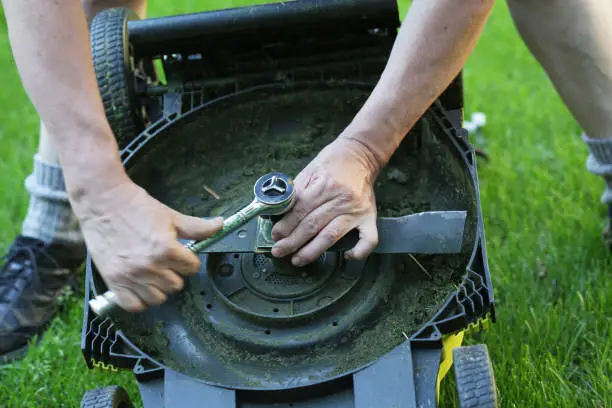
Make sure the blades are sharp before that first cut. A winter in the shed doesn’t improve them, and a dull blade tears rather than cuts — you can see it in the whitish, ragged look of the tips after mowing.
It also leaves the plant more vulnerable to disease right when it’s already under stress. Sharpening takes twenty minutes and the difference in how the lawn looks afterward is immediate.
Also: vary your mowing direction from whatever you were doing in autumn. Grass adapts to repeated mowing in one direction and starts to lean that way. Change it up and the blades stand more upright, which looks better and gets mowed more cleanly.
Weeds don’t wait, so you shouldn’t either
Weeds love the same conditions that newly recovering grass does: loosened soil, early spring warmth, less competition. They also get a head start if the lawn is patchy — bare soil is an open invitation.
This is why weed control in early spring isn’t optional. The weeds you ignore in March are the ones pulling seeds out of the ground and launching themselves across your lawn by May.
For small numbers of established weeds, hand-pulling with the root is still the most reliable method, especially for taprooted ones like dandelion.
For broader coverage, a selective broadleaf herbicide applied when weeds are actively growing — not stressed or wilting — works well. Read the label on whatever you use; application timing and soil moisture conditions affect how well they work.
And check out the guide on what to spray on grass in spring if you want to go deeper on product choices.
Bare patches: the honest answer is wait
This one’s frustrating to hear, but it’s true: if you have dead or bare areas after winter, the best time to reseed them is autumn, not spring. Spring seeding runs into two immediate problems.
First, you can’t use crabgrass pre-emergent on an area you’ve just seeded — it prevents new grass from germinating just as effectively as it stops crabgrass.
Second, any grass you manage to get established in spring immediately faces the most stressful season for it: hot, dry summer.
Most spring seeding either gets choked out by crabgrass that moved in because you couldn’t pre-treat, or it dies in the summer heat before it’s established enough to survive.
Autumn seeding, by contrast, gives the grass mild temperatures, decent rainfall, and the entire cool season to put down roots before winter.
I know waiting eight months for bare patches to fill in feels like a long time.
But if you seed in spring and it fails, you’ve lost the time anyway and you’re back to where you started. Patch them temporarily with a bit of topsoil to stop erosion, keep on top of weeds in that area, and plan a proper overseed in September.
If you want to know more about how to prepare your grass for spring properly — including timing the fertiliser application and the whole pre-emergent window — that guide covers it in more detail.
Watering in spring
Spring rain does most of the work, but it’s worth paying attention. Grass needs roughly an inch to an inch and a half of water per week — from rain or irrigation combined.
A cheap rain gauge tells you whether you need to supplement. In a typical spring, I rarely need to add water before late April or May.
When I do, I water in the morning — early enough that the blades dry before evening. Wet grass sitting overnight in cool spring temperatures is an invitation for fungal problems, and you’ve already got enough to think about without adding those.
What you should have done last fall — for the following year
This doesn’t help you right now, but worth noting for the next cycle: the lawns that come through winter in the best shape are the ones that went into it well-fed.
A late autumn “winterizer” fertiliser — typically higher in potassium, which supports cold hardiness and root development — makes a real difference to how quickly grass recovers the following spring.
The roots going into winter stronger means the crown survives frost better and the plant breaks dormancy faster when temperatures rise.
File it away. The best spring lawn care starts the previous October.
One more thing
The single most useful thing you can do in spring, before any product gets applied, is make sure you have the right lawn care tools in working order — aerator, spreader, sharp mower blades, rake.
The difference between a spring recovery that works and one that doesn’t is usually execution, not product choice. The right tool doing the job properly beats an expensive product applied badly, every time.
Be patient with it. A lawn that looks rough in March can be genuinely good by June if you work with it rather than at it.
Related Posts: