Is 2.5 Inches Too Short for Cool Season Grass?
Last Updated on May 11, 2026 by Duncan
I get why people ask this. You search “how short to mow cool-season grass” and you get ten different numbers from ten different websites, all stated with complete confidence and zero explanation. So let me try to actually make sense of it.
The first thing worth knowing is that grass height isn’t really about aesthetics — it’s about how much leaf the plant has left to work with. Grass feeds itself through photosynthesis, and the leaf blade is where that happens.
Cut too much of it off and the plant goes into emergency mode: it pulls energy up from the roots to regrow the blades, which means the roots shrink.
A lawn with shallow roots is a lawn that struggles in drought, goes thin fast, and gets invaded by weeds. That’s the whole chain. That’s why height matters.
The other end of the problem — letting it get too long — causes different headaches. Overgrown grass gets matted and creates humid conditions close to the soil that fungal diseases love. And when you finally do mow it, you end up having to take off way more than you should in one pass, which brings you right back to the shock problem.
The rule that actually governs all of this
There’s one principle that matters more than any specific number: never cut more than a third of the blade at once. If you want your lawn sitting at 3 inches, mow it when it hits about 4.5. If you want it at 2.5, mow at just under 4.
Simple arithmetic, but most people skip it because it means mowing more often than they feel like it — especially in spring when cool-season grass is putting on a half inch every few days.
I once inherited a rental property lawn that had been left to grow to nearly eight inches and then someone had mowed it to two in one go. The whole thing went yellow inside a week.
Not dead — but stressed to the point of looking dead, and it took six weeks to come back properly. The one-third rule exists for exactly that reason.
What height, when
The most common cool-season grasses — Kentucky bluegrass, perennial ryegrass, tall fescue, fine fescue — all sit comfortably in a 2.5 to 3.5 inch range for most of the year.
Tall fescue likes it slightly higher, up to 4 inches, because it’s a coarser grass with deeper roots that benefits from more leaf surface. The fine fescues and bluegrass are fine at 2.5.
Warm-season grasses are a different story. Bermuda can go as low as half an inch on a golf fairway, though for a home lawn 1 to 1.5 inches is more realistic.
Zoysia sits at 1 to 2 inches, centipede at 1.5 to 2. St. Augustine is the odd one out — it actually prefers 2.5 to 4 inches, closer to cool-season territory.
Season matters more than most people realise though. Here’s how I think about it:
Spring is when cool-season grass is growing hardest. 3 to 3.5 inches is where you want to be. You can get away with a slightly lower first cut of the season — maybe 2.5 inches — to clear out the matted winter debris and let light reach the new growth.
After that, bring it back up. Growth in a wet spring can be fast enough that you’re mowing every five or six days just to stay within the one-third rule. Don’t fight it — the lawn is doing what it’s supposed to do.
Summer is where most people go wrong. The instinct is to cut shorter in summer so you have to mow less often. Completely backwards. Taller grass shades the soil — on a hot day that can mean the ground surface under a 3.5 inch canopy is 10 degrees cooler than bare soil.
Cooler soil holds moisture longer, which means less watering. The taller blades also block the sunlight that crabgrass and other summer weeds need to germinate. I cut my tall fescue down to 2 inches one dry summer thinking it would need less water.
Within three weeks I had the worst crabgrass outbreak I’d had in years. The bare, hot soil was exactly what it needed. I keep summer height at 3 to 3.5 inches now without exception.
Autumn is when you bring it back down — gradually. Before the first hard frost, cool-season grass should be at around 2 to 2.5 inches.
Too tall going into winter and you get matted, wet thatch under snow that’s a perfect environment for snow mould. Too short and you’ve exposed the crown — the bit right at soil level where all new growth originates — to freeze damage. The 2 to 2.5 inch range is a reasonable middle ground.
Get there over two or three cuts rather than one dramatic autumn scalp. See also: how close to cut grass before winter, how short to cut grass before winter, and the best height before winter if you want the longer version of any of those questions.
There’s also a dedicated guide on the best length to cut grass for winter if that’s specifically what you’re working out.
A few things that actually make a difference
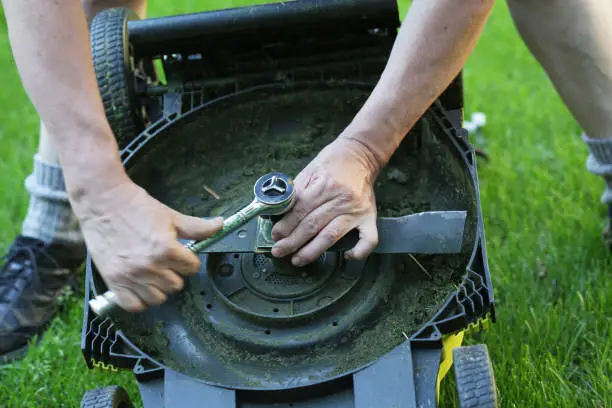
Height is important but it’s only part of the picture. Sharp blades matter more than most people think. A dull blade tears the grass rather than cutting it cleanly — you can actually see it: the tips go white and ragged rather than clean and green.
Those torn edges are how fungal infections get started. I sharpen my blades at least once a season. If you’re mowing a large area weekly, twice. The right way to sharpen mower blades isn’t complicated but there’s a right way to do it.
Don’t mow drought-stressed grass. If the lawn hasn’t had water in days and the blades are starting to curl or go slightly blue-grey, wait. Mowing a stressed lawn on a hot afternoon is asking for a bad outcome. Early morning or early evening cuts are gentler on the plant.
Change your mowing direction each time. Same direction every week and you get soil compaction along the wheel tracks and grass that starts leaning. Alternate between north-south, east-west, and diagonal. Your lawn will look better and the soil will stay looser.
Leave the clippings. If you’re mowing at the right frequency and staying within the one-third rule, clippings are short enough to fall through the canopy and break down within a few days.
They return nitrogen to the soil — roughly equivalent to one fertiliser application per season.
If they’re clumping on top and smothering the grass, that’s a sign you waited too long between cuts. Understanding what drives grass growth helps you get ahead of that.
One practical note on mower height settings: the number on the height dial doesn’t always mean what you think it does.
Park on a flat surface and measure from the ground to the underside of the deck — the blade cuts roughly a quarter inch below that. My mower’s “3” setting cuts at 2.75 inches. Close enough, but worth checking so you’re not guessing.
Quick answers to common questions
Is 2.5 inches too short for cool-season grass?
No. It’s within the healthy range for Kentucky bluegrass, ryegrass, and fine fescue. In summer, raising to 3 or 3.5 is better. Going consistently below 2 is where you start seeing real problems.
What’s the one-third rule?
Never cut more than a third of the blade height in one session. Target 3 inches → mow at 4.5. Target 2.5 inches → mow at around 3.75. This is the single most important mowing principle and the most ignored.
Should I cut shorter in summer to mow less often?
No — the opposite. Taller grass in summer shades the soil, retains moisture, and suppresses weeds.
Short summer grass is more drought-prone, more weed-prone, and more disease-prone. It feels counterintuitive until you’ve watched a scalped summer lawn fall apart.
My lawn went yellow after I mowed it. What happened?
You likely cut off too much at once, exposing the lower stem tissue which has less chlorophyll.
Stop mowing, water normally, apply a light nitrogen feed if you have one, and give it a few weeks. It’ll come back — just don’t mow again until it clearly has.
How do I know what height my mower is actually cutting at?
Measure under the deck on a flat surface. Subtract about a quarter inch for the blade position. Don’t trust the dial numbers alone.
Is longer or shorter better in summer?
Longer. Every time.
Related Posts: